


Benefits of Wearing Organic Cotton Clothing for Men
Table of Contents
- What Makes Organic Cotton Clothing Different
- Fewer Chemical Residues Against Your Skin
- Breathability and Comfort for Active Days
- Are Bamboo Clothes Better for Skin Than Cotton?
- OEKO-TEX STANDARD 100 Certified Fabric Benefits
- Durability, Cost Per Wear, and Care
- How to Choose Organic Cotton Clothing You Can Trust
- Frequently Asked Questions
Last Updated: September 18, 2026
What Makes Organic Cotton Clothing Different
Organic cotton clothing is apparel made from cotton grown without synthetic pesticides, chemical fertilizers, or GMO seeds, then processed with restricted chemical inputs. The difference starts in the field, not the factory.

Conventional cotton farming relies on heavy chemical inputs that leave residues on the fiber and run off into waterways. Organic farming replaces those inputs with crop rotation, composting, and biological pest control. That changes what ends up next to your skin.
Here's what most guides get wrong: they treat organic cotton as purely an environmental choice. For anyone with sensitive skin or a health-focused lifestyle, the more immediate benefit is what's not in the fabric. Fewer chemical residues and no PFAS-based finishes.
This guide from Mellow Mile walks through the practical benefits of wearing organic cotton clothing for men, from breathability during workouts to how these pieces hold up over years of washing.
USDA Organic Cotton Production Standards
Fewer Chemical Residues Against Your Skin
The most direct benefit is reduced exposure. Organic cotton is grown without the synthetic pesticides and chemical fertilizers used in conventional farming, so fewer residues remain on the raw fiber.
Finishing treatments matter just as much. Many conventional garments receive chemical finishes for wrinkle resistance, stain repellency, or moisture management. Some of those finishes fall into the PFAS family, a group of synthetic compounds regulators continue to scrutinize. Choosing apparel without those finishes lowers what sits against your skin for 12-plus hours a day.
For men with sensitive skin or dermatological concerns, that difference is noticeable. One Mellow Mile customer put it plainly: "I have sensitive skin and most workout shirts leave me itchy by the end of the day. Not this one. Zero irritation."
Breathability and Comfort for Active Days
Organic cotton breathes because of its fiber structure, not a marketing claim. Cotton fibers allow air to move through the fabric and absorb moisture rather than trap it against the skin.
That matters during a workout. Synthetic fabrics are engineered to wick sweat, but they can cling and hold odor over time. Cotton handles moisture differently: it absorbs and releases it, which keeps the fabric from feeling slick against your body.
Men who train hard notice this fast. As one customer reported after a summer run: "Wore it for a 6 mile run in August humidity. Didn't cling to me at mile 4 like my usual shirts do."
Breathability also affects comfort outside the gym. A fabric that moves air keeps you cooler on a job site, a range day, or a long commute. The same property that helps during activity helps during rest.
Are Bamboo Clothes Better for Skin Than Cotton?
Viscose from bamboo is not automatically better for skin than cotton, and the answer depends on which viscose from bamboo fabric you mean. Most viscose from bamboo apparel sold today is a regenerated cellulosic fiber made through chemical processing. It is soft, but it is semi-synthetic, not natural.
That distinction matters for two reasons. First, the properties often attributed to the bamboo plant do not survive viscose processing, so claims about odor resistance or antibacterial performance are not supported by the fiber itself. Second, viscose from bamboo has a different durability and care profile than cotton.
Organic Cotton Boxers – Wrapped →
Where viscose from bamboo shines is drape and initial softness. Where organic cotton wins is breathability and durability. For men who want a fabric that holds up to repeated washing and heavy rotation, organic cotton is the more reliable pick.
Neither fiber is inherently irritating.
OEKO-TEX STANDARD 100 Certified Fabric Benefits
OEKO-TEX STANDARD 100 is a testing framework that screens finished textiles for harmful substances. When a fabric carries this certification, it has been tested against limit values for chemicals that regulators and health authorities flag as concerning.
Durability, Cost Per Wear, and Care
Organic cotton clothing tends to cost more upfront, and the honest question is whether it lasts long enough to justify the price. Cost per wear answers that, but the answer depends on how you treat the garment.
How to Make Organic Cotton Last
A few habits extend the life of organic cotton clothing:
- Wash cold. Heat is the single biggest cause of shrinkage and elastic fatigue.
- Turn garments inside out before washing to reduce surface abrasion and pilling.
- Skip the dryer when you can. Hang dry boxers and tees to preserve fit and waistband tension.
- Use a mild detergent without bleach or fabric softener. Softener coats the fiber and can reduce breathability over time.
- Wash with similar colors and avoid overloading the machine, which stresses seams.
The Cost-Per-Wear Math
Cost per wear is simple: divide the price by the number of times you actually wear the item. A garment worn twice a week for two years gets roughly 200 wears. A cheaper alternative that pills, stretches, or loses its shape in three months might get 25 wears before you stop reaching for it. Even at half the sticker price, the shorter-lived item costs more per wear.
What to Look For in Construction
Since the cotton is rarely the failure point, check the parts that fail:
- Waistbands: look for a covered elastic that is stitched in place, not a loose band that twists.
- Seams: flatlock or reinforced seams hold up better through repeated washing than single-stitch seams.
- Fabric weight: a mid-weight knit resists see-through wear and holds shape longer than an ultra-thin one.
The End-of-Life Angle Most Guides Skip
There is one more durability question worth asking: what happens when the garment finally wears out? Synthetic fabrics shed microplastic fibers during normal washing, and those fibers are a documented source of microplastic pollution in waterways (pubmed.ncbi.nlm.nih.gov). Organic cotton is a natural fiber, so it does not shed microplastics the way synthetic textiles do. That does not make any garment disposable, but it does mean the fiber you choose affects what enters the water supply every time you do laundry.
How to Choose Organic Cotton Clothing You Can Trust
Most guides tell you to "look for organic cotton" and stop there. The harder question is how to tell a verified claim from a vague one. That comes down to understanding what the major certifications actually cover.
GOTS vs. OCS: What Each One Verifies
GOTS (Global Organic Textile Standard) is the stricter of the two. It covers the organic status of the fiber from harvest through processing, and it sets requirements for chemical inputs, wastewater treatment, and social criteria along the supply chain. When you see "made with GOTS certified organic cotton," it means the fiber and its processing chain were independently verified against that standard.
How to Verify a Claim Before You Buy
- Check the exact wording. "Made with GOTS certified organic cotton" is a verifiable claim. A bare "organic" or "eco" label is not.
- Look for the certification body. GOTS-certified products carry a license number you can look up in the public GOTS database.
- Check for OEKO-TEX STANDARD 100 certified fabric. This confirms the finished textile was tested for harmful substances. Class I means the fabric was tested against the limits used for baby articles.
- Read the care instructions. A garment you can wash cold and hang dry, that holds its shape for years, is cheaper over time than a disposable alternative.
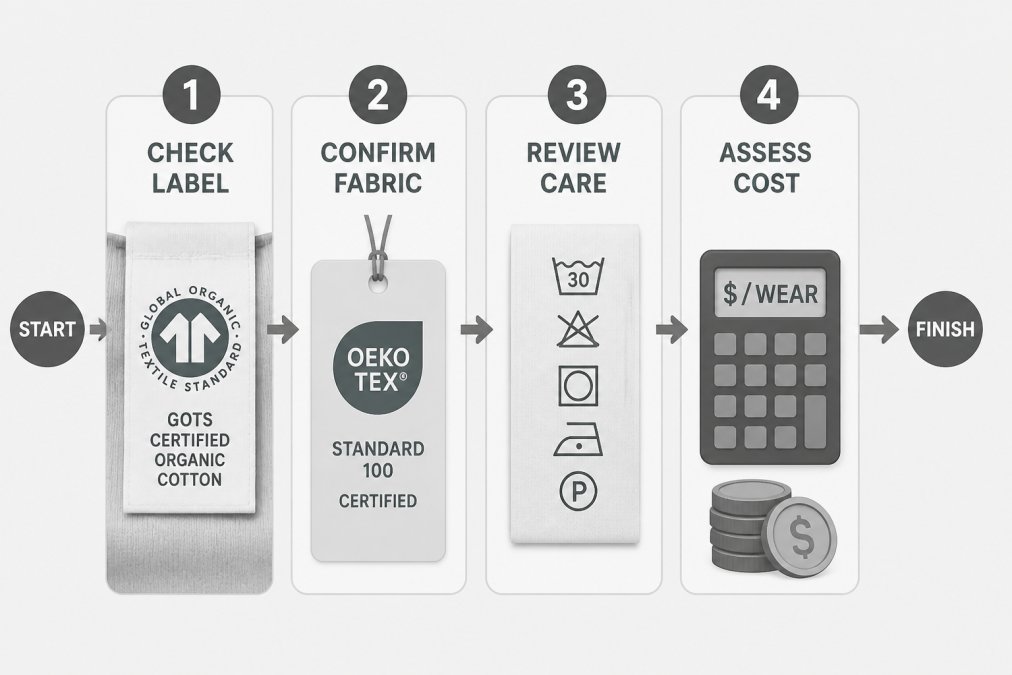
| What to Check | Why It Matters | Where to Look |
|---|---|---|
| GOTS certified organic cotton | Confirms fiber grown and processed to organic standard | Product label or page |
| OEKO-TEX STANDARD 100 fabric | Confirms textile tested for harmful substances | Product page details |
| No PFAS-based finishes | Reduces chemical exposure against skin | Brand material claims |
| Care instructions | Determines real-world longevity | Hang tag or listing |
| Cost per wear | Reveals true value over time | Your own usage math |
Frequently Asked Questions
Is wearing organic cotton clothing better for sensitive skin?
Organic cotton clothing is made with GOTS certified organic cotton grown without synthetic pesticides, and the fabric is often finished without the chemical treatments found in conventional textiles. For men with sensitive skin, that means less chance of irritation from residues left on the fabric. Breathable organic cotton also moves moisture away from the body, which helps reduce the itching and heat rash that synthetic blends can cause during workouts or long days.
Are bamboo clothes better for skin than organic cotton?
Viscose from bamboo is soft and moisture-wicking, but it is a semi-synthetic fiber made through chemical processing. Organic cotton is a natural fiber with a longer track record for skin comfort. If you want the fewest possible chemical inputs against your skin, organic cotton is a good choice. If you prioritize a silky feel for low-sweat wear, viscose from bamboo can work, but check the certifications on the label before buying.
What are the benefits of OEKO-TEX STANDARD 100 certified fabric?
OEKO-TEX STANDARD 100 certified fabric has been tested against limits for harmful substances, including chemicals that can remain after dyeing and finishing. Class I of the standard uses the limits set for baby articles, the strictest tier. When a garment is made with OEKO-TEX STANDARD 100 certified fabric, you have third-party verification that the material was screened, not just a marketing claim. That matters most for underwear and base layers that sit against skin all day.
Does organic cotton clothing last as long as conventional cotton?
Organic cotton fibers are the same species as conventional cotton, so durability depends more on fabric weight, knit quality, and how you wash the garment than on the farming method. A well-made organic cotton tee or boxer can hold its shape and color through dozens of washes if you wash cold and hang dry. Cost per wear often ends up lower than fast-fashion alternatives because the garment stays in rotation longer instead of pilling or stretching out.