


How to Avoid Toxic Chemicals in Clothes: 2026 Guide
Table of Contents
- What Toxic Chemicals Are Actually in Your Clothes?
- How to Read Clothing Labels to Spot Harmful Substances
- PFAS Free Clothing for Men: What to Look For
- OEKO-TEX STANDARD 100 Certified Fabric: Why It Matters
- How to Wash New Clothes to Remove Chemicals
- Second-Hand and Vintage Clothing: What You Need to Know
- Building a Non-Toxic Wardrobe: A Step-by-Step Approach
- Conclusion
- Frequently Asked Questions
Last Updated: September 27, 2026
What Toxic Chemicals Are Actually in Your Clothes?
Toxic chemicals in clothes are the residues and finishes left on fabric after dyeing, printing, and treatment. Your skin absorbs what sits against it all day. This guide from Mellow Mile breaks down how to avoid toxic chemicals in clothes without tossing your whole drawer.
The Most Common Chemical Finishes in Apparel
Finishes are added to make clothes look and behave a certain way. Common ones include:
- PFAS for stain repellency and water resistance
- Formaldehyde for anti-wrinkle and wrinkle-free finishes
- Phthalates in some screen prints and softeners
- Flame retardants on some children's sleepwear
- Heavy metals used in certain dyes and pigments
- Nonylphenol ethoxylates in some textile processing
How Your Skin Absorbs What's on Your Clothes
Dermal absorption is real, and it speeds up under the right conditions. Sweat, friction, and heat all open the door wider. The tighter the fabric and the more you sweat, the more contact your skin has with whatever residue is left in the material. Synthetic fibers can also trap heat, which keeps that contact going longer.
How to Read Clothing Labels to Spot Harmful Substances
Reading a clothing label for harmful substances takes about 30 seconds once you know what to look for. Most shoppers only check size and price, but the label tells you more, if you know which lines matter.
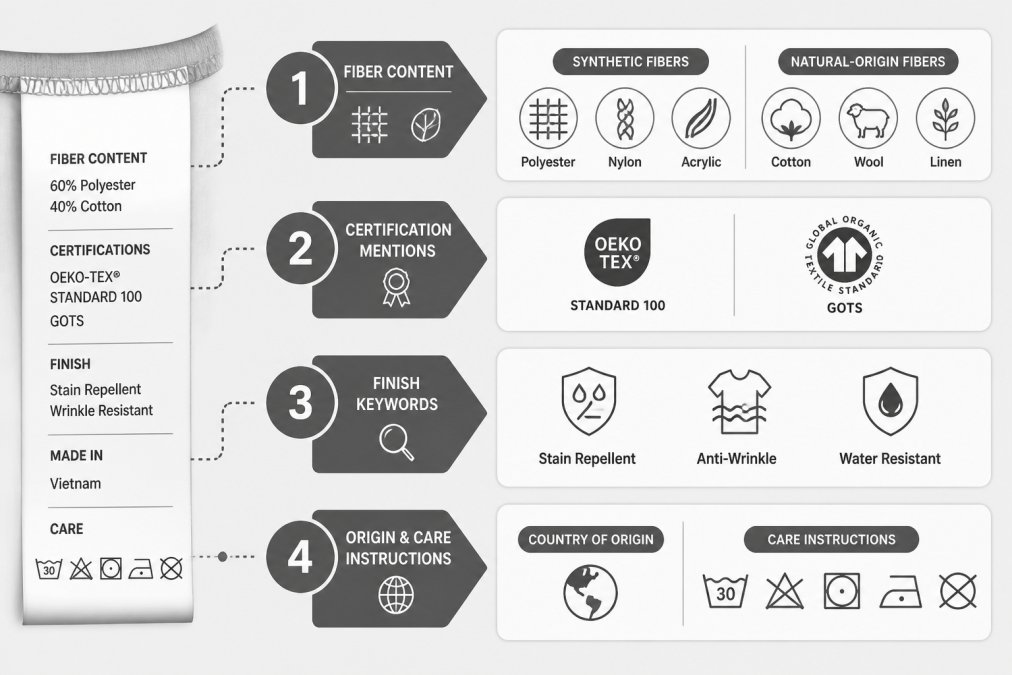
Here's the process, with the reasoning behind each step:
- Check fiber content first. The fiber tells you what finishes are likely. Polyester, nylon, and acrylic are frequently paired with chemical finishes because the fiber itself doesn't breathe or wick without help. Organic cotton and viscose from bamboo start with fewer necessary additives. This isn't a guarantee, but it narrows the field. This isn't a guarantee, but it narrows the field.
- Look for certifications by name. OEKO-TEX STANDARD 100 and GOTS are the two worth knowing. OEKO-TEX STANDARD 100 tests the finished fabric against a published limit list for substances like formaldehyde, heavy metals, and certain azo dyes. GOTS covers organic fiber content plus processing limits. Look for the certificate number or a link, not just the logo.
- Scan for finish keywords. "Stain repellent," "anti-wrinkle," "moisture-wicking," "odor-resistant," and "easy-care" are flags. Each implies a chemical treatment was applied to change how the fabric behaves. "Moisture-wicking" on a synthetic shirt often means a topical finish, not an inherent fiber property.
- Read the care tag for clues. "Machine wash cold, tumble dry low" on a wrinkle-free shirt tells you the finish is expected to survive washing, meaning it's bonded, not just surface residue.
Fiber-by-Fiber: What Each Label Line Tells You
| Fiber on Label | What It Usually Means for Chemical Contact |
|---|---|
| Polyester / nylon | Often finished for wicking, stain resistance, or odor control; finishes may be bonded |
| Organic cotton | Natural fiber; fewer necessary finishes, but still check for "easy-care" or "no-iron" claims |
| Viscose from bamboo | Regenerated cellulosic, semi-synthetic; check for OEKO-TEX STANDARD 100 on the fabric |
| Cotton-poly blend | Combines fiber types; finish profile depends on the dominant fiber and intended use |
| Wool | Naturally odor- and wrinkle-resistant; watch for "washable" treatments |
The Skin-Contact Priority Rule
Not every garment deserves the same scrutiny. Chemicals that matter most are the ones sitting against skin for hours. Rank your attention this way:

- Highest contact: underwear, undershirts, base layers, sleepwear, these sit against skin all day or all night.
- Medium contact: t-shirts, athletic wear, socks, direct skin contact but often for shorter stretches.
- Lower contact: outerwear, jackets, sweaters worn over a base layer, less direct skin time.
What the Label Won't Tell You
The label is a starting point, not a full disclosure. It won't list specific chemical finishes, dye chemistry, or processing aids. That's why certifications matter, they fill the gap. If a brand can't show you a certificate for a claim, treat the claim as unproven.
PFAS Free Clothing for Men: What to Look For
PFAS free clothing for men means garments made without per- and polyfluoroalkyl substances, the "forever chemicals" used for stain and water resistance. They don't break down easily and have been linked to health concerns.
So how do you spot PFAS-free clothing? Look for:
- No "stain repellent" or "water-resistant" claims on the tag
- Brands that name their certifications outright
- Simple fiber lists with no mystery finishes
- Natural or semi-synthetic fibers instead of coated synthetics
OEKO-TEX STANDARD 100 Certified Fabric: Why It Matters
OEKO-TEX STANDARD 100 certified fabric has been tested for harmful substances against a published limit list. It's one of the few labels that actually tells you something about chemical residues.
How to Wash New Clothes to Remove Chemicals
Washing new clothes before wearing them removes some surface residues, but it's not a full fix. The honest answer is chemical-specific: some residues rinse away, others don't budge.
What Washing Actually Removes
| Chemical / Finish | Does Washing Help? | Why |
|---|---|---|
| Loose dye residue | Yes, mostly | Surface dye not bonded to fiber rinses out in one or two washes |
| Formaldehyde (anti-wrinkle) | Partially | Free formaldehyde can off-gas and rinse; cross-linked resin stays bonded |
| PFAS (stain / water repellent) | No | Fluoropolymer finishes are designed to survive repeated washing |
| Phthalates in prints | Partially | Some surface plasticizer rinses; ink chemistry varies |
| Flame retardants | No | Applied as durable finishes on treated garments |
| Processing aids / softeners | Yes, mostly | Water-soluble and rinse away |
A single wash rinses away loose chemical residues and dye leftovers. It cannot strip out finishes bonded into the fabric during manufacturing. Anti-wrinkle and stain-repellent treatments are engineered to survive dozens of washes, that's the point.
The Wash-Before-Wear Protocol That Actually Helps
To get the most out of a wash:
- Wash new items separately before the first wear. This prevents dye transfer and keeps residues from redistributing onto other clothes.
- Use a fragrance-free, dye-free detergent. Added fragrance and dye are their own chemical load against skin.
- Skip fabric softener. It coats fibers with a new layer of chemical residue, the opposite of what you want.
- Add an extra rinse cycle. More water means more dilution of water-soluble residues.
- Hang dry when you can. Heat can set some finishes and drive off volatile compounds into your home air.
- Wash twice for items with strong chemical odor. A persistent smell suggests volatile compounds still off-gassing.
If you have sensitive skin, this step matters more. One Mellow Mile customer, Ben S., put it plainly: "I have sensitive skin and most workout shirts leave me itchy by the end of the day. Not this one. Zero irritation."
Inhalation vs. Dermal Absorption: Why It Matters
Most guides treat "chemicals in clothes" as one problem. It's actually two pathways:
- Dermal absorption, chemicals transferring through skin contact, driven by sweat, friction, heat, and time against skin. Base layers and athletic wear matter most here.
- Inhalation, volatile compounds off-gassing from fabric into the air you breathe. New clothes with a strong chemical smell, especially in sealed packaging, are the main concern. Air them out before wearing.
What Washing Won't Fix
If a garment has a bonded PFAS finish, no amount of home washing removes it. The same goes for durable flame retardants and cross-linked wrinkle-free resins. The only real fix is not buying the finish in the first place, which is why label reading and certification checks come before laundry.
Second-Hand and Vintage Clothing: What You Need to Know
Second-hand and vintage clothing carry their own chemical questions. Older garments may have been treated with finishes now restricted or banned, flame retardants, for example, were used more widely decades ago. That doesn't mean skip thrifting; it means wash carefully and inspect closely.
- Check for stiff, coated, or shiny finishes that suggest a treatment
- Wash vintage items twice before wearing
- Be cautious with anything labeled "stain-resistant" from an unknown era
- Air items out for a few days before washing
Building a Non-Toxic Wardrobe: A Step-by-Step Approach
Building a non-toxic wardrobe is a process, not a single purchase. Start with what touches your skin most, then work outward:
- Start with base layers. Underwear and undershirts sit against skin all day. Swap these first.
- Prioritize natural and semi-synthetic fibers. Organic cotton and viscose from bamboo beat coated polyester for daily wear.
- Check certifications. Look for GOTS and OEKO-TEX STANDARD 100 on the product page.
- Avoid finish keywords. Skip "stain repellent," "anti-wrinkle," and "odor-resistant."
- Wash before wear. Always, every time.
- Replace slowly. You don't need a new wardrobe overnight.
| Step | What to Do | Why It Matters |
|---|---|---|
| 1 | Swap underwear and undershirts first | Highest skin contact time |
| 2 | Choose organic cotton or viscose from bamboo | Fewer chemical finishes |
| 3 | Check for GOTS and OEKO-TEX | Third-party verified |
| 4 | Avoid finish keywords on tags | Flags for PFAS and formaldehyde |
| 5 | Wash before first wear | Removes loose surface residue |
| 6 | Replace gradually | Sustainable habit, not a purge |
Conclusion
The hardest part of avoiding toxic chemicals in clothes is that the label rarely tells the whole story. You have to know what to look for.
Frequently Asked Questions
Can toxic chemicals be washed out of clothing?
Some chemical residues, particularly formaldehyde-based finishes and excess dyes, can be reduced through washing. A first wash with fragrance-free detergent removes surface-level residues, but finishes bonded into the fabric during manufacturing, like PFAS stain repellents, will not wash out completely. The best approach is choosing clothing made with OEKO-TEX STANDARD 100 certified fabric or GOTS certified organic cotton from the start, then washing new items before wearing them to reduce whatever remains on the surface.
How do I identify PFAS free clothing for men?
Start by avoiding items labeled 'stain repellent,' 'water-resistant,' or 'wrinkle-free,' since these finishes often contain PFAS. Look for brands that state their products are made without PFAS and can back that up with third-party testing or certifications like OEKO-TEX STANDARD 100 certified fabric. Check fiber content too: PFAS free clothing for men tends to use organic cotton or viscose from bamboo rather than treated synthetics. When a brand shows certifications and specific material sourcing, that transparency is a stronger signal than a vague 'non-toxic' claim.
Does OEKO-TEX STANDARD 100 certification ensure a garment is safe?
OEKO-TEX STANDARD 100 means the fabric has been tested against limits for harmful substances like formaldehyde, heavy metals, and certain dyes. It is one of the most recognized textile safety certifications, and products made with OEKO-TEX STANDARD 100 certified fabric have passed testing at the fiber, yarn, and finished fabric stages. It does not cover every possible chemical, but it is a meaningful benchmark. Combining it with GOTS certified organic cotton gives you both chemical testing and organic fiber sourcing in one garment.
Is 92% cotton and 8% spandex toxic?
The fiber blend itself is not inherently toxic. Cotton is a natural fiber, and spandex adds stretch. The concern is how the fabric was processed: dyes, finishing treatments, and whether the cotton was grown conventionally or organically. A 92/8 cotton-spandex blend from a brand that uses OEKO-TEX STANDARD 100 certified dyes and discloses its supply chain is a different product than the same blend with unknown finishes. Check for certifications on the label rather than avoiding the blend outright.