


How to Find Ethical Clothing Brands: A Practical Guide
Table of Contents
- What Makes a Clothing Brand Ethical
- Build Your Ethical Clothing Brand Checklist
- Understanding Ethical Fashion Certifications
- Questions to Ask Clothing Brands About Ethics
- Ethical Clothing Brands for Men: Where to Start
- How to Verify Claims and Spot Greenwashing
- Building Your Ethical Wardrobe on Any Budget
- Frequently Asked Questions
Last Updated: October 11, 2026
What Makes a Clothing Brand Ethical
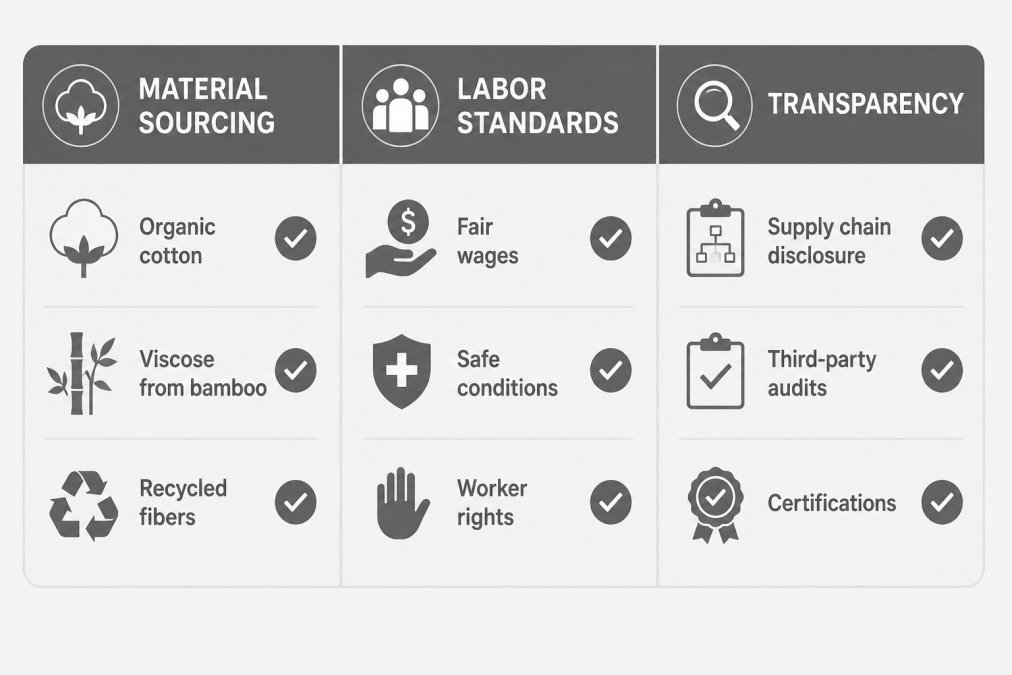
Finding ethical clothing brands means understanding what "ethical" actually means. It's a combination of how a brand sources materials, treats workers, and communicates what it does. We focus on three core pillars: materials, labor, and transparency.
The three pillars: materials, labor, and transparency
Materials are your first checkpoint. Organic cotton is a natural fiber grown without synthetic pesticides, making it better than traditional cotton. Other options include recycled materials or regenerated fibers like viscose from bamboo, which is made through chemical processing.

Labor standards matter just as much as materials. Look for evidence that workers earn living wages and work in safe environments.
Transparency ties it all together. Ethical brands share where their clothes are made, who makes them, and what certifications they hold.
Build Your Ethical Clothing Brand Checklist
Before you buy from any brand, verify these key details. This checklist helps you spot the difference between genuine commitment and marketing claims.
What to verify before buying
Start with the brand's website. Look for material sourcing, factory location, certifications, wage information, and supply chain details. If a brand's website doesn't answer these questions, that's a red flag.
Red flags that signal greenwashing
Greenwashing happens when a brand uses ethical language without backing it up. Watch for vague language ("eco-friendly" without specifics), no certifications, missing supply chain info, beautiful packaging with empty claims, one-off initiatives, and no worker information. Real ethical brands provide specifics. Greenwashing brands provide feelings.
Understanding Ethical Fashion Certifications
Certifications are proof that a third party verified specific claims. Each covers only part of the ethical picture. Understanding what each does, and what it does not, is essential.
What each major certification covers and does not cover
GOTS (Global Organic Textile Standard)
What it does NOT cover: Non-cotton fibers, garment assembly, or supply chain beyond the textile mill.
What to look for: "Made with GOTS certified organic cotton" on product labels.
OEKO-TEX STANDARD 100
What it does NOT cover: Fiber sourcing, labor conditions, environmental impact of processing, or garment assembly.
What to look for: "Made with OEKO-TEX STANDARD 100 certified fabric" on product tags.
Fair Trade Certified
What to look for: The Fair Trade Certified label. Search fairtradeusa.org to confirm.
B Corp Certification
What it covers: The entire company's labor practices, environmental impact, transparency, community engagement, and governance. Requires annual recertification.
What to look for: B Corp Certification on the brand's website. Visit bcorporation.net to read the full impact report.
How to combine certifications to evaluate a brand
The strongest ethical brands hold multiple certifications. GOTS + OEKO-TEX + Fair Trade covers materials, chemical safety, and labor. GOTS + OEKO-TEX without Fair Trade prioritizes materials but leaves labor unverified. Fair Trade without GOTS or OEKO-TEX prioritizes labor but leaves materials unverified. B Corp shows company-wide commitment but requires additional verification of specific fabrics and factories.
The limits of certifications: what they cannot guarantee
Certifications have real limits. They are point-in-time snapshots (check renewal dates), cover specific facilities not entire supply chains, don't cover everything (GOTS covers textile mills, not garment assembly), and don't guarantee affordability or durability. Smaller brands might lack certifications due to cost, not unethical practices. Ask for transparency to fill gaps.
How to use certifications as a starting point, not an ending point
Use certifications as a starting point: look for them first, understand what each covers, ask about gaps, request documentation, and cross-check independently. Transparency and specificity are the real proof of ethical commitment.
Questions to Ask Clothing Brands About Ethics
Direct communication matters. When you're considering a brand, reach out and ask. Their answers reveal a lot.
Supply chain and factory conditions
Ask: Where are garments cut and sewn? Can you name the factories or countries? How do you verify working conditions? What happens if a factory doesn't meet standards? Do workers earn a living wage? Ethical brands answer directly.
Materials and chemical safety
Ask: What certifications do your fabrics hold? Are dyes tested for harmful chemicals? Do you use synthetic finishes? How do you ensure fabric safety? A brand committed to your health will know the answers.
Ethical Clothing Brands for Men: Where to Start
When shopping for men's essentials, focus on basics that last. Quality matters more for ethical shopping because durable clothes mean fewer replacements and less waste.
What to prioritize in men's essentials
For basics, look for material quality, skin-safe materials, fit and comfort, and transparent sourcing. Mellow Mile's Organic Cotton Boxers are made with GOTS certified organic cotton and made with OEKO-TEX STANDARD 100 certified fabric. The Athletic Tee is crafted from 95% viscose from bamboo with made with OEKO-TEX STANDARD 100 certified fabric, offering breathability without polyester.

Evaluating durability and value
Durability matters more than price. Check customer reviews for longevity, compare cost-per-wear, look for warranty policies, and consider fit consistency. Better materials and construction cost more upfront but save money over time.
How to Verify Claims and Spot Greenwashing
Verify ethical claims systematically using official databases, supply chain documentation, public records, and independent reporting.
Step 1: Cross-check certifications in official databases
Verify certifications in official databases: GOTS at gots.org, OEKO-TEX at oeko-tex.com, Fair Trade at fairtradeusa.org, and B Corp at bcorporation.net. If a brand claims certification but doesn't appear, that's a red flag.
Step 2: Request and review supply chain documentation
Ethical brands should answer these questions directly:
- Factory location: Where are garments cut and sewn? Ask for specific factory names or at least countries. Vague answers like "ethical factories" or "vetted suppliers" without specifics are a warning sign.
- Material sourcing: Where do fibers come from? For organic cotton, ask which farms or producer groups supply the cotton. For other materials, ask the supplier name.
- Third-party audits: Does the brand commission independent labor audits? Ask for audit reports or summaries. Ethical brands often publish these or share them upon request.
- Wage documentation: Does the brand have wage data? Ask what workers actually earn and whether it meets living wage standards for the country where garments are made.
When a brand responds, look for specificity. "We work with ethical factories" is not an answer. "Our boxers are cut and sewn at Factory X in [location], which was audited by [auditor] in [year]" is.
Step 3: Verify claims against public records and independent reporting
Once you have factory names or locations, research independently.
Search for factory audits: Type the factory name into Google along with "audit" or "labor conditions." Independent labor organizations, NGOs, and news outlets sometimes publish audit findings or investigations.
Check for labor violations: The U.S. Department of Labor maintains a list of goods produced with child labor or forced labor (List of Goods Produced by Child Labor or Forced Labor). Search the brand's country of production and materials at dol.gov.
Look for news coverage: Search the brand name along with "labor," "factory," or "supply chain." Negative news doesn't automatically disqualify a brand, how they respond to criticism matters, but silence or defensiveness is a red flag.
Review the brand's own transparency reports: Many ethical brands publish annual or biannual supply chain reports. These should include:
- Factory names and locations
- Number of workers
- Wage ranges or living wage commitments
- Audit findings and corrective actions
- Environmental impact metrics
If a brand publishes nothing, ask why. Transparency is not optional for ethical brands.
Step 4: Identify greenwashing patterns
Beyond vague language, watch for these structural red flags:
Certification without substance: A brand holds one certification but provides no other transparency. For example, Fair Trade Certified but no factory information, no wage data, no environmental practices disclosed.
Selective transparency: A brand publishes detailed information about one product line (often their most popular) but nothing about the rest of their catalog.
Marketing-first language: The brand's website emphasizes how "sustainable" or "ethical" they are but provides few specifics. Real ethical brands lead with data, not adjectives.
No response to direct questions: You email asking for factory names, wage information, or audit reports, and the brand either doesn't respond or gives vague answers. Ethical brands make this information easy to find.
Certifications that don't match claims: A brand claims to be "sustainable" but only holds labor certifications. A brand claims to prioritize worker welfare but holds no Fair Trade or labor-focused certification.
A practical verification checklist
Before buying from a brand, complete this checklist:
- Search the brand in at least two certification databases (GOTS, OEKO-TEX, Fair Trade, B Corp). Document what you find.
- Email the brand asking for: factory location, material sourcing, third-party audit reports, and wage information.
- Review the brand's response for specificity. Grade it: detailed and transparent, somewhat vague, or evasive.
- Search the factory name online for independent audit reports or labor news.
- Check the U.S. Department of Labor's list for the country and industry where garments are made.
- Review the brand's published supply chain or sustainability report, if available.
- Compare what the brand claims against what you verified. Do they match?
If most of your checks pass, the brand is likely genuine. If several fail or the brand refuses to answer, move on.
Building Your Ethical Wardrobe on Any Budget
Ethical clothing costs more upfront. That's real. But you can build an ethical wardrobe without breaking the bank.
Start small. Buy one or two quality basics from an ethical brand. Wear them frequently. Once you understand the fit and feel, buy more.
Prioritize basics over trends. A plain organic cotton tee or pair of boxers works with everything.
Buy less, choose well, and make it last. This is the core of ethical fashion.
Look for sales and discounts from ethical brands. Many offer seasonal promotions. Sign up for newsletters to catch them.
Consider secondhand options for non-basics. Ethical fashion includes wearing clothes longer. Resale platforms extend garment life and reduce waste.
Finding ethical clothing brands takes effort, but it's worth it.
Frequently Asked Questions
How can I verify that an ethical clothing brand's claims are actually true?
Ask for third-party certifications and documentation. Legitimate brands publish supply chain information, factory locations, and audit results. Request certificates from GOTS (for organic cotton), OEKO-TEX (for dyes and chemical safety), or Fair Trade verification. Check whether a brand shares specific details about where and how garments are made. Vague language or refusal to disclose sourcing is a red flag. Look for brands that name their suppliers and allow site visits or publish audit reports.
What are the most important ethical fashion certifications to look for?
Made with GOTS certified organic cotton ensures the fiber was grown without synthetic pesticides and processed responsibly. Made with OEKO-TEX STANDARD 100 certified fabric confirms fabric was tested for harmful chemicals and dyes. Fair Trade certification verifies workers received fair wages and safe conditions. Look for certifications from organizations with independent auditing, not claims made by the brand alone. However, certifications have limits, they verify specific aspects (materials, chemical safety, labor) but not the entire supply chain. Always pair certification with direct questions about sourcing and manufacturing practices.
What questions should I ask a brand about its supply chain and labor practices?
Ask: Where are your garments cut and sewn? Who owns the factories? What is your wage policy, do workers earn a living wage? How do you monitor factory conditions? Are workers allowed to organize? Do you conduct independent audits? Request specific answers with names and locations, not general statements. Ask about chemical safety in dyeing and finishing. Ethical brands answer these questions directly. If a brand deflects, provides vague responses, or refuses to disclose information, that signals they may not have established practices in place.
Are ethical clothing brands for men more expensive, and is the cost worth it?
Ethical brands often cost more upfront because they use better materials, invest in safe production, and pay fair wages. However, the cost-per-wear is often lower if the garment lasts significantly longer. Look for durability, quality construction, natural fibers like organic cotton, and proper finishing prevent premature wear. Brands that use made with GOTS certified organic cotton and made with OEKO-TEX STANDARD 100 certified fabric tend to hold up better because harsh chemicals and shortcuts are eliminated. Before buying, compare expected lifespan: a $44 shirt that lasts three years costs less per wear than a $15 shirt that falls apart in six months.