


How to Build a Non-Toxic Wardrobe on a Budget
Last Updated: November 1, 2026
Quick Summary
Build a non-toxic wardrobe on a budget by replacing clothes in phases, starting with base layers that touch skin 12 to 16 hours a day. Read fiber and certification tags, set a monthly spending cap, and fill later phases with secondhand finds.
- A non-toxic garment has its fiber, dye, and finish disclosed and independently tested.
- Replace garments on failure, not on schedule, so you never discard clothing that still works.
- Screen secondhand pieces by fiber tag, feel, smell, and care tag before buying.
- Rank purchases by skin contact hours, then compare cost per wear.
- Wash secondhand garments twice before wearing and skip fabric softener and dryer sheets.
Table of Contents
- Start With a Practical Definition of Non-Toxic Clothing
- How to Read Clothing Labels Before You Buy
- Clothing Chemical Finishes to Avoid on the Tag
- Build a Budget-Friendly Capsule Wardrobe in Phases
- Secondhand Clothing Shopping Tips for a Non-Toxic Wardrobe
- Prioritize Purchases by Skin Contact and Cost Per Wear
- Shop the Mellow Mile Essentials That Fit Your Plan
- Frequently Asked Questions
Start With a Practical Definition of Non-Toxic Clothing
A non-toxic wardrobe is apparel made without the chemical finishes, dye residues, and synthetic fiber blends that can sit against your skin all day. It is not a legal term.
That definition does three things for your budget. It tells you what to check, what to skip, and where spending more actually buys something. A $90 shirt with no certifications is not automatically better than a $30 one with a paper trail.
Start with the fiber. Organic cotton is a natural fiber. Viscose from bamboo is a regenerated cellulosic fiber made through chemical processing, so it is semi-synthetic, not natural. What matters is how the fabric was finished and dyed.
If you want the fuller explanation before you spend anything, our guide on what makes clothing truly non-toxic breaks down fibers, dyes, and finishes in plain terms.
How to Read Clothing Labels Before You Buy
The label is your first filter, and most shoppers read it backwards. They check the size and the fiber content, then stop. The useful information is usually on the smaller tag underneath.
Read in this order:
- Fiber content - percentages, listed largest to smallest
- Care instructions - a "dry clean only" tag hints at a delicate finish
- Country of origin - tells you where it was cut and sewn, not where the fiber grew
- Certification marks - the part almost everyone skips
Certification marks are where a budget shopper gets real use. A tag reading "made with OEKO-TEX STANDARD 100 certified fabric" tells you the finished fabric was tested against a restricted substance list (OEKO-TEX® STANDARD 100).
Watch out: a brand name on a hangtag is not a certification. Look for the standard's name and a license or certificate number you can look up.
Clothing Chemical Finishes to Avoid on the Tag
Finish labels are the hardest part of a garment to decode, because most are invisible. A shirt can feel soft and still carry a treatment you would rather not wear against your skin for ten hours.
These are the finish terms worth noticing:
- Stain and water repellents - often tied to PFAS chemistry
- Antimicrobial or antibacterial treatments - added to reduce odor
- Easy-care or wrinkle-free - usually a resin finish
- Flame retardants - common in some children's wear
- "Performance" or "moisture-wicking" - often a coating on a synthetic base
You will not always see these printed. When a garment claims a benefit that fabric cannot deliver on its own, ask what was added to make it happen. That question alone filters out a lot of impulse buys.
For a deeper walkthrough on spotting these treatments and checking certifications, see our guide on how to identify toxic chemical finishes in clothing.
Build a Budget-Friendly Capsule Wardrobe in Phases
A phased plan beats a full closet overhaul, because it spreads cost across months, lets you test fabrics before you commit, and never asks you to throw away clothing that still works.
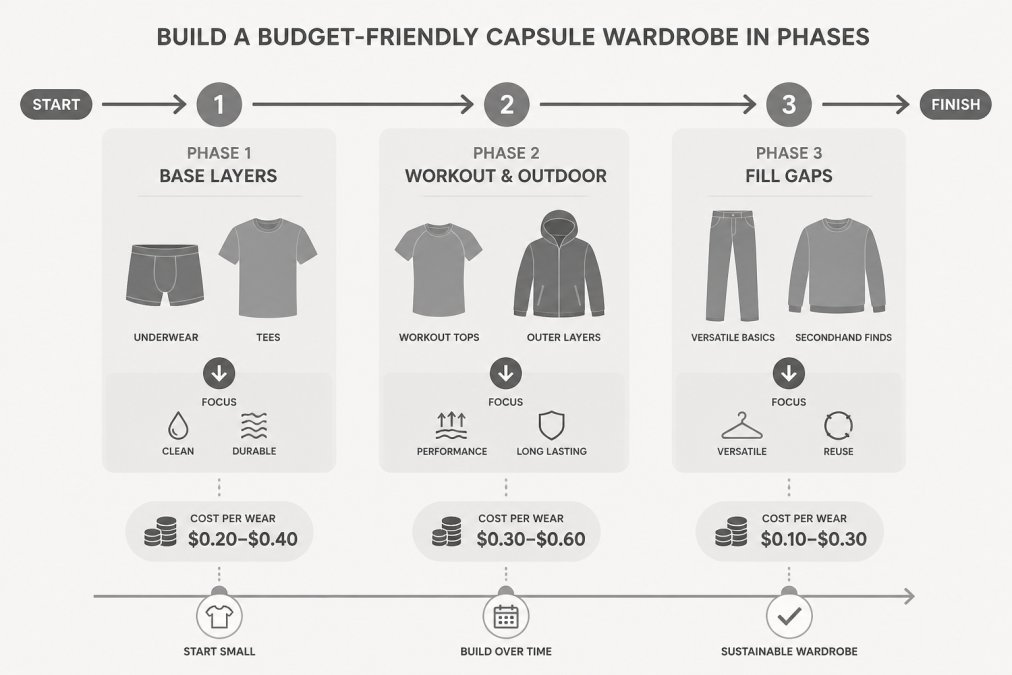
The rule that makes this work: replace on failure, not on schedule. A garment leaves your rotation when it wears through, stops fitting, or irritates your skin, not because a phase chart says so.
Phase 1: Base layers (months 1-3)
Underwear and the tees you wear most. These sit against skin for 12 to 16 hours a day, so they carry the highest contact hours per dollar. If your budget only covers one category this year, make it this one.
Set a Phase 1 budget that fits your finances, spent across three months. Buy one piece, wear it for two weeks, then decide whether to buy a second in the same style or try a different fabric.
Phase 2: Workout and outdoor pieces (months 4-6)
Sweat, heat, and friction amplify how any fabric feels against skin, which is why these pieces come second. Replace them as they wear out, not all at once. Set a cap that fits your budget over three months.
Phase 3: Everything else (months 7-12)
Visible layers, outerwear, and versatile basics, filled in slowly with secondhand finds. Because these pieces touch skin for shorter stretches, they are the lowest priority for a non-toxic transition and the easiest place to save money.
Set a monthly number you can actually hold
Pick a monthly cap before you shop, write it down, and treat it as a ceiling rather than a target. A common pattern is to set a fixed monthly amount for the first year and spend within it.
What a capsule is not
A capsule wardrobe is not a shopping list, and it is not a uniform. It is a smaller set of pieces that mix and match, which means every purchase has to work with at least three things you already own. If a piece only matches one outfit, it is not a capsule purchase, no matter how good the certification looks.
If you want a curated shortlist to prioritize each phase, our sustainable essentials guide for men maps it out.
The phased plan spreads cost across a year and tells you what to buy first when a garment needs replacing.
| Phase | What to buy | Timing |
|---|---|---|
| Phase 1 | Base layers: underwear and most-worn tees | Months 1-3 |
| Phase 2 | Workout and outdoor pieces | Months 4-6 |
| Phase 3 | Visible layers, outerwear, versatile basics | Months 7-12 |
Secondhand Clothing Shopping Tips for a Non-Toxic Wardrobe
Thrift shopping is the cheapest way into better fabrics, with one honest catch: you rarely know what was applied to a garment before you bought it. Secondhand clothing removes the new-finish question but not the dye or treatment question, and no resale platform can tell you what a previous owner sprayed, washed, or stored it with.
That uncertainty is manageable. Treat secondhand as a screening process rather than a gamble, and use the same order every time.
Screen the garment before you commit
- Read the fiber tag first. Natural fibers like organic cotton and linen age predictably and show wear honestly. Blends hide their composition and their finishes.
- Feel for coatings. Stiff, slick, waxy, or heavily sized fabric is a pass. A finish you can feel is a finish you will wear against skin.
- Smell test, twice. A strong chemical smell, a sharp perfume smell, or a mothball smell can mask something else. If the smell survives a minute out of the bag, walk away.
- Check the care tag for "easy-care," "wrinkle-free," or "stain-resistant." Those words describe a treatment, and a treatment is the thing you are trying to avoid.
- Look at the seams and underarms. Yellowing, stiffness, or a crusty residue near the underarm suggests a treatment or a product that has bonded to the fabric.
When to walk away
Some secondhand items are not worth the laundering effort, even at a low price:
- Anything with a visible finish sheen or a plastic-like hand feel
- Performance and moisture-wicking activewear, which is usually a coated synthetic base
- Children's sleepwear labeled flame-resistant, since that label describes a chemical treatment
- Items that still smell after two washes
Launder before you wear, and launder deliberately
Wash secondhand garments twice before the first wear. A hot wash with a plain detergent and a line dry clears surface residues and loosens sizing. Skip fabric softener and dryer sheets on the first two cycles, since both add a coating of their own. If a garment still feels stiff or smells after two washes, it is a return or a rag, not a wardrobe piece.
Where secondhand fits in the budget
Secondhand is the fastest route to quality over quantity, and it is the best use of a Phase 3 budget. The trade-off is time: expect to visit three or four stores or spend an hour online to find one piece worth buying.
Pre-loved clothing is also the cheapest way to test a fabric before you spend new-piece money on it. Wear a secondhand linen shirt for a month, and you will know whether linen belongs in your Phase 3 plan.
Prioritize Purchases by Skin Contact and Cost Per Wear
Rank your closet by contact hours, not by how visible a piece is. Underwear and base tees touch skin for 12 to 16 hours a day. A jacket touches you for twenty minutes. Spend where the contact is.
Then run the cost-per-wear math. Divide the price by the number of times you expect to wear it.
This is the logic behind how we build our own line. Our Organic Cotton Boxers are $24 and made with GOTS certified organic cotton, dyed with OEKO-TEX certified dyes. Our Athletic Tee is $44 and made from 95% viscose from bamboo with 5% elastane, also dyed with OEKO-TEX certified dyes.


If you are comparing brands on value over time, our buyer's guide to sustainable men's clothing covers how to check claims and compare cost per wear.
Shop the Mellow Mile Essentials That Fit Your Plan
You do not need to rebuild your closet in a weekend. Pick your phase, set your number, and start with the layer that touches your skin most.
At Mellow Mile, we make a small batch of essentials for men who want to know what is against their skin. You can browse the full product lineup in one place. Our design work is done in the USA, and garments are cut and sewn in China.
What we focus on:
- Non-toxic materials - no polyester blends in our boxers
- OEKO-TEX certified dyes - on both the boxers and the tees
- Small-batch production - fewer pieces, made deliberately
Start with one piece. Wear it. Wash it. See how it feels at hour twelve.
Sign up for 20% off and get started with Mellow Mile.
Frequently Asked Questions
How do I start building a non-toxic wardrobe without replacing everything?
Start with the garments that sit closest to your skin and get the most wear. Replace underwear and base-layer tees first, then move outward to workout gear and everyday shirts. You do not need to discard what you own; wear it out and swap pieces as they wear down. A phased plan spreads the cost over months and keeps you from impulse buying. Track cost per wear so each new piece earns its place before you add the next one.
What materials should I look for in non-toxic clothing?
Look for organic cotton, which is a natural fiber, and check for certified dyes and finishes on the label. Viscose from bamboo is a semi-synthetic fiber made through chemical processing, so judge it by the finished garment's certifications rather than the plant it came from. Avoid polyester and other synthetic fibers when skin contact matters most, since they trap heat and often carry chemical finishes. Read the fiber content line first, then look for certification names.
How can I tell whether clothing is PFAS-free?
Ask the brand directly and look for third-party certification names on the product page or tag, such as OEKO-TEX STANDARD 100 for the fabric. PFAS are often used in water- and stain-repellent finishes, so treat any garment marketed as stain-proof or water-repellent with extra questions. A brand that shows its certifications and answers supply chain questions is easier to trust than one that only uses marketing language. If a claim cannot be verified, leave the item on the shelf.
Is secondhand clothing a good way to build a non-toxic wardrobe on a budget?
Yes, with one caveat: you usually cannot verify what finishes or dyes a secondhand garment was treated with. Wash thrifted pieces before wearing them, favor natural fibers you can identify by the tag, and skip items with heavy stain-repellent or wrinkle-free marketing. Use it to fill gaps in your capsule wardrobe rather than as a reason to buy more than you need.
