


Best PFAS-Free Men's Activewear That Lasts Through Washes
Last Updated: October 28, 2026
Quick Summary
The best pfas-free activewear is verified by finished-garment testing from an independent lab, not just a brand's claim or restricted-substances list. Look for named certifications with stated scope, such as GOTS certified organic cotton and OEKO-TEX STANDARD 100 certified fabric.
- PFAS-free is not regulated, so a brand claim alone is only a starting point.
- The strongest evidence is an independent test on the finished garment, not raw yarn.
- Ask which substances were tested, which method was used, and which production lot.
- Measure shirts at washes 5, 10, and 20 to check shrinkage and fit.
- Air drying preserves elastane and reduces shrinkage; heat is the main enemy of stretch.
Table of Contents
- What PFAS-Free Activewear Actually Means
- How to Verify a PFAS-Free Claim Before You Buy
- PFAS-Free Men's Workout Clothes: Fabrics Compared
- What Makes Men's Activewear Durable After Repeated Washing
- How to Wash Men's Activewear So It Lasts
- Price Per Wear: Is Premium Activewear Worth It?
- Choosing Your First PFAS-Free Activewear Pieces
- Frequently Asked Questions
What PFAS-Free Activewear Actually Means
PFAS-free activewear is clothing made without intentionally added per- and polyfluoroalkyl substances, the chemicals often used to make fabric water- and stain-resistant.
The term is not regulated, and "PFAS-free" means different things from brand to brand. Some companies test finished garments, others only raw materials, and some use the phrase loosely. Read any claim as a starting point, not a guarantee.
At Mellow Mile, we define the term narrowly: no chemical finishes like PFAS are added to the garment. That is a specific, checkable statement, and it is the one readers should press brands to back up.
How to Verify a PFAS-Free Claim Before You Buy
What separates a strong PFAS-free claim from a weak one is the evidence behind it. There are three tiers, and they are not interchangeable.
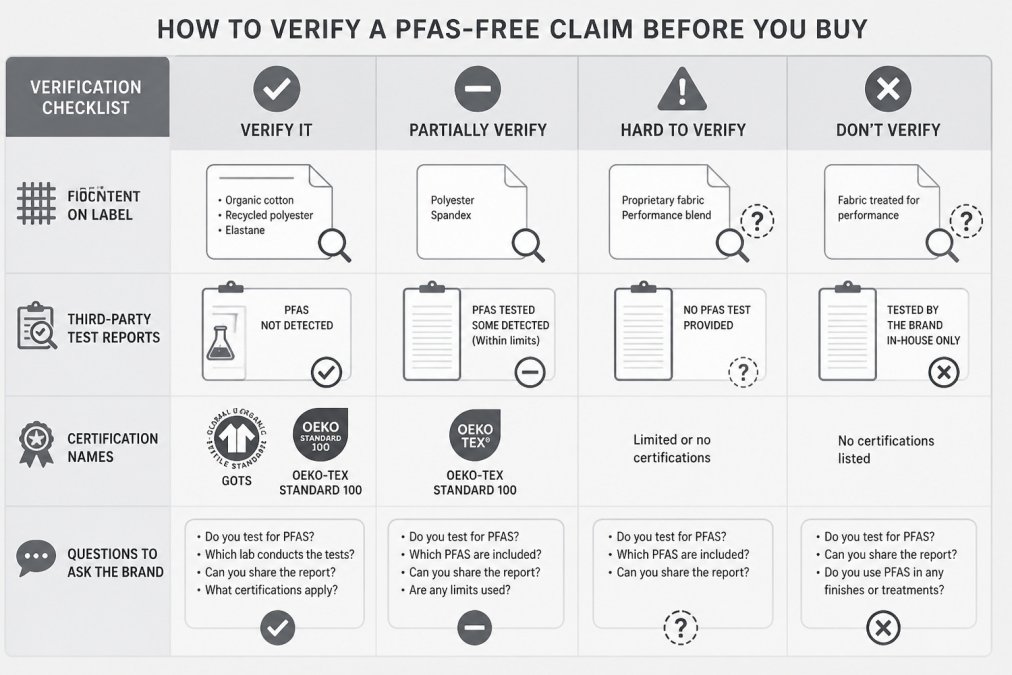
Checklist matrix outlining steps to verify fabric safety, including label checks, test reports, and certifications.
Tier 1: A brand claim
This is a statement on a product page or hangtag, "no PFAS," "PFOA-free," "no added chemical finishes." It may be accurate, but it is self-reported. The useful follow-up question is simple: what is that claim based on?
Tier 2: A restricted-substances list or supplier policy
Many brands publish a restricted-substances list (RSL) naming chemicals they ask suppliers not to use. An RSL is a policy, not a test result: it tells you what the brand intends, not what is in the finished garment. A specific, current RSL is worth reading, but it is not evidence of absence.
Tier 3: Independent finished-garment testing
This is the strongest tier. A laboratory report from an independent testing body, run on the finished garment rather than the raw yarn, is the closest thing to proof a shopper can ask for. Chemical finishes are applied late in production, so a clean raw material can still pick up a treatment downstream.
What a useful test report actually covers
When you ask a brand for test information, here is what to look for:
- What was tested. The finished garment, a fabric swatch, or the raw fiber? Finished garment is the meaningful answer.
- Which substances and which method. A report should name the analyte list or the standard method used, not just say "passed."
- Who ran the test. An independent, accredited laboratory carries more weight than an in-house check.
- When it was run. A report from several seasons ago may not reflect the current production run.
- Which SKU or production lot. A report tied to a specific style and lot is more useful than a generic statement covering a whole catalog.
Where test reports have limits
A test report is a snapshot, not a guarantee. It covers the substances on the panel, at the method's detection limits, for the sample tested, not every possible chemical, and not future runs unless the brand retests. That is why the strongest brands pair testing with a restricted-substances policy and a willingness to answer direct questions.
Certifications: know what each one covers
Certifications help only if you know their scope. A certification for one material does not cover the whole garment, and a fabric certification is not a finished-product certification. Ask which standard applies to which part of the product, and read the scope statement rather than the logo.
For reference, Mellow Mile's Organic Cotton Boxers are made with GOTS certified organic cotton and made with OEKO-TEX STANDARD 100 certified fabric, and the Athletic Tee is made with OEKO-TEX STANDARD 100 certified fabric.


A practical checklist for evaluating a brand
- Fiber content is listed on the product page and the tag
- The brand states whether testing covered finished garments or raw materials
- Test reports or summaries are available on request
- Certifications are named precisely, with the scope stated
- The brand answers direct questions about finishes and dyes
- A current restricted-substances list is published
At Mellow Mile, we define the term narrowly: no chemical finishes like PFAS are added to the garment. That is a specific, checkable statement, and it is the one readers should press brands to back up.
PFAS-Free Men's Workout Clothes: Fabrics Compared
Fabric choice drives how a shirt or pair of shorts feels, breathes, and holds up. The main options differ in ways that matter for training.
Natural and regenerated fibers take a different path, each with trade-offs worth understanding.
Organic Cotton for Training and Everyday Wear
Organic cotton is a natural fiber.
Mellow Mile's Organic Cotton Boxers are made with GOTS certified organic cotton and made with OEKO-TEX STANDARD 100 certified fabric.
Viscose From Bamboo and Blended Options
Viscose from bamboo is a regenerated cellulosic, semi-synthetic fiber made through chemical processing, so it is not a natural fiber.
Mellow Mile's Athletic Tee is made from 95% viscose from bamboo with 5% elastane, and is made with OEKO-TEX STANDARD 100 certified fabric.
The two fabrics in this article differ in fiber type, and the product pages name the certifications behind each.
Fabric |
Fiber type |
Mellow Mile product |
|---|---|---|
Organic cotton |
Natural fiber |
Organic Cotton Boxers |
Viscose from bamboo blend |
Regenerated cellulosic, semi-synthetic |
Athletic Tee (95% viscose from bamboo, 5% elastane) |
What Makes Men's Activewear Durable After Repeated Washing
Most roundups stop at fiber content. The real question is narrower: after five, ten, or twenty washes, does the shirt still fit, hold its color, and keep its seams? That is a construction and care question as much as a material one.
A repeatable wash protocol you can run at home
- Baseline the garment. Before the first wash, lay it flat and note three things: overall length from the high point of the shoulder, chest width seam to seam, and sleeve or inseam length. Photograph the collar, the underarm seams, and the waistband.
- Wash the same way every time. Cold water, gentle cycle, inside out, mild detergent, no fabric softener, no dryer sheets. Wash with similar-weight knits, not with jeans or towels.
- Dry the same way every time. Either hang dry every cycle or tumble low every cycle, do not mix, because heat exposure is the variable you are trying to isolate.
- Re-measure at washes 5, 10, and 20. Compare against the baseline. A half inch of shrink on a tee is normal; an inch or more changes the fit.
- Inspect the stress points. Collar edge, shoulder seams, underarm gusset, side seams, hem, and, on shorts and boxers, the waistband and its stitching.
Run this on one piece before buying three more of it.
The five failure modes, and what each one tells you
- Shrinkage. Usually a fiber-and-finish issue, not a care issue, if you followed the label. Cotton-rich knits move more than blends with elastane; viscose from bamboo blends can relax or shrink depending on how the fabric was finished. Measure, don't eyeball.
- Pilling. Small fiber balls at friction points, underarms, side seams, where a bag strap rubs. Pilling is driven by fiber length, yarn twist, and abrasion in the wash. Washing with rough items like jeans accelerates it.
- Fading and color shift. Shows up first at the collar and underarms. Cold water, inside-out washing, and avoiding overloading the drum all slow it. A dark tee that goes gray at the collar after ten washes is telling you about dye fastness, not about PFAS.
- Seam integrity. Look for skipped stitches, pulled threads at the shoulder and side seams, and separation at the underarm. Seam failure is a construction signal and usually appears before the fabric itself wears out.
- Stretch recovery. Relevant to any blend with elastane. Heat is the main enemy: high dryer temperatures degrade elastane over time, and a garment that used to snap back starts to bag at the elbows, knees, and waistband. Air drying or low heat preserves recovery far longer than high heat.
Men's construction details that predict longevity
- Collar and neckline. A ribbed collar with a taped or bound seam holds shape better than a simple folded hem. Check that the collar stitching is dense and even.
- Shoulder and side seams. Flatlock or overlocked seams with a bit of stretch move with you; a straight stitched seam with no give is a stress point under load.
- Underarm and gusset. A gusset or a higher underarm seam reduces strain during overhead movement, which is where lifting and climbing put the most stress.
- Waistband on shorts and boxers. Look for a covered elastic or a wide knit waistband rather than a narrow exposed elastic, which tends to roll and lose recovery first.
- Hem and sleeve finish. A clean double-needle hem resists curling; a single folded hem can twist after repeated washing.
What real-world reports can and cannot tell you
For a deeper look at materials and labels, our chemical-free athletic wear guide covers which certifications matter, and our organic cotton workout shirt durability article explains what helps these pieces last.
How to Wash Men's Activewear So It Lasts
Wash in cold or lukewarm water on a gentle cycle, and turn garments inside out to reduce abrasion. Skip fabric softener, which can coat fibers and reduce breathability.
Air drying preserves elastane and reduces shrinkage. Heat is the main enemy of stretch fabrics, so dry low or hang when you can.
Wash similar fabrics together, and avoid putting activewear in the same load as rough items like jeans, which can cause pilling.
Price Per Wear: Is Premium Activewear Worth It?
Our Athletic Tee is priced at $44.00 and our Organic Cotton Boxers at $24.00.
One reviewer found the shirt ran slightly long for a 5'8" frame.
Choosing Your First PFAS-Free Activewear Pieces
Prioritize verification. Pick brands that name their certifications, publish test information, and explain what their claims cover, and be wary of vague language.
Frequently Asked Questions
How can I tell whether activewear is free of PFAS?
Start with the fiber content and the brand's stated testing. Look for specific claims tied to a named test or standard rather than general wording like 'clean' or 'safe.' Ask whether the brand publishes third-party lab results for finished garments, not just raw materials, and whether the fabric is made with OEKO-TEX STANDARD 100 certified fabric.
Does PFAS-free activewear last as long as synthetic workout clothes?
Durability depends more on construction, fabric weight and care than on fiber alone. Check seam quality, elastane content for stretch recovery and whether the brand reports how garments perform after repeated washing.
How should I wash activewear to help it last longer?
Wash in cold or lukewarm water on a gentle cycle, turn garments inside out and avoid high heat in the dryer, since heat is the main cause of shrinkage and loss of stretch. Hang or lay flat to dry when you can. Wash similar fabrics together and avoid fabric softener, which can coat fibers and reduce breathability. Follow the care label first, because it reflects the specific blend.
