


What Are Forever Chemicals in Textiles? A 2026 Guide
Table of Contents
- What Are Forever Chemicals in Textiles?
- Why They're Called Forever Chemicals
- Common Uses in Textiles: Water and Stain Repellency
- Health Risks and Human Exposure
- Environmental Impact and Persistence
- Regulatory Landscape and State Bans
- How to Identify PFAS Free Clothing for Men
- OEKO-TEX STANDARD 100 Certification Explained
- Caring for PFAS-Free Gear: Maintenance Tips
- Frequently Asked Questions
Last Updated: September 28, 2026
What Are Forever Chemicals in Textiles?
Forever chemicals in textiles are per- and polyfluoroalkyl substances (PFAS), a family of synthetic compounds built on carbon-fluorine bonds, one of the strongest bonds in chemistry. That bond is why they resist water, oil, and stains so effectively, and why they persist instead of breaking down. This guide from Mellow Mile explains where PFAS show up in clothing, how exposure happens, what the current regulatory picture looks like, and how to shop for PFAS free clothing for men without guesswork.

The practical problem is simple: a finish applied to a shirt does not stay on the shirt forever. It sheds, it washes out, and it goes somewhere. Below, we break down the eight things worth knowing before your next purchase, plus a maintenance routine for gear you already own.
PFAS are a class of thousands of synthetic chemicals used since the mid-20th century in non-stick coatings, food packaging, firefighting foam, and textile finishing.
Why They're Called Forever Chemicals
The nickname comes from persistence, not marketing. Carbon-fluorine bonds resist breakdown by water, heat, sunlight, and most biological processes, so PFAS accumulate rather than degrade. That persistence drives bioaccumulation up the food chain and long-term environmental contamination.
Regulators and researchers track this through exposure pathways rather than a single source. The EPA's PFAS research portal documents how these compounds move through water, soil, and consumer products.
Common Uses in Textiles: Water and Stain Repellency
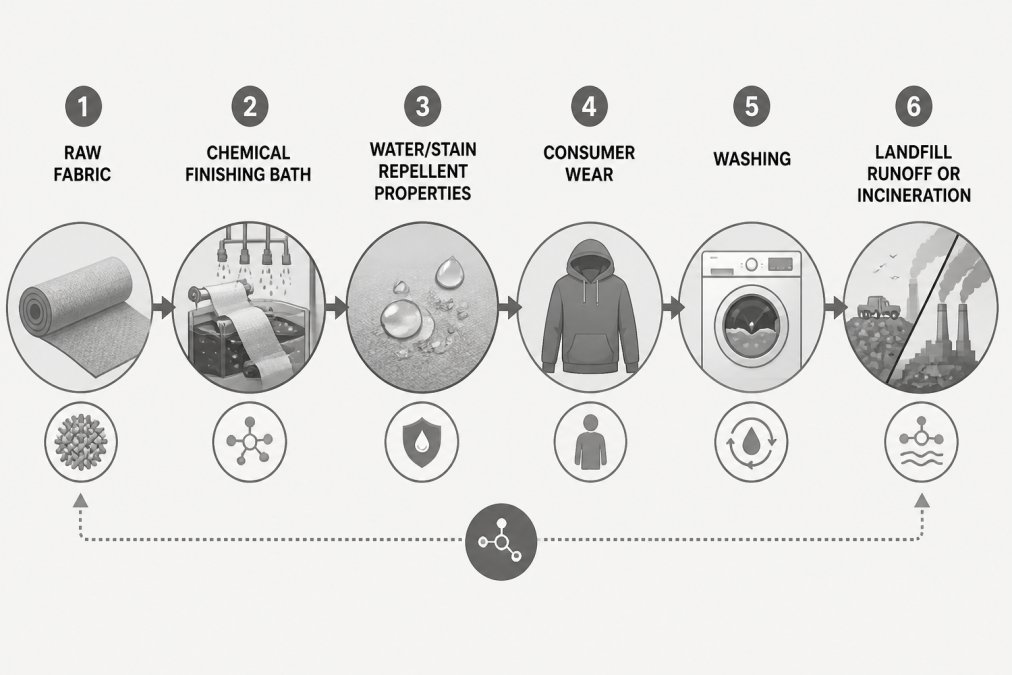
Textile mills apply PFAS during finishing to deliver water-repellent, stain-resistant, and oil-repellency performance. The finish also provides soil release, odor barriers, and in some cases UV protectants, which is why it appears across activewear, outerwear, uniforms, and upholstery.
Health Risks and Human Exposure
Human exposure to PFAS happens mainly through ingestion, but skin contact and inhalation play a role with treated apparel. Toxicology research continues to develop, and the honest position is that no one has a complete picture of low-dose, long-term dermal exposure from clothing.
How PFAS Enter Your Body
Three pathways matter for clothing:
- Dermal contact - treated fabric sits against skin for hours, especially during workouts when pores open and sweat increases surface contact.
- Hand-to-mouth transfer - handling treated garments, then eating, moves residue into the digestive tract.
- Inhalation - fibers and finish particles shed into the air, particularly in enclosed spaces like gyms.
The CDC's National Center for Environmental Health maintains ongoing biomonitoring of PFAS levels in the population. The takeaway for consumers is not panic. It is reduction: fewer treated garments against the skin means fewer exposure opportunities.
Environmental Impact and Persistence
Environmental persistence is where PFAS earn their reputation. Because the compounds resist chemical breakdown, they migrate from landfills into groundwater and from wastewater treatment into sludge, which is often spread on agricultural land. Incineration destroys some PFAS but can release fluorinated byproducts if temperatures are insufficient.
Regulatory Landscape and State Bans
Regulatory compliance for PFAS in textiles is moving faster than most buyers realize, and the rules are state-led. There is no single federal ban on PFAS in apparel. Instead, a growing patchwork of state statutes targets intentionally added PFAS in consumer products, with textiles and outdoor gear often called out by name.
What the Patchwork Means for Shoppers
- Labels are getting more specific. Brands selling into restricted states increasingly disclose whether PFAS were intentionally added, because they need that data for compliance.
- "PFAS-free" claims are becoming verifiable. Suppliers now have to document what they use, which makes third-party certification more meaningful than a marketing line.
- Outdoor gear is the leading edge. Waterproof and severe-weather apparel has been the first category targeted, which is why jackets and rain shells are where you see the most reformulation.
For consumers, the takeaway is that the regulatory floor is rising. A shirt that carries no water- or stain-repellent claim is not waiting on a state ban to be a lower-exposure choice, it simply has no fluorinated finish to regulate.
How to Identify PFAS Free Clothing for Men
Identifying PFAS free clothing for men comes down to four checks: the claim, the certification, the fiber, and, if you want to go further, a home verification step. Most guides stop at the label. This one covers what to do when the label is silent.
Which Fabrics Carry the Most PFAS Risk
PFAS are applied as a finish, not woven into the fiber, so the fiber itself does not determine risk. The performance claim does. Still, some categories are far more likely to be treated:
- Highest likelihood: waterproof and water-repellent outerwear, stain-resistant dress shirts and chinos, technical activewear marketed as sweat- or odor-resistant, and uniforms with soil-release finishes.
- Moderate likelihood: any garment labeled "moisture-wicking" or "quick-drying" that also claims stain resistance.
- Lower likelihood: untreated knits, tees, and underwear with no performance claim. Viscose from bamboo and organic cotton are not inherently repellent, so a shirt made from them cannot be water-repellent unless a finish was added.
Checking Labels and Certifications
Start with these steps:
- Read the fiber content. It tells you what the fabric is, not what was applied to it.
- Look for a certification mark. OEKO-TEX STANDARD 100 and GOTS are the two most useful signals for chemical safety in apparel. GOTS applies to organic cotton textiles; it does not cover viscose.
- Ask about the finish. If a brand cannot tell you what was applied, the answer is usually "something."
- Be skeptical of performance language. "Moisture-wicking" and "quick-drying" are structural claims; "stain-resistant" and "water-repellent" are chemical claims.
Home Testing and Verification: What You Can Actually Do
There is no reliable at-home test that tells you whether a specific garment contains PFAS. What you can do is screen for the performance that PFAS are used to deliver:
- The water-bead test. Drip a few drops of water on the fabric. If it beads and rolls off a knit tee or a casual shirt that makes no waterproof claim, that is a signal a repellent finish is present. Untreated cotton and viscose from bamboo absorb water.
- The oil test. Place a drop of cooking oil on the fabric. If it sits on the surface instead of soaking in, an oil-repellent finish, often fluorinated, is likely present.
- The label audit. Cross-check the care label and hangtag for terms like "stain release," "soil release," "water repellent," or "DWR." DWR stands for durable water repellent, and older DWR chemistry was built on PFAS.
OEKO-TEX STANDARD 100 Certification Explained
OEKO-TEX STANDARD 100 certification is a third-party testing standard that screens finished textiles for harmful substances, including regulated and non-regulated chemicals, at limits set for the product's intended use class.
| Class | Intended Use | Testing Limits |
|---|---|---|
| Class I | Baby articles | Strictest limits |
| Class II | Close-to-skin textiles | Tight limits |
| Class III | Away-from-skin textiles | Moderate limits |
| Class IV | Furnishing materials | Baseline limits |
Caring for PFAS-Free Gear: Maintenance Tips
PFAS-free gear needs different care than treated performance wear, mostly because you are no longer relying on a chemical finish to manage moisture and odor. Fabric structure and fiber choice do the work instead.
- Wash cold, hang dry. Heat degrades elastane and accelerates shrinkage in cellulosic fibers.
- Skip fabric softener. Softener coats fibers and reduces breathability, which is the opposite of what you want in a non-treated fabric.
- Use a mild detergent. Harsh detergents strip dyes and shorten garment life.
- Wash with similar fabrics. Zippers and denim abrade softer knits and cause pilling.
- Rotate your drawer. Giving garments rest between wears extends elastic life considerably.
Frequently Asked Questions
Which fabrics are most likely to contain PFAS?
Synthetic fabrics treated for water, stain, or oil repellency are the most likely to contain PFAS. This includes outdoor gear, athletic wear, and some uniforms. Natural fibers like organic cotton or viscose from bamboo are less likely to be treated, but always check for certifications like OEKO-TEX STANDARD 100 to be sure.
Can PFAS be washed out of clothes?
No, PFAS cannot be washed out of clothing. These chemicals are bonded to the fabric fibers and do not break down with normal laundering. Washing may release small amounts into wastewater, but the fabric retains most of the treatment. The only way to avoid exposure is to choose PFAS-free clothing from the start.
How to tell if clothing has PFAS?
Look for terms like 'water-repellent,' 'stain-resistant,' or 'oil-repellent' on labels. If a garment claims these properties without specifying a PFAS-free alternative, it likely contains forever chemicals. Certifications such as OEKO-TEX STANDARD 100 can help verify that a fabric has been tested for harmful substances.
What is the unhealthiest fabric to wear?
There is no single 'unhealthiest' fabric, but those treated with PFAS or other chemical finishes may pose higher exposure risks. Synthetic fabrics like polyester are often treated for performance, while natural fibers like organic cotton or viscose from bamboo are less likely to be treated. The key is to look for transparency and third-party certifications.
Why are PFAS used in textile manufacturing?
PFAS are used to give fabrics water, stain, and oil repellency. They create a durable barrier that resists liquids and dirt, which is why they are common in outdoor gear, athletic wear, and uniforms. However, these same properties make them persistent in the environment and in the human body.
How can consumers identify if their clothing contains PFAS?
Consumers can check for certifications like OEKO-TEX STANDARD 100, which tests for harmful substances. They can also avoid garments labeled 'water-repellent' or 'stain-resistant' unless the brand explicitly states PFAS-free. Reading labels and researching brands that prioritize non-toxic materials helps reduce exposure.