


What Is GOTS Certified Cotton Clothing? A 2026 Guide
Table of Contents
- What Is GOTS Certified Cotton Clothing?
- The Four Pillars GOTS Certification Requires
- GOTS vs OEKO-TEX STANDARD 100: What Each One Covers
- How to Verify GOTS Certification Before You Buy
- Does GOTS Cover the Whole Garment or Just the Fabric?
- Caring for GOTS Certified Cotton Clothing So It Lasts
- What to Look For in a GOTS Label
- Frequently Asked Questions
Last Updated: September 21, 2026
What Is GOTS Certified Cotton Clothing?
GOTS certified cotton clothing is apparel made with organic cotton processed and manufactured according to the Global Organic Textile Standard, a voluntary international standard covering fiber content, chemical inputs, and labor conditions from harvest through finished garment. The label tells you a third-party auditor has checked the supply chain against those requirements, not just the farm field. This guide breaks down what the standard covers, how it differs from other certifications, and how to verify a claim before you buy.

What the Standard Actually Covers
The Global Organic Textile Standard covers the entire textile processing chain, from organic fiber harvesting through manufacturing to labeling of the final product. It addresses four areas: organic fiber content, chemical restrictions during processing, wastewater treatment at wet-processing facilities, and social criteria for workers.
The Four Pillars GOTS Certification Requires
GOTS certification rests on four requirement categories that must all be met before a facility or product qualifies. Miss any one of them and the certification doesn't apply.
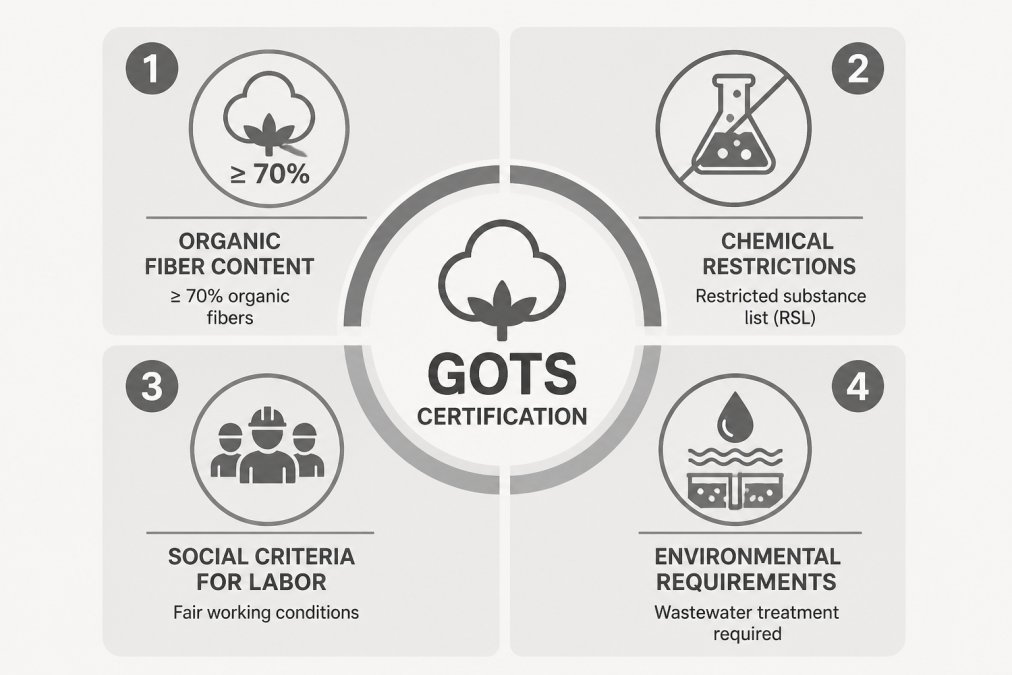
Organic Fiber Content Requirements
Products labeled "organic" under GOTS must contain a minimum percentage of certified organic fibers, with different thresholds for different label grades. Organic cotton must be grown without synthetic pesticides or genetically modified organisms, and the fiber must be tracked from the farm forward.
Chemical Restrictions in Dyeing and Finishing
GOTS restricts hazardous chemical inputs across dyeing, printing, and finishing, banning a long list of substances and setting limits on toxic residues in the finished textile. This separates the standard from a bare "organic cotton" claim: a shirt can be made from organic fiber and still be dyed with prohibited inputs. The restrictions apply at every wet-processing stage, not just at the farm.
Social Criteria and Ethical Labor Conditions
Certified facilities must meet social criteria covering fair wages, safe working conditions, and child labor prohibition, verified through third-party audit. These apply to the people doing the cutting, sewing, and finishing.
GOTS vs OEKO-TEX STANDARD 100: What Each One Covers
GOTS and OEKO-TEX STANDARD 100 answer different questions, and confusing them is the most common labeling mistake shoppers make. GOTS is a full supply-chain standard covering organic fiber content, chemical restrictions, environmental requirements, and social criteria. OEKO-TEX STANDARD 100 tests the finished fabric for harmful substances and certifies that the material passes those limits. It does not certify organic fiber content or cover labor conditions.
How to Verify GOTS Certification Before You Buy
Most guides stop at "check the database." Here is the actual sequence, and what each step catches.
- Which entity is certified. It may be the mill, the cut-and-sew factory, or a trader, not necessarily the brand whose name is on the tag. That's normal, but you should be able to trace how the brand connects to it.
- Which product categories are approved. A facility certified for yarn or fabric is not automatically certified for finished garments. If the category listed doesn't match what you're buying, the claim doesn't reach your item.
- Whether the certification is current. Certifications are renewed on a cycle. An expired or lapsed entry means the facility is no longer covered, even if the brand's marketing copy hasn't been updated.
Scope Certificate vs. Transaction Certificate
A Scope Certificate proves that a specific facility is certified to produce or trade goods under the standard, and it lists the product categories that facility is approved for. It is a facility-level credential. It says nothing about any particular order, batch, or item.
What a Failed Check Looks Like
Verification is most useful when you know what a bad result looks like. Common patterns:
- The number doesn't return a result. Either it's transcribed wrong, expired, or was never issued. Ask for it again in writing.
- The entity name doesn't match anyone in the chain. If the brand can't explain how it connects to the certified entity, the claim is unanchored.
- The approved category doesn't cover the product. Certification for fiber or yarn is not certification for a finished garment.
- The brand answers with a logo image instead of a number. Logos are graphics. Numbers are records.
Does GOTS Cover the Whole Garment or Just the Fabric?
GOTS covers the processing chain and the organic fiber content, but not every component of a finished garment. Buttons, zippers, elastic, and trims fall outside the standard's fiber requirements, and a product can be labeled as made with GOTS certified organic cotton even when those non-fiber components aren't certified.
Organic Cotton Boxers – Wrapped →
Caring for GOTS Certified Cotton Clothing So It Lasts
Organic cotton holds up well when you treat it sensibly. Wash in cold water, turn garments inside out, and skip the dryer when you can. Heat shrinks cotton and wears down elastic over time, and a garment made with GOTS certified organic cotton is still cotton at the end of the day.
- Wash cold and use a mild detergent rather than a heavy-duty one
- Hang dry or lay flat; if you tumble dry, use low heat
- Wash with similar colors, since organic cotton dyes can behave differently than synthetic finishes
- Skip fabric softener, which coats the fiber and reduces breathability
- Treat stains promptly rather than reaching for bleach
What to Look For in a GOTS Label
A legitimate label gives you specific, checkable information rather than a vague nod toward organic. Here's how to read one.
The Three Elements Every Real Claim Carries
- The exact wording of the claim. The standard distinguishes between a product made entirely with certified organic fibers and a product made with a minimum share of them. Those are different label grades with different thresholds, and the wording on the tag is supposed to reflect which one applies. "Made with GOTS certified organic cotton" is the phrasing that describes a product built from certified organic cotton fiber. If a tag says something looser, "organic cotton blend," "contains organic cotton," "organic-inspired", you're looking at marketing language, not a certification claim.
- A license or certification number. This is the thread you pull to verify everything else. No number, no verification.
- The name of the certifying body. Certification is issued by independent accredited bodies, not by the standard's own office. Knowing which body issued it tells you where to look and who to contact if something doesn't add up.
Wording Traps to Watch For
Labels are written by marketing teams, and the gap between an accurate claim and a suggestive one is often a single word.
- "GOTS certified" applied to the finished garment. The certification applies to the fiber and the processing chain, not to the assembled product as a whole. A brand that describes its boxer or tee as "GOTS certified" is overstating what the certificate covers. The accurate phrasing is "made with GOTS certified organic cotton."
- "Organic" with no certifier named. Organic fiber content claims are supposed to be backed by certification. An unbacked "organic" is a word, not a standard.
- A certification logo with no number. See the verification section above.
- "Chemical-free." Nothing textile-related is chemical-free. This phrase signals that the label is written to sound reassuring rather than to be accurate.
- Certifications stacked without explanation. Two or three logos on one tag can be legitimate, but each one covers something different. If the brand can't tell you what each logo actually certifies, the stack is decoration.
What the Label Does Not Cover
At Mellow Mile, our Organic Cotton Boxers are made with GOTS certified organic cotton and made with OEKO-TEX STANDARD 100 certified fabric, and we list both so you can see exactly what each claim covers. The organic cotton wrapped waistband and breathable, lightweight construction are built for daily wear. For a guy who reads labels, that's the point.
Frequently Asked Questions
What's better, OEKO-TEX or GOTS?
They answer different questions. GOTS certified cotton covers the full supply chain: organic fiber content, chemical restrictions in textile processing, wastewater treatment, and social criteria like fair wages and child labor prohibition. OEKO-TEX STANDARD 100 tests finished fabric for harmful substances against specific limits. A garment made with GOTS certified organic cotton can also be made with OEKO-TEX STANDARD 100 certified fabric, and many brands use both.
Is organic cotton the same as GOTS certified cotton?
No. Organic cotton refers to how the fiber is grown, without synthetic pesticides or genetically modified organisms. GOTS certification goes further: it verifies organic fiber content and adds requirements for textile processing, hazardous chemical inputs, wastewater treatment, and ethical labor across the supply chain. Cotton can be grown organically but not processed under GOTS requirements. The certification covers the whole chain, not just the farm.
Does GOTS certification apply to the entire garment or just the fabric?
GOTS covers the entire textile supply chain from raw material through finished product, including dyeing, finishing, manufacturing, and labeling. For a product to carry the GOTS label, at least 70% of its fibers must be certified organic. Products with 95% or more organic fibers can use the 'GOTS Organic' label. Items with 70-94% use 'Made with GOTS certified organic cotton.'
How can I verify GOTS certification on a product I'm buying?
Check the product label for a license number or the GOTS logo. You can then look up that license number in the GOTS public database to confirm the certified entity and what products are covered. Ask the brand for their Scope Certificate, which shows what they are certified to produce. For specific orders, a Transaction Certificate confirms that particular shipment meets GOTS requirements. This two-document system is how end-to-end certification is verified.
What is the difference between a Scope Certificate and a Transaction Certificate?
A Scope Certificate proves a company is certified to produce certain product categories under GOTS. It covers their capability, not a specific order. A Transaction Certificate confirms that a specific batch or shipment of goods meets GOTS requirements. The Scope Certificate tells you a supplier is authorized; the Transaction Certificate proves the actual goods you received were produced under certification. Buyers verifying supply chain transparency should ask for both.
Does GOTS certification cover viscose from bamboo?
No. GOTS applies to organic natural fibers, primarily organic cotton, wool, and other natural materials. Viscose from bamboo is a regenerated cellulosic fiber made through chemical processing, so it falls outside GOTS scope. If you see a bamboo viscose garment with a GOTS claim, that claim would only apply to any organic cotton content in the blend, not the viscose portion.