


Why Small Batch Clothing Lasts Longer: Quality Explained
Table of Contents
- The Benefits of Small Batch Manufacturing for Durability
- Fast Fashion vs Slow Fashion Durability: What the Difference Means for Your Wardrobe
- How to Identify High Quality Clothing That Lasts
- The Relationship Between Production Scale and Garment Quality
- Quality Control Protocols in Small Batch Production
- Cost Per Wear: The Real Math Behind Small Batch Clothing
- Caring for Small Batch Clothing to Maximize Longevity
- Frequently Asked Questions
Last Updated: September 28, 2026
The Benefits of Small Batch Manufacturing for Durability
Small batch clothing lasts longer because fewer garments move through each run, giving makers time to control stitching, fabric handling, and finishing at every stage. At Mellow Mile, we build our essentials this way on purpose, the durability is a direct result of how the garment is made.
The core benefit of small batch manufacturing is attention. On a short run, a cutter or sewer handles fewer units per shift, so defects get caught at the machine instead of the warehouse. Longer runs trade that attention for volume, and the trade shows up in the seams.
Here is what actually changes when a run is short:
- Operators inspect each piece rather than spot-checking a sample
- Fabric is cut in smaller lays, so tension and alignment stay consistent
- Stitch density can be adjusted per seam instead of set once for speed
- Finishing, from hemming to trim removal, gets done by hand where it matters
Fast Fashion vs Slow Fashion Durability: What the Difference Means for Your Wardrobe
Fast fashion and slow fashion diverge on one measurable point: how many wash-and-wear cycles a garment survives. Fast fashion optimizes for speed to shelf and low cost per unit. Slow fashion, which small batch production belongs to, optimizes for how many wears you get before a seam, hem, or knit structure gives out.
The difference is not a vibe. It is a set of construction decisions you can see if you know where to look. Here is what actually separates the two in a typical tee or knit.
Stitch density and seam type. A mass-market tee is often sewn at a lower stitch-per-inch count so the machine can run faster, leaving more space between load-bearing points where a single broken thread can start a run. Small batch production can slow the machine and raise stitch density on stress seams, shoulder, armhole, side seam, because the operator is not timed against a units-per-hour target. Coverstitch and flatlock seams, which stretch with the fabric, are also more common on short runs.
Seam allowance and finishing. On a fast-fashion knit, the seam allowance is often serged and left wide. On a small batch knit, it is trimmed narrower and cleaner, reducing bulk at the seam line and lowering the chance of rolling or fraying after repeated washing. A cleanly trimmed seam holds its shape for years; a bulky one distorts at the first sign of heat.
Knit density and fabric weight. Fast fashion often uses a lighter, more open knit to cut material cost per yard. Open knits pill faster, snag more easily, and lose opacity at stress points like the chest and elbows. A denser knit uses more yarn per square inch, so it feels more substantial and holds shape through more cycles.
Elastic recovery. Stretch garments live or die on how the elastane or spandex recovers. Fast fashion often uses a thin, low-denier yarn that fatigues quickly, which is why waistbands go slack and cuffs stop gripping. Small batch production can specify a higher-quality stretch yarn and a higher percentage of it, so a well-made pair still feels new after months of wear.
Trim and hardware. Zippers, buttons, and drawcord tips are where cheap garments fail irreparably. A plastic zipper that skips teeth or a button that pulls through the fabric ends the garment's life even if the seams are fine. Small batch makers tend to spec metal zippers and reinforced button attachment because the order size does not force them to shave cents per unit.
That gap matters more than the label. A shirt that survives two years of regular wear replaces three or four cheaper shirts that pill, stretch, or lose shape within months. The wardrobe math favors the garment that stays in rotation, and the reason is almost always one of the five construction points above, not the hangtag.
To test this on your own wardrobe, pick the two oldest knits you own and turn them inside out. The one that still looks structurally sound will almost always have the denser stitch line, the cleaner seam allowance, and the stretch yarn that still snaps back.
How to Identify High Quality Clothing That Lasts
You can judge quality before you buy by checking four things: the fiber content, the seams, the weight, and the finish. None of these require a lab. They require turning the garment inside out.
Fiber content tells you what the fabric will do over time.
- Check the fiber content tag, not the marketing copy
- Turn the garment inside out and inspect the seams
- Hold the fabric to light to judge weight
- Look for certification language on the label, stated precisely
The Relationship Between Production Scale and Garment Quality
Production scale and garment quality move in opposite directions past a certain point. As a run gets larger, unit complexity rises and more hands and machines touch each garment. Every additional step is a chance for a seam to slip or a hem to drift.
Quality Control Protocols in Small Batch Production
Quality control in small batch production works differently from mass production. Instead of auditing a statistical sample at the end, a short run can be inspected piece by piece, and problems get fixed while the run is still on the table.
A practical small batch QC protocol looks like this:
- Incoming fabric check. Verify weight, width, and shrinkage before cutting.
- Cut inspection. Confirm pattern alignment and grain direction on every lay.
- In-line seam check. Pull and stress seams at the machine, not after finishing.
- Post-wash test. Wash a finished sample and measure shrinkage and colorfastness.
- Final piece-by-piece review. Check hems, trims, and symmetry on each unit.
Cost Per Wear: The Real Math Behind Small Batch Clothing
Input one: price. Easy. It is on the tag.
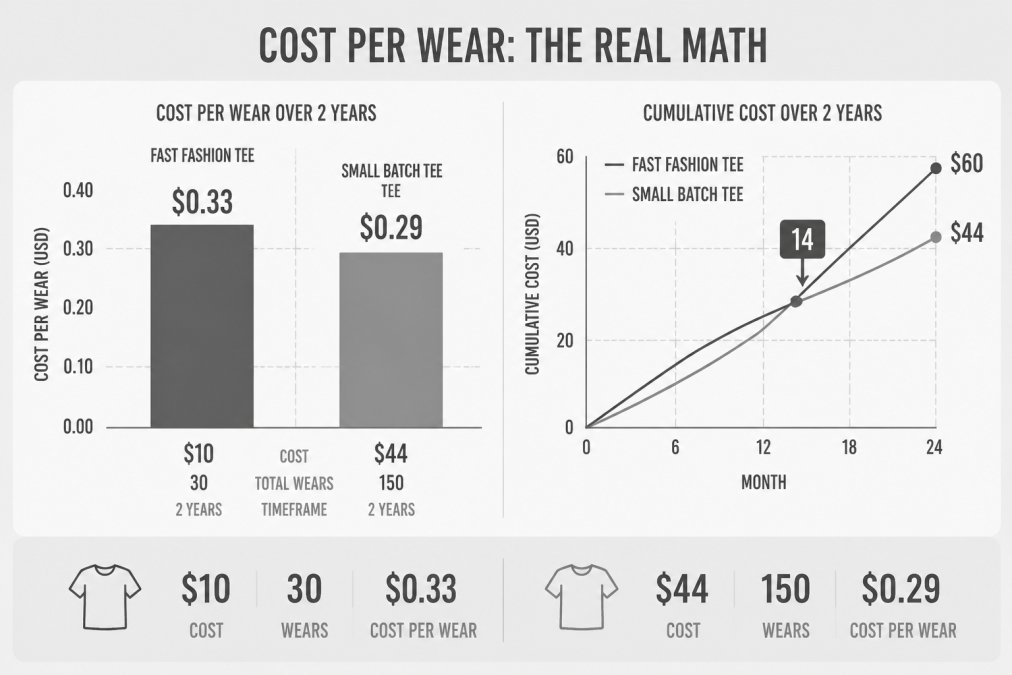
- Fast fashion tee. Assume a low stitch density, a serged seam allowance, and a thin knit. A common pattern is that the collar relaxes and the side seams start to distort within a few months of regular wear. If you wear it once a week, that is roughly 30 wears before it stops being something you reach for.
- Mid-tier tee. Better fabric, but often the same construction shortcuts at the seams. Call it 70 wears before the collar or a seam becomes the reason you stop wearing it.
- Small batch tee. Denser knit, higher stitch density on stress seams, cleaner seam allowance, and a stretch yarn that recovers. If you wear it once a week, 150 wears is roughly three years of regular rotation, and many owners get more, because the failure modes above are the ones small batch construction is specifically designed to delay.
| Garment | Price | Wears Before Failure | Cost Per Wear |
|---|---|---|---|
| Fast fashion tee | $10 | 30 | $0.33 |
| Mid-tier tee | $25 | 70 | $0.36 |
| Small batch tee | $44 | 150 | $0.29 |
A higher upfront price only pays off if the garment stays in rotation. That is what you are buying when you buy small batch: not a label, but a longer denominator in the cost-per-wear equation.
Caring for Small Batch Clothing to Maximize Longevity
How you wash a garment decides how long it lasts, regardless of how well it was made. Viscose from bamboo and organic cotton both respond well to cool water, low heat, and less agitation. Heat and friction are what break fibers down.
A simple care routine that protects construction:
- Wash in cold water on a gentle cycle
- Turn garments inside out to reduce surface abrasion
- Skip fabric softener, which coats fibers and reduces breathability
- Air dry when you can, or tumble on low
- Fold knits rather than hanging them to avoid shoulder stretch
Frequently Asked Questions
What is the difference between small batch and mass-produced clothing?
Small batch clothing is produced in limited quantities, allowing for closer attention to detail, stricter quality control, and higher-quality materials. Mass-produced clothing prioritizes speed and low cost, often using cheaper fabrics and construction methods that reduce garment lifespan. Small batch production also reduces inventory risk and waste, as items are made to meet demand rather than overproduced.
How does production volume affect garment construction quality?
Higher production volumes often lead to shortcuts: lower stitch density, less durable seams, and cheaper trims. Small batch manufacturing allows for slower sewing speeds, more frequent needle changes, and tighter quality checks at each stage. This results in stronger seams, better fit, and fewer defects. For example, a small batch tee may use double-needle stitching and reinforced shoulder seams, while a mass-produced version might use single stitching that unravels faster.
Does small batch manufacturing reduce textile waste?
Yes. Small batch production typically creates less overstock and deadstock because items are made in limited runs based on demand. This reduces the volume of unsold clothing that ends up in landfills. Additionally, the focus on durability means garments stay in use longer, further reducing waste. While exact waste reduction varies by brand, the model inherently avoids the overproduction common in fast fashion.
Why do mass-produced garments often fail faster than small batch items?
Mass-produced garments often use lower-quality fabrics, fewer stitches per inch, and less durable threads. They may also skip steps like pre-shrinking or reinforcing stress points. Small batch items benefit from better materials, slower production, and more rigorous quality control. For instance, a small batch shirt might use 95% viscose from bamboo with 5% elastane for comfort and durability, while a fast fashion alternative might use polyester that pills and stretches out quickly.