


5 Reasons to Switch to Bamboo Workout Gear
Table of Contents
- Why Bamboo Workout Gear Deserves a Spot in Your Gym Bag
- Reason 1: Softness and Comfort That Synthetic Fabrics Can't Match
- Reason 2: Breathability and Temperature Regulation During Workouts
- Reason 3: Moisture Absorption and Sweat Management
- Reason 4: Gentler on Sensitive Skin Than Polyester Blends
- Reason 5: Durability That Survives Heavy Rotation
- Viscose From Bamboo vs Organic Cotton: Which Works Better for Training?
- How to Wash Viscose From Bamboo Workout Gear
- Frequently Asked Questions
Last Updated: October 14, 2026
Why Bamboo Workout Gear Deserves a Spot in Your Gym Bag
Most workout shirts are built for performance, not for your skin. Polyester blends are engineered to stretch and dry fast, and many are finished with chemical treatments that sit against your body for hours. That is why so many active men are making the switch to bamboo workout gear.

This guide from Mellow Mile breaks down five practical reasons to switch, plus how to care for it and how it compares to organic cotton. Below, we cover exactly what changes when your training shirt stops fighting your skin.
Bamboo workout gear is athletic clothing made with viscose from bamboo, a soft semi-synthetic fiber that moves moisture and feels smooth against the skin. It is not the same as raw bamboo, and it is not a natural fiber.
That distinction matters. It tells you what the fabric can and cannot do.
Reason 1: Softness and Comfort That Synthetic Fabrics Can't Match
Softness is the first thing men notice. Viscose from bamboo has a smooth, fluid hand feel, so it drapes instead of clinging. Polyester tends to feel slick or plasticky, and it can chafe once you start sweating.
The difference shows up over hours, not minutes. Our Athletic Tee is made from 95% viscose from bamboo with 5% elastane for stretch and durability. No polyester. The result is a lightweight shirt that stays comfortable through a workout and the rest of the day.
A common mistake is judging a shirt by how it feels in the store. Try it on after a hard session instead. That is when softness actually matters.
- Smooth texture that glides instead of grabbing
- Lightweight feel, even when damp
- Stretch that moves with you, not against you
Reason 2: Breathability and Temperature Regulation During Workouts
Breathability is not a single property. It is the result of fiber, knit structure, fabric weight, and fit working together. Viscose from bamboo contributes a smooth, low-friction surface and a moisture-absorbing fiber, but the fabric only breathes as well as the knit allows air to move through it.
Here is the mechanism in plain terms. As your body heats up, sweat evaporates and carries heat away (Physiology of sweat gland function). A fabric that traps that vapor against your skin keeps the heat there too. A more open knit lets vapor pass through, so heat escapes instead of building up across your back and chest.
Temperature regulation is not the same as cooling. The fabric helps you stay level as your body heats up, and it works in both directions. It feels comfortable in summer humidity and layers well when the air turns cold.
How it plays out by activity and intensity
- Yoga and mobility work (low sweat): Breathability matters less than drape and stretch. A lighter knit in viscose from bamboo moves with you through long holds without bunching at the shoulders.
- Strength training (moderate sweat, high friction): The smooth surface reduces chafe against barbells, benches, and mats. Look for a slightly denser knit so the shirt does not snag on equipment.
- Running and intervals (high sweat, high airflow): This is where moisture absorption and an open knit matter most. A looser fit and lighter color help, because airflow across the fabric does more for comfort than any label claim.
- Hot-weather outdoor sessions: A 95 degree day on the range is a real test. One customer wore his shirt through it and said staying cool was a first for him. That is the whole point of breathable fabric.
What to look for on the label
Fabric weight and knit tell you more than marketing copy. A mid-weight jersey breathes differently than a dense interlock, even when both are viscose from bamboo. If you run hot, choose the lighter option and size for airflow rather than a tight fit.
Reason 3: Moisture Absorption and Sweat Management
Sweat management is where cheap shirts fail. Viscose from bamboo absorbs moisture into the fiber, so sweat moves off your skin instead of pooling.
Polyester works differently. It pushes moisture to the surface to dry fast, but it can cling and trap odor along the way. If you sweat heavily, that difference is obvious by mile four.
You do not need a lab test to check this. Wear a shirt for a long, sweaty session and see if it sticks to your shoulders. That is the real test.
- Absorbs sweat instead of letting it bead on the surface
- Dries without the cold, clammy feel
- Holds its shape when wet
Reason 4: Gentler on Sensitive Skin Than Polyester Blends
Sensitive skin reacts to what touches it. Viscose from bamboo has a smooth surface and no polyester, which means less friction and fewer scratch points during movement.
We also think about what goes into the fabric, not just what it is made of. Our tees are dyed using OEKO-TEX® certified dyes, helping ensure the finished shirt is free from harsh chemical residues. The fabric is made with OEKO-TEX STANDARD 100 certified material. That standard tests for harmful substances, and Class I applies the limits used for baby articles.
If you break out or itch after training, start by changing the fabric closest to your skin. One customer with sensitive skin said most workout shirts leave him itchy by the end of the day, and this one caused zero irritation.
Reason 5: Durability That Survives Heavy Rotation
Durability in a soft knit comes down to construction, not just fiber. Viscose from bamboo can pill or stretch if the fabric is thin or the knit is loose, so the blend, the knit density, and the garment build matter as much as what the fiber is called.
Fabric construction and stretch
Our Athletic Tee is made from 95% viscose from bamboo with 5% elastane. That 5% is doing real work. Elastane gives the knit stretch and, just as important, recovery, the ability to snap back to its original shape after you move, sweat, and wash it. Without enough recovery, a soft knit sags at the neckline and stretches out at the shoulders over time.
Knit density is the other lever. A denser knit resists pilling better than a loose one because fewer loose fibers work their way to the surface and tangle. That is why two shirts with the same fiber content can age very differently.
What pilling actually is
Pilling happens when short fibers work loose from the yarn, tangle into little balls, and stay attached to the surface. Friction drives it, backpack straps, seatbelts, barbells, and the inside of a dryer. You cannot eliminate it, but you can slow it down.
How to extend lifespan
- Wash cold on a gentle cycle. Heat breaks down elastane and speeds shrinkage.
- Turn shirts inside out. This puts friction on the inside of the garment, not the face you see.
- Skip fabric softener. It coats fibers and reduces the moisture-absorbing behavior you bought the shirt for.
- Wash with similar fabrics. Heavy denim and towels abrade soft knits. One customer washed a shirt with jeans by accident and reported no pilling, but that is luck, not a plan.
- Hang dry when you can, or tumble on low. Keep the dryer short if you must use it.
- Rotate two or three shirts. Fewer wash cycles per shirt means longer life, and you always have a clean one ready.
Customers report the fabric holding up after about 15 washes. Heavy rotation is the real test: if a shirt survives gym sessions, runs, and weekend wear without losing its drape, it earned its spot in the drawer.
Viscose From Bamboo vs Organic Cotton: Which Works Better for Training?
Both work, but they solve different problems. Viscose from bamboo wins on softness and moisture absorption. Organic cotton wins on durability and heat tolerance in dry conditions.
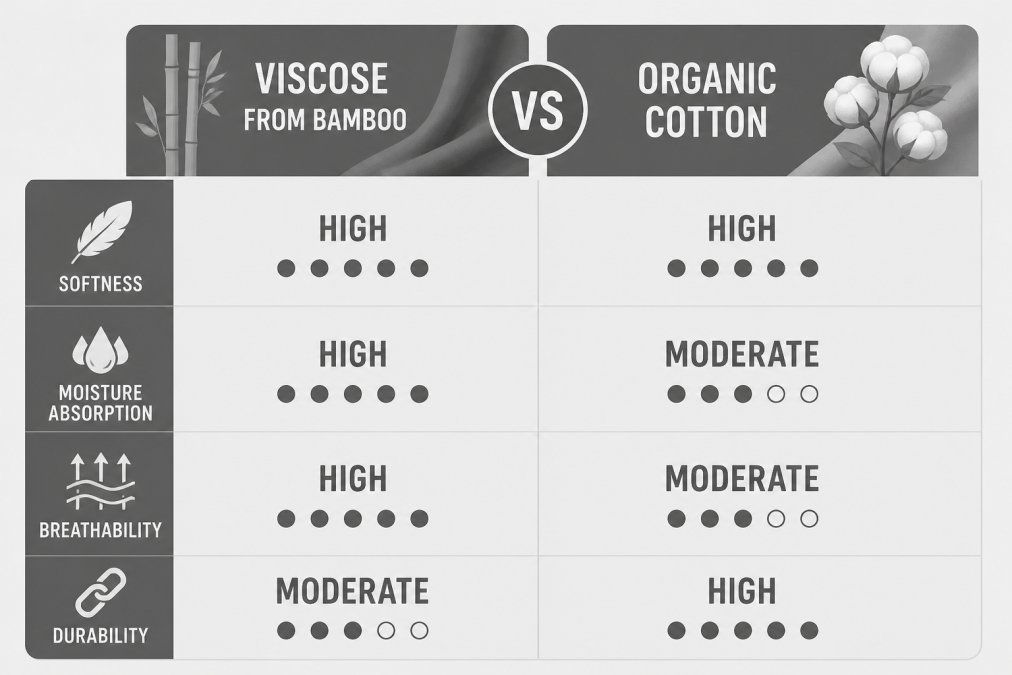
For intense training, viscose from bamboo is the better pick. It moves sweat and stays smooth against the skin. For base layers and everyday wear, organic cotton is a strong choice, and it is a natural fiber.
Many men keep both. Bamboo for the gym, organic cotton for the rest of the week.
| Fabric | Best For | Softness | Moisture Absorption | Durability |
|---|---|---|---|---|
| Viscose from bamboo | Intense training, humid days | High | High | Moderate |
| Organic cotton | Base layers, everyday wear | High | Moderate | High |
How to Wash Viscose From Bamboo Workout Gear
Wash viscose from bamboo in cold water on a gentle cycle, then hang dry or tumble on low. Heat is the enemy. Hot water and a hot dryer cause shrinkage and break down the stretch.
A few habits keep your gear in shape:
- Turn shirts inside out before washing
- Skip fabric softener, which coats the fibers
- Wash with similar fabrics, not heavy denim or towels
- Hang dry when you can, or use low heat
- Keep the dryer short if you must use it
One customer noted his organic cotton tee shrank a little in the dryer, so he hang dries now. The same care applies here. Cold wash and air dry is the simplest way to protect any soft fabric.
Frequently Asked Questions
Is viscose from bamboo a natural fiber?
No. Viscose from bamboo is a regenerated cellulosic, semi-synthetic fiber made through chemical processing. While it starts with bamboo plant material, the manufacturing process transforms it into a new fiber type. This matters when you read labels: a shirt listed as viscose from bamboo is not the same as one made from raw bamboo fiber. The processing also means bamboo plant properties do not carry over to the finished fabric.
How does viscose from bamboo compare with organic cotton for activewear?
Viscose from bamboo tends to feel softer and drapes more fluidly, while organic cotton is a natural fiber with a more structured hand. For workouts, viscose from bamboo often wins on breathability and moisture absorption. Organic cotton can work well for lower-intensity activities or everyday wear. The right pick depends on your activity level, how much you sweat, and whether you prefer a lighter or more substantial feel against the skin.
How should you wash viscose from bamboo workout clothes?
Turn garments inside out and machine wash cold on a gentle cycle with mild detergent. Skip fabric softener and bleach, which break down the fibers over time. Tumble dry low or hang dry to protect the drape and stretch. If you use a dryer, remove items while slightly damp to reduce wrinkling. Following these steps helps viscose from bamboo hold its shape and softness through repeated wash cycles.
What should men look for in non-toxic workout clothes?
Check the fiber content first: viscose from bamboo, organic cotton, or blends with a small amount of elastane for stretch. Look for certifications like OEKO-TEX STANDARD 100, which confirms the fabric was tested for harmful substances. Avoid vague claims like 'chemical-free' without documentation. Fit matters too: a shirt that clings or rides up during movement defeats the purpose. Prioritize construction quality, flat seams, and a cut that moves with you.
The real challenge is not finding workout gear. It is finding gear that performs without leaving you guessing about what is against your skin. At Mellow Mile, we build small-batch essentials from non-toxic materials, free from chemical finishes like PFAS, with construction meant to last. Our Athletic Tee uses 95% viscose from bamboo with 5% elastane, dyed with OEKO-TEX certified dyes for a breathable, easy-wearing fit. Sign up for 20% off and see how your training shirt should feel.