


Durable Organic Cotton Underwear for Men: 2026 Guide
Table of Contents
- Why Durable Organic Cotton Underwear for Men Outlasts the Rest
- The Labels That Decide Quality: GOTS Certified and OEKO-TEX STANDARD 100
- Organic Cotton vs Viscose from Bamboo vs Tencel: Durability Compared
- Boxer Briefs, Trunks, or Boxers: Choosing a Fit That Lasts
- Looking for a Wearpact Alternative for Men? What to Check First
- How to Wash Organic Cotton Underwear So It Keeps Its Shape
- Mending and Care: Making Durable Organic Cotton Underwear Last Years
- Conclusion: Buy Fewer, Wear Longer
- Frequently Asked Questions
Last Updated: October 4, 2026
Why Durable Organic Cotton Underwear for Men Outlasts the Rest
Durable organic cotton underwear for men is built from longer-staple cotton fibers, denser knits, and covered elastic waistbands, so it resists pilling, sagging, and thinning far longer than flimsy fast-fashion pairs.

Most men's underwear fails at three points: the waistband, the crotch seam, and the fabric weight.
Below, we break down the labels that matter, how organic cotton compares to viscose from bamboo and Tencel, and how to wash your pairs.
The Labels That Decide Quality: GOTS Certified and OEKO-TEX STANDARD 100
Two certifications do most of the work when you're judging quality: GOTS for the cotton itself, and OEKO-TEX STANDARD 100 for what's left in the finished fabric.
What GOTS Certification Actually Covers
The Global Organic Textile Standard is a textile processing standard for organic fibers. It covers the organic status of the cotton from harvest through manufacturing, along with environmental and social criteria at each processing stage.
The Global Organic Textile Standard overview sets out those requirements in detail. Look for the phrase "made with GOTS certified organic cotton" on the label rather than a vague "organic" claim. Our Organic Cotton Boxers are made with GOTS certified organic cotton and dyed with OEKO TEX certified dyes.

OEKO-TEX STANDARD 100 and Skin Sensitivity
OEKO-TEX STANDARD 100 tests finished fabric for harmful substances against published limit values. Class I is the strictest tier, tested against the limits used for baby articles. For men with skin sensitivity, this is the label worth checking.
You can review the testing criteria through the OEKO-TEX STANDARD 100 criteria. If irritation is your main concern, this certification matters more than thread count claims.
Organic Cotton vs Viscose from Bamboo vs Tencel: Durability Compared
Organic cotton is a natural fiber. Viscose from bamboo and Tencel are regenerated cellulosic, semi-synthetic fibers made through chemical processing. That difference shapes how each one wears.
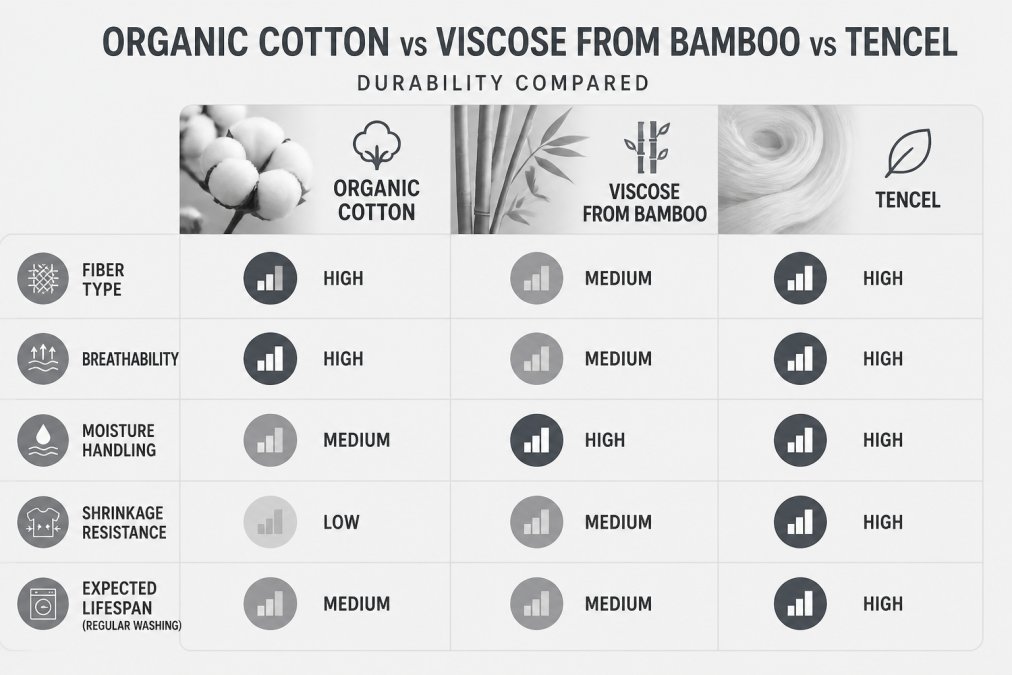
| Attribute | Organic Cotton | Viscose from Bamboo | Tencel |
|---|---|---|---|
| Fiber type | Natural | Regenerated cellulosic | Regenerated cellulosic |
| Breathability | High | High | High |
| Moisture handling | Good, holds shape when damp | Very soft, slower to dry | Good, dries quickly |
| Shrinkage resistance | Medium, pre-shrunk helps | Medium | High |
| Lifespan under regular washing | High | Medium | Medium-high |
Softness at unboxing tells you almost nothing about durability. Viscose from bamboo feels incredibly soft on day one and often loses structure faster. Organic cotton starts slightly crisper and holds its shape longer, which is why we build our boxers on it.
Boxer Briefs, Trunks, or Boxers: Choosing a Fit That Lasts
Fit affects durability more than most men realize. A pair that rides up gets tugged and stretched all day, and that strain wears out the waistband and leg openings faster than washing ever would.
- Boxers: loose through the leg, best for standing and desk work, least support
- Boxer briefs: snug through the thigh, good for workouts, most prone to leg roll if the fabric is thin
- Trunks: shorter leg, less fabric to bunch, a solid middle ground for daily wear
For durability, the deciding factor is the elastic waistband. A covered, organic cotton wrapped waistband resists rolling and stretching better than a bare elastic band.
A pair that fits properly gets pulled and adjusted far less than one that's a size off.
Looking for a Wearpact Alternative for Men? What to Check First
If you're comparing brands, judge each one on the same four criteria rather than marketing language: certification, fabric weight, waistband construction, and wash care instructions. Ask for the GOTS scope certificate and the OEKO-TEX standard number.
Transparency is the real test. Brands that publish their certifications are easier to verify than brands that just use the word "organic." We list ours directly on the product page, and our Federal Trade Commission guidance on textile claims explains why vague environmental and fiber claims are worth questioning.
Then check the care label. A brand that tells you to machine wash cold and tumble dry low is being honest about shrinkage. One that promises zero shrinkage on untreated cotton is overselling.
How to Wash Organic Cotton Underwear So It Keeps Its Shape
Most men's underwear doesn't wear out from wearing. It wears out from washing. Heat, agitation, and the wrong detergent chemistry do more damage to cotton fibers and covered elastic than a full year of daily wear.
What Actually Breaks Down in the Wash
Three things fail in a washing machine:
- Cotton fibers abrade against each other and against the drum. Short-staple fibers work loose and pill first; longer-staple fibers in durable organic cotton underwear resist this because there are fewer fiber ends exposed at the yarn surface.
- Covered elastic waistbands lose recovery when heat and detergent residue attack the rubber core. Once the core stops snapping back, the waistband rolls and sags even if the cotton itself is fine.
- Dyes fade from hot water and residual bleach in shared loads. Cold water and like-color sorting slow this.
The Wash Routine That Preserves Shape
- Turn each pair inside out. The outer face takes the drum abrasion; the inner face touches skin, so protect the visible surface.
- Wash cold, around 60 to 80°F. Cold water slows fiber swelling and reduces shrinkage. Hot water is the biggest cause of cotton underwear that no longer fits.
- Use a gentle or normal cycle with like colors. Heavy-duty cycles and bulky items like towels and jeans beat up lightweight knits.
- Skip fabric softener and dryer sheets. They leave a waxy coating that reduces breathability and traps odor. A half-cup of white vinegar in the rinse cycle softens without coating the fabric.
- Use a mild, dye-free detergent. Enzyme-heavy detergents designed for stains can degrade cotton over repeated washes.
- Tumble dry low, or hang dry. Low heat is acceptable; high heat is not. Hang drying eliminates shrinkage risk entirely.
- Never bleach. Chlorine bleach weakens cotton fibers and destroys elastic. Oxygen-based color-safe bleach is a safer substitute.
The 50-Wash Reality Check
Judge durability claims in wash cycles, not months. A pair worn once a week and washed once a week hits 50 washes in about a year.
Pairs made with longer-staple organic cotton and a covered waistband still hold their shape at 50 washes, while short-staple pairs from the same rotation are already retired.
To test your own pairs, wash two 25 times in a row, then compare them with a brand-new pair from the same pack.
Organic Cotton Boxers – Wrapped →
Drying: The Step Most Men Get Wrong
The dryer does more damage than the washer. High heat shrinks cotton, cooks elastic, and accelerates pilling. Tumble dry low is a compromise; hang drying is the durability move.
One customer, Evan C., put it plainly: "Very soft organic cotton. Shrank a little in the dryer, so I hang dry now. Still great." That's the pattern, the pairs that last are the ones that never see high heat.
Mending and Care: Making Durable Organic Cotton Underwear Last Years
This section covers which failures are worth repairing, which aren't, and how to fix the three that matter most on men's underwear.
Which Failures Are Worth Fixing
Not every problem is a repair candidate:
- Worth fixing: a dropped stitch at the crotch seam, a loose waistband thread, a small hole at the inner thigh, a separated leg hem.
- Not worth fixing: a waistband that has lost its elastic recovery (the rubber core is dead, no stitch will bring it back), fabric that has thinned across a wide area, or a crotch seam that has blown out along its full length.
Repairs restore structure, not material. If the fiber itself is gone, you're patching a hole that will just move.
The Three Repairs That Matter
1. Reinforcing the crotch seam before it fails.
The crotch seam takes the most stress of any seam on the garment.
2. Re-stitching a loose waistband edge.
When the thread attaching the covered waistband starts to unravel, catch it early. Use a whipstitch, small diagonal stitches over the edge, with matching thread, working in one-inch sections so the band doesn't pucker.
3. Patching thin spots on the inner thigh.
Inner-thigh wear is the most common failure point on boxer briefs and trunks. Cut a soft cotton scrap slightly larger than the thin area, place it inside the garment, and stitch around the perimeter with a running stitch.
Building a Rotation That Extends Life
Rotation prevents wear. Keep at least seven pairs in active rotation so each gets a full week to rest. Elastic recovers better when it isn't stretched daily, and cotton fibers return to shape during the rest period.
Pairs worn twice a week fail noticeably faster than pairs worn once a week, even with an identical wash routine. It's not the washing, it's the lack of recovery time.
When to Retire a Pair
Retire a pair when:
- The waistband no longer lies flat after washing
- The fabric is thin enough to see light through when held up
- A repair has already been done in the same spot twice
- The crotch seam has been reinforced and still pulls apart
Retired pairs aren't trash. Cut them into patches for future repairs, or use them as cleaning rags.
One customer, Brandon E., noted three months of heavy rotation with the elastic still feeling new, compared with a previous brand that stretched out by month two. The difference was fiber length, waistband construction, and a rotation that gave each pair time to recover.
Conclusion: Buy Fewer, Wear Longer
Cheap pairs seem like a bargain until you're replacing them twice a year. Durable organic cotton underwear for men solves that by combining certified fiber, solid construction, and care that respects the fabric. At Mellow Mile, we build small-batch essentials made with GOTS certified organic cotton, finished with OEKO-TEX certified dyes, and free from chemical finishes like PFAS, so each pair feels good against the skin and holds up to daily wear.
Frequently Asked Questions
What makes organic cotton underwear more durable than conventional cotton?
The fiber itself behaves similarly, but the finishing does not. Organic cotton is grown without synthetic pesticides and processed without the harsh chemical treatments used on conventional cotton, which can weaken fibers over repeated washing. Durable organic cotton underwear also tends to use tighter knitting and a wrapped elastic waistband instead of a bare elastic strip. Customers report elastic that still feels new after three months of heavy rotation, while cheaper pairs stretch out by month two.
How should you care for organic cotton underwear to extend its lifespan?
Wash in cold water on a gentle cycle with a mild detergent, skip fabric softener because it coats fibers and reduces breathability, and tumble dry low or hang dry. One customer noted their pair shrank slightly in the dryer, so they switched to hang drying and the fit held. Turning garments inside out protects the waistband. Following these steps is the simplest way to keep organic cotton underwear for men in rotation for years rather than months.
Is organic cotton underwear better for sensitive skin?
For many men, yes. Organic cotton is a natural fiber that breathes and moves moisture away from skin, and it is not blended with polyester or finished with the chemical treatments that some sensitive-skin wearers react to. Look for fabric made with GOTS certified organic cotton and dyed with OEKO-TEX certified dyes, which means the fabric was tested against restricted substance limits. One customer with sensitive skin reported zero irritation after switching from synthetic workout pairs.
What should I check before buying a wearpact alternative for men?
Start with the certification label: fabric made with GOTS certified organic cotton and OEKO TEX certified dyes gives you third-party verification rather than marketing claims. Then check construction details, including a wrapped waistband and shrinkage resistance after washing. Confirm sizing runs through XL and XXL if you need it, since small-batch production does not have to mean limited sizing. Finally, read the return policy so you can test fit and durability risk-free.