


How to Verify Clothing Supply Chain: A 2026 Guide
Table of Contents
- Why Verifying a Clothing Supply Chain Starts With the Label
- Garment Certification Verification: How to Check If a Claim Is Real
- Clothing Supply Chain Documentation: What to Request From a Brand
- Clothing Supply Chain Traceability: Following a Garment From Fiber to Shelf
- Your Clothing Supply Chain Audit Checklist
- Red Flags That Mean You Should Walk Away
- Frequently Asked Questions
Last Updated: October 8, 2026
Why Verifying a Clothing Supply Chain Starts With the Label
Learning how to verify clothing supply chain claims starts with one habit: read the label before you trust the marketing, because the tag is where you begin to verify clothing supply chain promises. That tag is the only part of the garment a brand is legally accountable for, and it is where real verification begins.
At Mellow Mile, we build our own garments through small-batch production, so we know how much of this process happens behind the scenes. That is exactly why the label matters.
Most shoppers never look past the fiber content. But the certifications printed there tell you which claims have been checked by an outside party, and which ones are just words.
What Certifications Actually Cover (and What They Don't)
A certification only covers what it was written to cover. Nothing more.
This is the part most people get wrong. A logo on a hangtag does not mean the whole garment is verified. It means one specific material or process passed one specific standard.
- GOTS covers organic cotton, from the farm through processing.
- OEKO-TEX STANDARD 100 tests fabric for harmful substances.
- Fair trade labels cover labor conditions, not fiber content.
- A generic "eco" icon covers nothing. It is a design choice.
So a shirt can carry a real certification and still have unverified parts. Understanding that gap is the skill.

Garment Certification Verification: How to Check If a Claim Is Real
Garment certification verification means checking the claim against the certifying body's own records, not the brand's website. Every major standard issues a license or certificate number, and most let you look that number up directly.
Here is the practical version:
- Find the certification name on the label or product page.
- Look for a license or certificate number.
- Search that number in the certifying body's public database.
- Confirm the company name matches the brand you are buying from.
- Check the scope. Does it cover this product, or just one material?
If a brand shows a logo but no number, that is a gap. Not proof of a lie, but a gap. A real certificate has a paper trail.
Checking GOTS, OEKO-TEX, and Other Standards
GOTS keeps a public database of certified companies. You can search by company name or certificate number and see what each one is certified to produce.
OEKO-TEX runs a similar lookup tool. You can enter a certificate number and confirm the product class and the company behind it.
A few things to know before you search:
- GOTS applies to organic cotton. It does not cover viscose from bamboo.
- OEKO-TEX STANDARD 100 tests for harmful substances. Class I is the strictest level, tested against the limits used for baby articles.
- A brand can hold one certificate for one product line, not its whole catalog.
The GOTS public certified supplier database lets you confirm a company's scope in about a minute. The OEKO-TEX label and certificate lookup works the same way for STANDARD 100.
Clothing Supply Chain Documentation: What to Request From a Brand
Clothing supply chain documentation is the paper trail behind a product: certificates, test reports, and supplier lists that show where materials came from and how they were handled. If a brand cannot share any of it, treat the claim as unproven.
You do not need to be a supplier to ask. A short, direct email works.
Ask for these:
- The certificate number and the certifying body for any claim on the label.
- A list of the main suppliers, at least the final stage.
- Test reports for chemical or safety claims.
- The name of the factory that cut and sewed the garment.
Small brands often have this on hand. Larger ones may route you to a sustainability page. Either is fine, as long as the documents are real and specific.
The Federal Trade Commission's Green Guides explain what environmental marketing claims are allowed and how they must be backed. It is worth knowing, because a vague claim with no backup is exactly what the guides warn against.
Clothing Supply Chain Traceability: Following a Garment From Fiber to Shelf
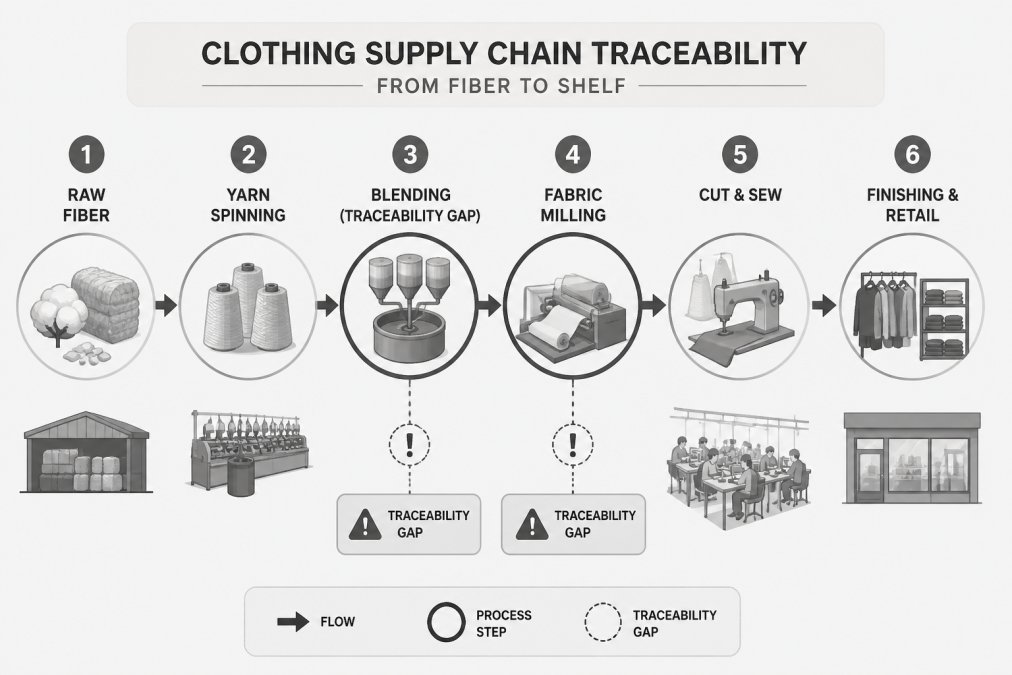
Clothing supply chain traceability is the ability to follow a garment backward from the finished product to the raw fiber, and to prove each step along the way. Full traceability is rare. Most brands can trace one or two stages at best.
Here is how the chain usually runs:
- Raw fiber, such as organic cotton or wood pulp
- Yarn spinning
- Fabric milling and dyeing
- Cut and sew
- Finishing and packaging
- Retail
Each handoff is a place where records can thin out. A brand that knows its cut-and-sew factory may have no idea which mill spun the yarn.
Where Traceability Breaks Down
Traceability breaks down at the points where materials get mixed. When fiber from many farms is blended at a mill, the link to any single source disappears.
Viscose from bamboo is a good example. It is a regenerated cellulosic fiber made through chemical processing, and fiber chain of custody for it is often not established. So a brand can tell you the fiber type without being able to trace it to a specific farm.
This is not a scandal. It is a limit. Knowing where the limit sits helps you judge what a brand can honestly claim.
Your Clothing Supply Chain Audit Checklist
A clothing supply chain audit checklist turns all of this into a repeatable routine. Run these six steps on any brand before you buy, and you will separate real claims from decoration.
- Check the label. Note every certification and fiber claim.
- Verify the certification number. Look it up in the certifying body's database.
- Request documentation. Ask for certificates, test reports, and supplier names.
- Trace the fiber origin. Confirm how far back the brand can actually go.
- Review audit reports. Look for third-party factory audits, not self-written summaries.
- Assess the gaps. Decide if the unverified parts matter for what you are buying.
Most brands will pass three or four steps. Very few pass all six. That is normal, and it tells you where to focus.
Red Flags That Mean You Should Walk Away
Some signals are worth acting on immediately. Here is what should stop you.
- A certification logo with no certificate number anywhere.
- A claim that a standard covers more than it does.
- No supplier information at all, not even the final factory.
- Vague words like "eco" or "green" with nothing behind them.
- A refusal to answer a simple documentation request.
One red flag might be an oversight. Two or three together is a pattern.
The honest brands are not the ones with the most logos. They are the ones who can point you to a database entry and a document when you ask.
Verifying a clothing supply chain takes a few minutes and a few good questions, and it changes how you shop. At Mellow Mile, we make that easier by naming the standards behind our essentials, from our Athletic Tee made with OEKO-TEX STANDARD 100 certified fabric to our Organic Cotton Boxers made with GOTS certified organic cotton. Small-batch production and a focus on material composition mean fewer unknowns between the fiber and your skin. Sign up for 20% off and start with essentials you can actually trace.

Frequently Asked Questions
How do you verify a clothing supply chain?
Start with the label. Look for certifications like GOTS or OEKO-TEX STANDARD 100, then verify those certification numbers directly on the certifying body's website. Request documentation from the brand: fiber certificates, factory audit reports, and dye compliance records. If a brand cannot provide these, the claim is unverified. Traceability matters most for the fiber stage, where chain of custody is hardest to confirm.
What documents can verify a clothing supplier's claims?
Ask for transaction certificates from fiber certifiers, factory audit summaries from recognized auditing bodies, dye and finish compliance reports, and shipping or production records that connect fiber to finished garment. A brand that shares these documents willingly is more credible than one that only shows logos on a hangtag.
What is the difference between supply chain transparency and traceability?
Transparency means a brand publishes information about its suppliers, factories, and practices. Traceability means the brand can follow a specific garment back through each production stage to the fiber source. A brand can be transparent about where it sources without having full traceability for every material. Both matter, but traceability is harder to achieve.
How can you check whether a clothing certification is valid?
Every legitimate certification has a unique number or license code. Go to the certifying body's website, enter that number, and confirm the brand, product category, and scope match what you were told. Certifications are issued to specific facilities or products, not to a brand name in general. If the number doesn't appear or the scope doesn't match, treat the claim as unverified.