


Non Toxic Men's Essentials Shop: What to Buy in 2026
Table of Contents
- What to Look For in a Non Toxic Men's Essentials Shop
- Quick Comparison: Mellow Mile Non Toxic Essentials
- Men's Organic Cotton Shirts and Boxers That Hold Up
- OEKO-TEX STANDARD 100 Certified Fabric, Explained
- How to Build a Men's Capsule Wardrobe Around Clean Fabrics
- Long-Lasting Men's Basics: Care Tips That Prevent Pilling and Shrinkage
- What to Ignore When You Shop for Non Toxic Essentials
- Conclusion: Start With the Layer Closest to Your Skin
- Frequently Asked Questions
Last Updated: October 6, 2026
What to Look For in a Non Toxic Men's Essentials Shop
A non toxic men's essentials shop is a retailer that stocks clothing made without the chemical finishes, synthetic dyes, and plastic-based fabrics common in standard apparel. At Mellow Mile, we built our entire catalog around that idea, and we've learned that the label tells you more than the marketing copy ever will.
Here's the uncomfortable part: "non-toxic" is not a regulated term in apparel. Any brand can print it on a hangtag. What you can verify is third-party certification, and that's where most shopping decisions should start.
Below, we'll show you exactly which certifications matter, what they actually cover, and how to build a small wardrobe of men's organic cotton shirts, boxers, and tees that hold up past the first dozen washes.

The Labels That Actually Tell You Something
GOTS stands for the Global Organic Textile Standard. It covers organic fiber content, processing, and social criteria across the supply chain. When we say our boxers are made with GOTS certified organic cotton, that's the standard doing the work, not our own claim.
OEKO-TEX STANDARD 100 tests finished fabric against a published list of harmful substances, including restricted dyes and heavy metals. The OEKO-TEX STANDARD 100 testing criteria are published openly, so you can read exactly what gets tested rather than taking a brand's word for it.
One detail worth knowing: OEKO-TEX Class I is the strictest tier, tested against the limits used for baby articles. Fabric that clears Class I has been held to a tighter threshold than standard adult apparel requires.
Quick Comparison: Mellow Mile Non Toxic Essentials
Two products anchor our lineup, and they solve different problems. The boxers are the layer closest to your skin, worn daily. The Athletic Tee is the one you reach for on a run or at the gym.

| Product | Price | Fabric | Dye Certification | Best For |
|---|---|---|---|---|
| Organic Cotton Boxers | $24.00 | GOTS certified organic cotton | OEKO-TEX certified dyes | Daily wear, skin-sensitive guys |
| Athletic Tee | $44.00 | 95% viscose from bamboo, 5% elastane | OEKO-TEX certified dyes | Workouts, humidity, all-day wear |
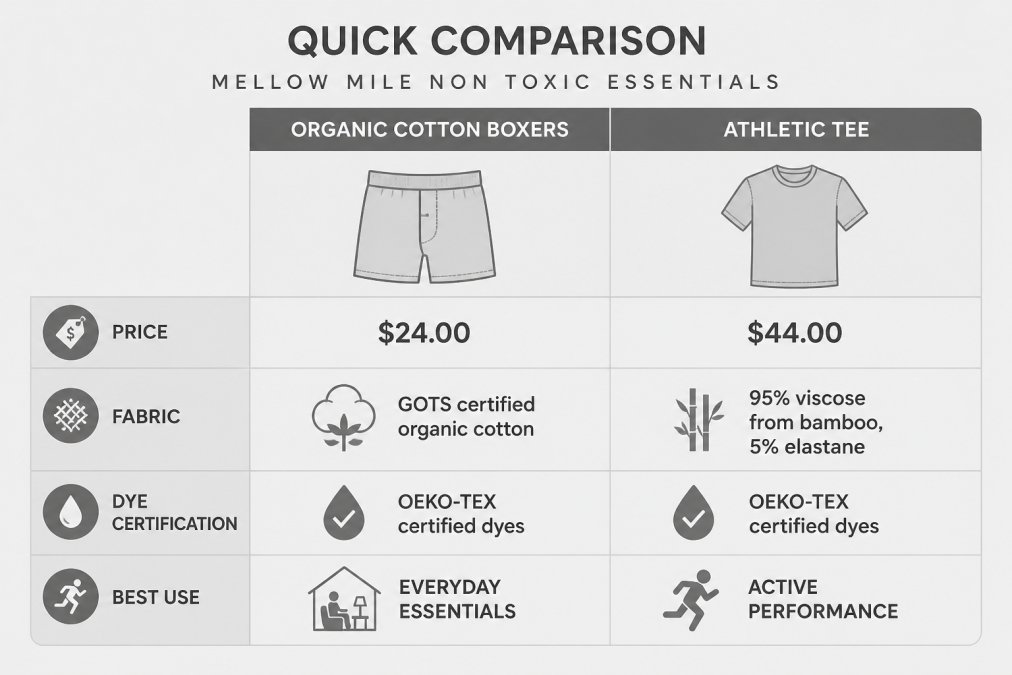
The boxers come in two versions: Organic Cotton Boxers and a wrapped-waistband cut, Organic Cotton Boxers - Wrapped, both at $24.00.

Men's Organic Cotton Shirts and Boxers That Hold Up
Durability is where most non-toxic apparel disappoints. Soft fabric that pills by month two isn't a bargain at any price, and we hear that complaint constantly from guys who tried other brands first.
Our approach is small-batch production, which lets us control construction rather than chase volume. The result is basics that survive heavy rotation.
Organic Cotton Boxers: $24 and Built for Daily Rotation
The Organic Cotton Boxers are made with GOTS certified organic cotton and dyed with OEKO-TEX certified dyes. No polyester blends, no harsh chemical treatments.
What most guides miss is the waistband. A rolled or twisted waistband ruins an otherwise good pair of boxers, so ours uses an organic cotton wrapped waistband that stays flat through a full day.
Brandon E. put it plainly: "Three months of heavy rotation and the elastic still feels new. My last brand was stretched out by month two."
The Athletic Tee: Viscose From Bamboo at $44
The Athletic Tee is 95% viscose from bamboo with 5% elastane for stretch and recovery. Viscose from bamboo is a regenerated cellulosic fiber, semi-synthetic and made through chemical processing, so we don't call it natural and neither should anyone else.
What it does deliver is breathability and a soft hand feel without polyester. Marcus T. wore his for a six-mile run in August humidity: "Didn't cling to me at mile 4 like my usual shirts do."
OEKO-TEX STANDARD 100 Certified Fabric, Explained
OEKO-TEX STANDARD 100 certified fabric is material that has been tested against a published limit list for harmful substances, including restricted azo dyes, formaldehyde, and heavy metals (OEKO-TEX® STANDARD 100). The standard is maintained by the International Association for Research and Testing in the Field of Textile and Leather Ecology.
Organic Cotton Boxers – Wrapped →
Why this matters more than a brand's own testing claims: the limits are set independently and updated regularly. If a substance gets reclassified, the standard changes with it.
Class I is the tier you want if skin sensitivity is your concern. It's tested against the limits used for baby articles, which is a stricter threshold than standard adult apparel.
Both of our products use OEKO-TEX certified dyes, which means the color itself was screened, not just the base fabric.
How to Build a Men's Capsule Wardrobe Around Clean Fabrics
A men's capsule wardrobe built on certified fabrics starts with the layer touching your skin most hours of the day. Underwear first, then the shirt you'll wear most often, then everything else.
Here's the order we'd recommend:
- Replace your boxers first. You wear them daily and they sit against skin for 16+ hours. Two or three pairs of Organic Cotton Boxers at $24.00 each is the highest-impact swap.
- Add one Athletic Tee. At $44.00, it covers workouts, errands, and casual days. Start with one, see how it wears, then expand.
- Rotate rather than accumulate. Three shirts worn in rotation outlast six worn randomly, because each gets recovery time between washes.
- Match fabric to use. Organic cotton for daily wear and sleep. Viscose from bamboo for sweat-heavy activity.
- Stop at what you'll actually wear. A capsule fails when it's a collection instead of a rotation.
Long-Lasting Men's Basics: Care Tips That Prevent Pilling and Shrinkage
Pilling comes from friction and fiber abrasion. Shrinkage comes from heat. Both are preventable, and neither requires special detergent.
- Wash cold. Heat is the main cause of shrinkage in organic cotton. Cold water protects the fit.
- Turn garments inside out. This puts abrasion on the inside face, not the visible surface.
- Skip the dryer for cotton. Evan C. learned this the practical way: "Shrank a little in the dryer, so I hang dry now. Still great."
- Wash with similar weights. Heavy denim against lightweight knits causes pilling. Nate G. got lucky: "Washed it with jeans by accident, no pilling."
- Use less detergent. Residue stiffens fabric over time. Half the recommended amount is usually enough.
- Air dry flat or on a line. Viscose from bamboo holds shape better when it isn't tumbled.
What to Ignore When You Shop for Non Toxic Essentials
Marketing language is the biggest obstacle. "Chemical-free" is meaningless because everything is a chemical. "Detoxifying" apparel doesn't exist. "Bamboo" alone tells you nothing about how the fiber was processed.
Ignore these entirely:
- Vague certification claims. If the brand won't name the standard, assume there isn't one.
- "Antibacterial bamboo" claims. Bamboo plant properties do not survive viscose processing, so any odor or bacteria claim tied to the plant is unsupported.
- Fear-based copy about other brands. A shop that sells by making you afraid of everything else isn't giving you information.
- Logo-heavy waistbands. A wide branded band is often stiffer and less comfortable than a simple wrapped one. Matt V. noticed: "Simple, clean, no giant logo band."
The FTC guidance on environmental marketing claims is worth reading if you want to know how loosely terms like "green" and "eco-friendly" are actually regulated.
Conclusion: Start With the Layer Closest to Your Skin
The hardest part of switching to non-toxic essentials isn't finding them. It's trusting that the fabric is what the label says, and that it won't fall apart in three months.
We built Mellow Mile around small-batch production, GOTS certified organic cotton, and OEKO-TEX certified dyes, with no PFAS finishes and no synthetic blends in our boxers. Start with one pair and one tee. If the fabric doesn't feel different against your skin, you'll know within a week.
Sign up for 20% off and start with the layer closest to your skin.
Frequently Asked Questions
What should men look for when shopping for non-toxic clothing?
Start with the fiber and the dye certification. Look for labels that name a specific standard, such as GOTS certified organic cotton or OEKO-TEX STANDARD 100 certified fabric, rather than vague phrases like "chemical-free." Check the fabric content for polyester blends, which trap heat and often carry chemical finishes. A non toxic men's essentials shop should show certifications on the product page so you can verify the claim before you buy.
Is 100% organic cotton the same as 100% cotton?
No. Both are natural fibers, but organic cotton is grown under stricter agricultural rules that restrict synthetic pesticides and fertilizers. The label "100% cotton" only tells you the fiber content, not how it was grown or finished. When a product is made with GOTS certified organic cotton, the certification covers the organic status of the fiber along with processing and social criteria. That is a meaningfully different claim than generic cotton.
What does OEKO-TEX STANDARD 100 mean for fabric?
OEKO-TEX STANDARD 100 is a testing standard for harmful substances in textiles. Fabric that meets it has been tested against limit values for substances such as heavy metals and formaldehyde. The standard has product classes; Class I applies to the limits used for baby articles. When a product says it is made with OEKO-TEX STANDARD 100 certified fabric, the fabric itself was tested, not the finished garment or the brand.
How do you build a long-lasting wardrobe of men's essentials?
Pick a small number of pieces in fabrics that survive repeated washing: organic cotton boxers and a viscose from bamboo athletic tee cover most days. Buy multiples of what works instead of rotating through cheap replacements. Wash cold, skip the dryer when you can, and expect some shrinkage in cotton on the first dry cycle. Customers report elastic holding up after three months of heavy rotation, which is the signal that a basic is worth rebuying.