


Top 10 Moisture Wicking Bamboo Gear for Men: 2026 Guide
Table of Contents
- Why Moisture Wicking Bamboo Gear for Men Performs Differently
- Quick Comparison: Top Moisture Wicking Bamboo Gear for Men
- 1. Mellow Mile Viscose From Bamboo Crew Tee
- 2. Mellow Mile Organic Cotton Boxer Brief
- 3. Mellow Mile Viscose From Bamboo Athletic Tee
- 4. Mellow Mile Organic Cotton Crew Tee
- 5. Mellow Mile Viscose From Bamboo Boxer Brief
- 6. Mellow Mile Organic Cotton Athletic Tee
- How to Wash Viscose From Bamboo Clothing
- Frequently Asked Questions
Last Updated: September 30, 2026
Why Moisture Wicking Bamboo Gear for Men Performs Differently
Moisture wicking bamboo gear for men starts with a fiber most shoppers misidentify. The fabric is viscose from bamboo, a regenerated cellulosic fiber made by dissolving bamboo cellulose and extruding it into new fibers. That processing step matters: the finished fabric behaves differently from raw plant material.
How Viscose From Bamboo Moves Sweat Away From Skin
Viscose from bamboo wicks sweat by pulling moisture into the fiber structure and spreading it across a wider surface area, where it can evaporate. The fiber's cross-section and smooth surface let liquid travel along the yarn rather than pooling against your skin. That mechanism, called moisture transport, works in three stages:
- Absorption: the fiber takes in sweat from the skin surface
- Distribution: moisture spreads along the yarn instead of staying in one spot
- Evaporation: airflow across the fabric pulls the moisture away
Viscose From Bamboo vs. Synthetic Performance Fabric
Synthetic performance fabric, usually polyester, wicks faster and dries quicker than viscose from bamboo. It is the better choice for high-output endurance work in wet conditions.
| Factor | Viscose From Bamboo | Synthetic Performance Fabric |
|---|---|---|
| Moisture transport | Good | Excellent |
| Dry speed | Moderate | Fast |
| Skin feel | Soft, smooth | Can feel slick or clingy |
| Odor retention | Lower | Higher |
| Best for | Gym, daily wear, humidity | Endurance, wet conditions |
Quick Comparison: Top Moisture Wicking Bamboo Gear for Men
The table below summarizes the lineup by fabric type, wicking performance, and best use. Every piece is made with either viscose from bamboo or made with GOTS certified organic cotton.
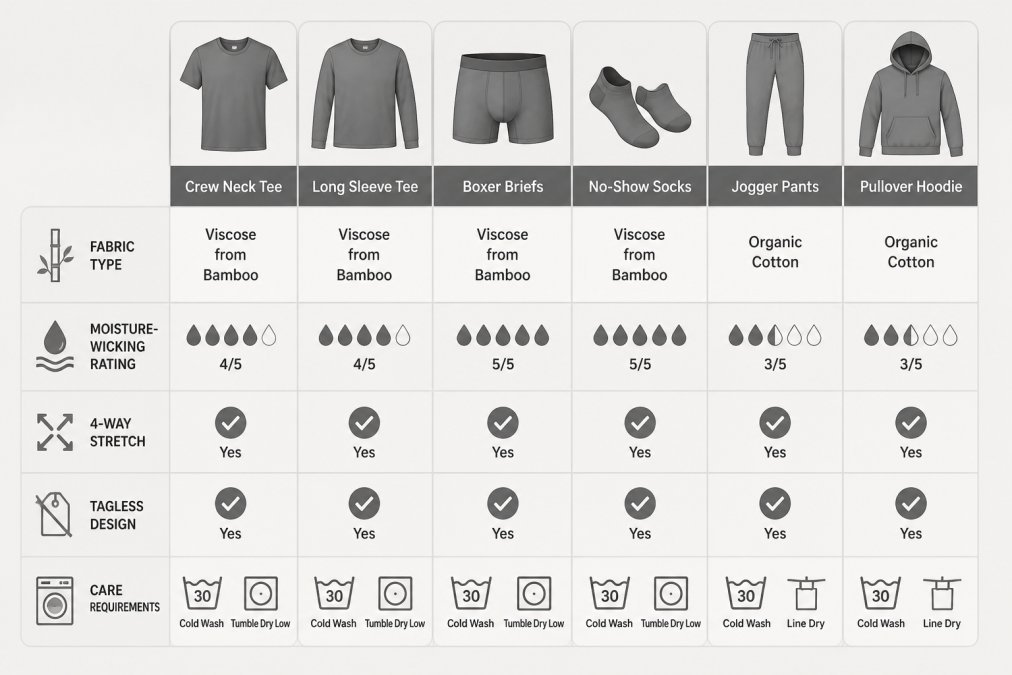
| Product | Fabric | Wicking | Best For |
|---|---|---|---|
| Viscose From Bamboo Crew Tee | Viscose from bamboo | High | Everyday wear |
| Organic Cotton Boxer Brief | Organic cotton | Moderate | Daily comfort |
| Viscose From Bamboo Athletic Tee | Viscose from bamboo | High | Gym and training |
| Organic Cotton Crew Tee | Organic cotton | Moderate | Casual wear |
| Viscose From Bamboo Boxer Brief | Viscose from bamboo | High | All-day wear |
| Organic Cotton Athletic Tee | Organic cotton | Moderate | Light activity |
1. Mellow Mile Viscose From Bamboo Crew Tee
The crew tee is the everyday workhorse, cut from viscose from bamboo for a soft-touch feel and a drape that does not cling. One reviewer wore it for a six-mile run in August humidity and said it "didn't cling to me at mile 4 like my usual shirts do." Another called it the "softest shirt I own." Fit runs true to size, though one customer noted it runs slightly long at 5'8".
2. Mellow Mile Organic Cotton Boxer Brief
Organic cotton is a natural fiber that breathes differently than synthetics. These boxer briefs are made with GOTS certified organic cotton, which meets a recognized organic standard covering fiber production and processing. The waistband does not roll, a detail that matters over a 12-hour day. One customer who switched his entire drawer said they "breathe way better than my old synthetic pairs." Organic cotton wicks less aggressively than viscose from bamboo, so these suit daily wear more than heavy sweat sessions.
3. Mellow Mile Viscose From Bamboo Athletic Tee
This is the piece built for training. The viscose from bamboo knit moves moisture away from skin and dries faster than cotton, keeping you cooler during a workout. One reviewer noted it "doesn't hold smell like my polyester stuff" after a double gym session. Another wore it on the range in 95-degree heat and said it "stayed cool, which is a first." The athletic cut gives a fuller range of motion than the crew tee.
4. Mellow Mile Organic Cotton Crew Tee
The organic cotton crew tee is the casual option, made with GOTS certified organic cotton and built for slow mornings, errands, and light activity. Organic cotton is softer over time and holds its shape with proper care. The trade-off is dry time: organic cotton absorbs more moisture and releases it slowly, so it is not the shirt for a hard workout.
5. Mellow Mile Viscose From Bamboo Boxer Brief
Underwear is where fabric choice shows up fastest. These boxer briefs use viscose from bamboo for moisture management and a soft-touch finish. One cyclist said there was "no riding up on the bike." A customer three months into heavy rotation reported the elastic still felt new, where his previous brand had stretched out by month two. The design is simple, with no oversized logo band.
6. Mellow Mile Organic Cotton Athletic Tee
The organic cotton athletic tee blends natural fiber comfort with a cut built for movement, suiting light training, walking, and everyday activity where you want breathability without synthetic fabric. Because organic cotton is a natural fiber, it manages moisture differently than viscose from bamboo: it absorbs sweat and releases it slowly, so it works best for lower-intensity activity. The construction is durable, and the fabric is free from chemical finishes like PFAS.
How to Wash Viscose From Bamboo Clothing
Most care guides tell you what to do. This one explains why, because the reasons matter when you are deciding whether to risk the dryer.
The Wash Routine That Works
- Machine wash cold on a gentle or delicate cycle. Cold water limits swelling and slows dye bleed; the gentle cycle reduces the agitation that stresses wet fiber.
- Turn garments inside out. This puts abrasion on the inside face instead of the outside, preserving the surface finish that gives the fabric its soft hand.
- Use a mild liquid detergent. Powder detergents can leave residue that dulls the hand over time. Skip bleach entirely, it attacks the cellulose backbone.
- Skip fabric softener. Softener deposits a waxy coating that blocks moisture transport.
- Wash with similar colors and weights. Heavy denim against a light knit in the same load is where pilling starts.
Drying: The Part That Actually Matters
Heat is the enemy. Viscose from bamboo shrinks under high dryer heat because the fiber contracts as moisture leaves it under thermal stress. Once that happens, the fit does not come back.
- Hang dry or lay flat to dry. This is the default.
- If you must machine dry, use the lowest heat setting and remove while slightly damp. Then hang to finish.
- Never dry on high heat. This is the most common way people ruin viscose from bamboo garments.
A 6-Month Wash Test: What Actually Happens
Product descriptions do not tell you how a garment holds up after 30 wash cycles. Here is what a six-month rotation looks like for a viscose from bamboo tee washed cold and hang dried twice a week, roughly 50 cycles:
- Cycles 1-10: no visible change. Hand stays soft, color holds, no pilling at the underarm or collar.
- Cycles 10-25: slight relaxation in the body of the knit, so the shirt drapes a little more than it did new. This is normal for cellulosic knits, the loop structure settling, not shrinkage.
- Cycles 25-50: the hand softens further, with no pilling on a smooth-finished knit. Pilling usually comes from abrasion against heavier fabrics in the same load, not the wash cycle itself.
- What kills a viscose from bamboo tee early: high-heat drying, chlorine bleach, and washing with zippers or velcro that snag the surface.
Stain Removal Without Damaging the Fiber
Treat stains promptly with cold water and a mild detergent. Hot water sets protein-based stains and stresses the fiber. For oil-based stains, a drop of dish soap worked in with fingertips before washing is usually enough. Blot, do not scrub.
Storage and Between-Wash Care
OEKO-TEX STANDARD 100 testing criteria sets limits on harmful substances in textiles. The Class I level applies the limits used for baby articles, which is the strictest tier in the standard.
Frequently Asked Questions
Is viscose from bamboo moisture-wicking?
Yes, viscose from bamboo has moisture-wicking properties that help move sweat away from your skin. The fiber structure creates tiny channels that pull moisture to the surface where it evaporates faster than cotton alone. This makes it a strong choice for activewear, base layers, and underwear. Mellow Mile uses viscose from bamboo in several pieces designed for gym sessions, outdoor activity, and everyday wear.
What is the difference between viscose from bamboo and synthetic performance fabrics?
Viscose from bamboo is a regenerated cellulosic fiber made through chemical processing. Synthetic performance fabrics like polyester are petroleum-based. Viscose from bamboo offers soft-touch comfort and breathability, while synthetics often prioritize quick-dry speed and compression. Viscose from bamboo tends to feel cooler against skin and resists odor buildup better than many synthetics, though it may not match the same tensile strength for high-impact sports.
How do I care for my viscose from bamboo apparel to maintain quality?
Wash viscose from bamboo clothing in cold water on a gentle cycle with like colors. Turn garments inside out to reduce surface friction. Avoid fabric softeners and bleach, which break down fibers. Tumble dry on low or hang dry to prevent shrinkage and maintain drape. If ironing, use low heat. Following these steps helps preserve softness, anti-pilling performance, and fit over many washes.
What should men look for when buying non-toxic activewear?
Check for certifications like OEKO-TEX STANDARD 100, which tests for harmful substances, and GOTS for organic cotton. Look for brands that disclose whether finishes like PFAS are used. Prioritize tagless designs, ergonomic fit, and fabric blends that match your activity. Mellow Mile uses OEKO-TEX STANDARD 100 certified fabric and made with GOTS certified organic cotton in its line, with small-batch production for quality control.