


Why Organic Cotton Lasts Longer: Fiber Science Guide
Table of Contents
- Why Organic Cotton Lasts Longer: The Fiber Integrity Factor
- Why Organic Cotton Lasts Longer: The Fiber Integrity Factor
- Organic Cotton vs Conventional Cotton Durability: A Side-by-Side Look
- How to Wash Organic Cotton Clothes Without Shortening Their Life
- The Quality of Staple Factor: Why Longer Fibers Resist Pilling
- Wash-Cycle Testing and Micro-Fiber Shedding: What the Data Shows
- How Mellow Mile Applies These Principles to Everyday Essentials
- Conclusion: Choosing Organic Cotton That Earns Its Place in Your Drawer
- Frequently Asked Questions
Last Updated: September 25, 2026
Why Organic Cotton Lasts Longer: The Fiber Integrity Factor
Organic cotton lasts longer because it is grown and processed in ways that preserve the fiber's natural structure. Fiber integrity is the measure of how intact a cotton fiber stays through growing, ginning, spinning, and washing. When that structure survives, the fabric resists thinning, pilling, and tearing for far more wash cycles.

Why Organic Cotton Lasts Longer: The Fiber Integrity Factor
Staple Length and Fiber Maturation
Staple length is the length of an individual cotton fiber, and longer staples make stronger yarn. Organic cotton is often harvested after fuller maturation, so fibers grow longer before picking. Longer fibers mean more points of contact when spun into yarn, so the yarn holds together under tension instead of slipping apart.
- Longer staple = stronger yarn
- Fuller maturation = fewer weak points
- Fewer weak points = slower wear at stress areas
Chemical Processing and Tensile Strength
Tensile strength is how much pulling force a fiber can take before it breaks. Harsh chemical processing can strip the natural wax coating that protects each fiber, keeping it flexible and reducing friction between fibers.
Organic Cotton vs Conventional Cotton Durability: A Side-by-Side Look
Organic cotton and conventional cotton differ most in how they are grown and finished, and those differences shape durability.
| Factor | Organic Cotton | Conventional Cotton |
|---|---|---|
| Pesticide use | Synthetic pesticides avoided | Synthetic pesticides used |
| Fiber wax coating | Often better preserved | Frequently stripped |
| Tensile strength over time | Holds up longer | Declines faster |
| Pilling risk | Lower with longer staple | Higher with shorter staple |
| Soil health impact | Supported by organic methods | Depends on chemical inputs |
Pesticide Residue and Fiber Degradation
Pesticide residue can remain on conventional fiber and interact with finishing agents, weakening the fiber over time. Organic farming avoids synthetic pesticides, so there is less residue to react with.
Softening Agents and Mechanical Stress
Softening agents coat fabric to make it feel smooth. Some sit on the surface and wash away, taking fiber strength with them, and mechanical stress from tumbling then wears the exposed fibers faster.
How to Wash Organic Cotton Clothes Without Shortening Their Life
Washing organic cotton clothes well comes down to three habits: cold water, low heat, and less agitation. Heat and friction break fibers down, not the water itself.
- Wash in cold water to reduce fiber stress
- Turn garments inside out to cut surface friction
- Use a gentle cycle with like fabrics
- Skip fabric softener and use a mild detergent
- Hang dry or tumble on low heat
- Wash less often when a garment isn't dirty
The Quality of Staple Factor: Why Longer Fibers Resist Pilling
Staple length is the average length of an individual cotton fiber, measured in millimeters or fractions of an inch. It is the single most useful number for predicting how a cotton garment will wear.
What Counts as Long Staple
Cotton is graded in broad staple bands. The exact cutoffs vary by grading system, but the practical ranges are consistent:
- Short staple: roughly under 1 inch (about 25 mm). Common in mass-market cotton and in recycled fiber blends.
- Medium staple: roughly 1 to 1⅛ inches (about 25-29 mm). The bulk of conventional apparel cotton.
- Long staple: roughly 1¼ inches and up (about 32 mm and up). Includes varieties like Pima and Egyptian cotton.
- Extra-long staple (ELS): roughly 1⅜ inches and up (about 35 mm and up). The top of the range.
How Staple Length Becomes Yarn Strength
Spinning twists fibers around each other. Every fiber overlaps its neighbors along the yarn, and those overlaps are the friction points that hold the structure together under tension.
- A 1⅜-inch fiber overlaps far more neighbors per inch of yarn than a ¾-inch fiber.
- More overlaps mean more resistance to fiber slippage when the yarn is pulled.
- Fewer slippage points mean fewer thin spots where a hole can start.
Fiber Migration and the Pilling Cycle
Pilling is a four-step process, and staple length influences every step:
- Fiber ends work loose from the yarn surface through abrasion and flexing.
- Loose ends tangle with each other into small knots.
- Pills anchor to the fabric as long as there are enough surface fibers holding them.
- Pills shed once the anchoring fibers break, which is why a pilled garment also looks thinner.
Weave and Knit Density: The Second Variable
Fabric construction also sets how tightly the fibers are held:
- Higher yarn count (finer yarns, more of them) packs more fibers per square inch.
- Tighter knit gauge reduces the gaps where loose fibers can escape.
- Higher twist per inch grips fibers harder but can make fabric feel stiffer.
How to Tell Long-Staple Cotton Without a Lab
You cannot measure staple length at home, but you can read the signals:
Organic Cotton Boxers – Wrapped →
- Look for named varieties on the label, Pima, Supima, and Egyptian cotton are long-staple or ELS by definition.
- Check the hand feel. Long-staple cotton tends to feel smoother and slightly denser, not fuzzy.
- Check the price band. Long-staple fiber costs more to grow and process, so a suspiciously cheap "Pima" claim is worth a second look.
- Check the ply. Two-ply yarns twist two strands together, which adds strength independent of staple length.
Why This Matters More Than the Organic Label Alone
Organic farming protects fiber integrity by avoiding the aggressive chemical processing that strips the natural wax coating. Staple length determines how much strength that intact fiber can deliver. The two factors compound: a long-staple fiber that keeps its wax coating holds up better than either a stripped long-staple fiber or a gently handled short-staple fiber.
Wash-Cycle Testing and Micro-Fiber Shedding: What the Data Shows
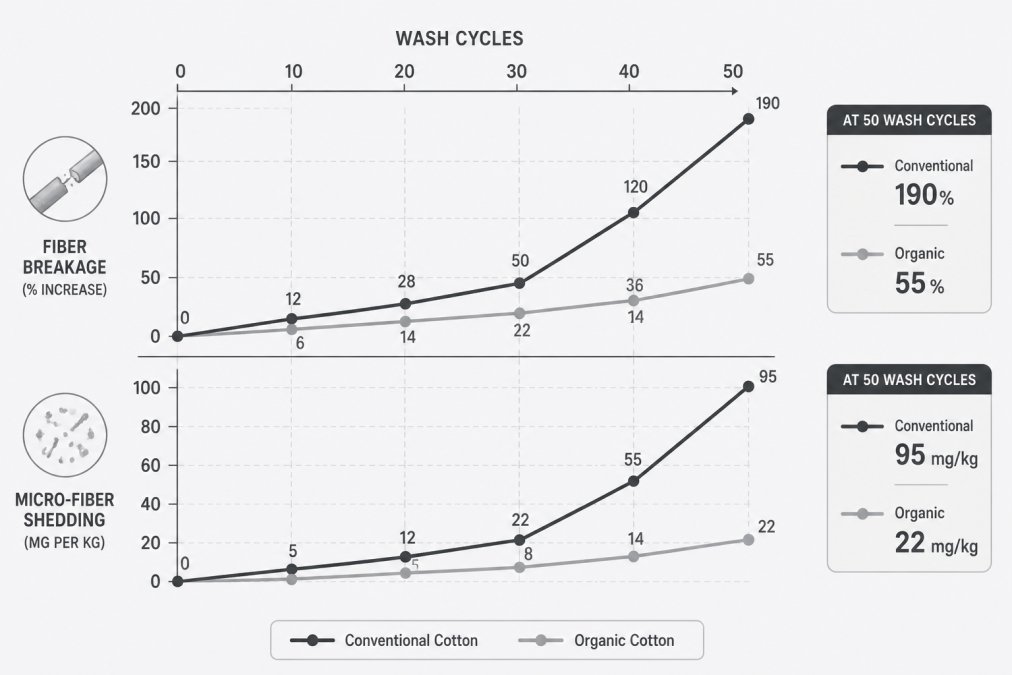
Most articles stop at "no chemicals means stronger." That skips the two mechanisms that actually decide how a cotton garment ages: how much fiber it sheds in the wash, and how fast it loses tensile strength across repeated cycles. Both are measurable.
How a Wash-Cycle Test Actually Works
A controlled wash test is straightforward, even when exact numbers vary by fabric weight, yarn count, and machine. A typical protocol:
- Cut matched swatches from the same fabric weight and weave, one organic, one conventional, so the only variable is the fiber source.
- Record dry mass, yarn count, and fabric thickness before the first cycle.
- Run identical cycles at the same temperature, detergent dose, load size, and agitation setting.
- Dry every swatch the same way, line dry or the same low-heat tumble setting, because dryer heat alone can dominate the results.
- Weigh each swatch after drying to capture mass loss, and filter the wash water to collect shed fiber fragments.
- Measure tensile strength at set intervals, commonly every 10 cycles, using a strip test that pulls the fabric until it breaks.
What the Curves Typically Show
A common pattern reported by textile testing labs is a slow, roughly linear loss of strength for well-preserved long-staple cotton versus a steeper curve for short-staple or heavily finished fabric. The divergence usually widens after 20 to 30 cycles, when shorter fibers have worked loose and the yarn structure starts to thin.
Why Shedding and Durability Are the Same Story
Micro-fiber shedding is not separate from durability. It is the visible symptom of fiber breakage, every shed fragment is a fiber no longer reinforcing the yarn. Three mechanisms drive it:
- Mechanical abrasion in the drum rubs fiber ends against each other and against the fabric surface.
- Fiber fatigue from repeated wet-dry and flex cycles cracks brittle fibers at their weakest points.
- Yarn slippage lets short fibers migrate out of the twist, where they tangle into pills or wash away.
What This Means for Your Drawer
The practical takeaway is a direction, not a number. If two garments start at similar weight and weave, the one made from longer, less-processed fiber loses mass and strength more slowly across the same wash schedule, which is why wash habits (cold water, low heat, less agitation) matter as much as the fiber itself.
How Mellow Mile Applies These Principles to Everyday Essentials
Mellow Mile builds essentials for men who want real durability. Our Organic Cotton Boxers - Wrapped are made with GOTS certified organic cotton and dyed with OEKO-TEX certified dyes. The listing notes an organic cotton wrapped waistband, breathable and lightweight fabric, and no synthetic blends.
Conclusion: Choosing Organic Cotton That Earns Its Place in Your Drawer
The fiber science is clear: longer staple, gentler processing, and better wash habits add up to a garment that lasts. Choosing well means reading labels, checking certifications, and caring for what you buy instead of replacing it every season.
Frequently Asked Questions
Why does organic cotton fiber hold up better over time?
Organic cotton is typically grown without the synthetic pesticides and defoliants used in conventional farming, and it is often processed without the harsh chemical finishing agents that can weaken fibers. Longer staple length and slower fiber maturation mean fewer fiber breakage points during spinning and washing. The result is a fabric that resists pilling, thinning, and loss of shape across repeated wash and wear cycles.
Does organic cotton lose its shape after washing?
Organic cotton can shrink slightly on the first wash, especially in hot water or a hot dryer. To protect shape, wash in cold water on a gentle cycle and hang dry or tumble on low. Following the consumer care instructions on the label preserves fiber integrity and prevents the mechanical stress that causes stretching or distortion over time.
Is organic cotton more resistant to pilling than conventional cotton?
Yes, in most cases. Pilling happens when short fibers work loose from the fabric weave and tangle into small balls. Organic cotton often has a longer staple length, which means fewer short fibers are available to migrate to the surface. Combined with less mechanical stress from chemical processing, this makes organic cotton less prone to pilling than conventional cotton of similar weight.
How should you care for organic cotton to maximize its lifespan?
Wash in cold water with a mild detergent, avoid fabric softeners and bleach, and turn garments inside out before washing. Skip the dryer when possible; if you use one, choose low heat. These steps reduce fiber degradation and mechanical stress. Mellow Mile's Organic Cotton Boxers, made with GOTS certified organic cotton and OEKO-TEX certified dyes, hold up well under this routine.