


Is Bamboo Fabric Really Non Toxic? A 2026 Guide
Table of Contents
- The Short Answer: What Makes Viscose from Bamboo Different
- Viscose from Bamboo Chemical Processing: What Happens Between Plant and Shirt
- OEKO-TEX STANDARD 100 Fabric Meaning: What That Label Actually Verifies
- Bamboo Viscose vs Organic Cotton: How the Two Compare for Sensitive Skin
- How to Choose Non-Toxic Clothing: A Practical Label-Reading Checklist
- Dyes, Finishes, and What Gets Added After the Fiber Is Made
- Conclusion: Making a Confident Choice for Your Skin
- Frequently Asked Questions
Last Updated: October 15, 2026
The Short Answer: What Makes Viscose from Bamboo Different
Is bamboo fabric really non toxic? The honest answer depends on which fiber you mean. Viscose from bamboo is a semi-synthetic fiber made by dissolving bamboo cellulose in chemicals, then regenerating it into fiber. The plant itself is not what ends up in your shirt.
That distinction matters more than most labels admit. At Mellow Mile, we build our essentials around it, and we think you deserve the full picture rather than a slogan.
Here is the core tension: the word "bamboo" sells softness and purity. The chemistry behind the fiber tells a more complicated story. Below, we break down what happens between plant and shirt, what certifications actually verify, and how to read a label without getting fooled.
Why the Word 'Bamboo' on a Label Doesn't Tell the Whole Story
Viscose from bamboo is a regenerated cellulosic fiber, not a natural fiber. That single sentence explains most of the confusion in this category.
The raw material starts as bamboo cellulose. Then chemical processing breaks that cellulose down and rebuilds it into fiber. What you wear is the rebuilt version.
So a tag that says "bamboo" tells you the source plant. It does not tell you how the fiber was made, what solvents were used, or what got added afterward.
That gap is where marketing lives. It is also where your real questions should start.
Viscose from Bamboo Chemical Processing: What Happens Between Plant and Shirt
Bamboo cellulose gets extracted, dissolved in a chemical bath, and pushed through spinnerets to form new fibers. Those fibers are washed, dried, spun into yarn, then knit or woven into fabric. Each stage can introduce or remove residues.
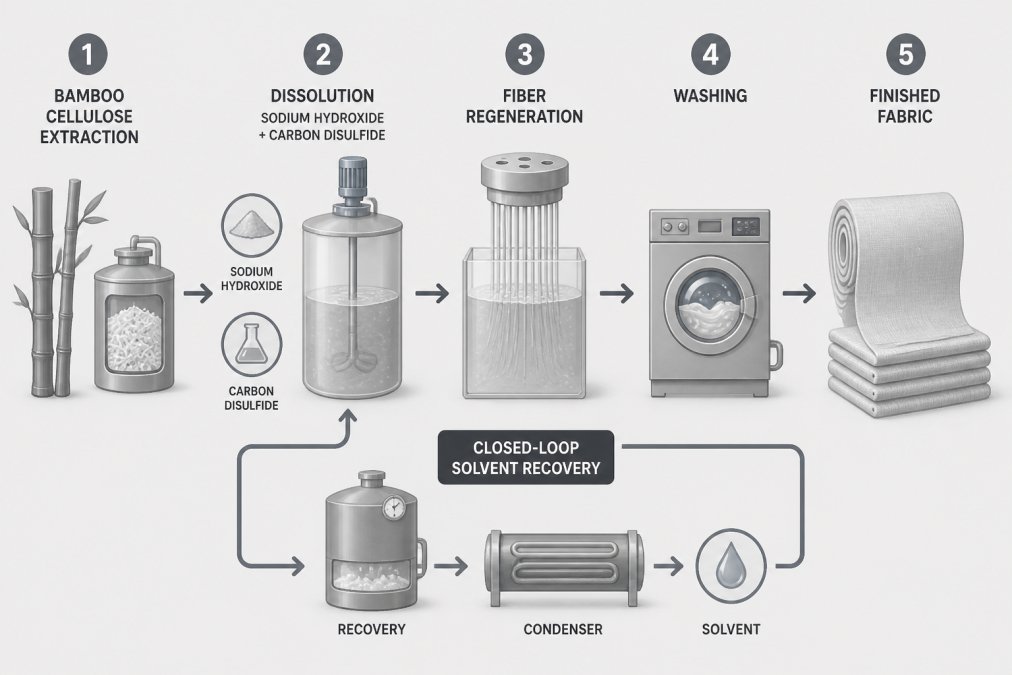
Mechanical vs. Chemical Processing: A Critical Difference
Mechanical processing crushes and combs plant stalks to separate fiber. It uses no dissolving chemicals. Linen and hemp are often made this way.
Chemical processing dissolves cellulose and regenerates it. Viscose, rayon, and lyocell all fall here. The fiber is manufactured, not extracted.
That is not automatically bad. It does mean the finished textile is a product of industrial chemistry, and the process deserves scrutiny.
The Solvents Involved and Why Closed-Loop Production Matters
The classic viscose route uses sodium hydroxide and carbon disulfide. Carbon disulfide is the one that draws attention, mainly for worker exposure during manufacturing.
Lyocell takes a different path. It uses an amine oxide solvent in a closed-loop system, where most of the solvent is captured and reused.
Here is the part most guides get wrong. Solvent handling is largely a factory-floor and environmental story. Trace residues in finished fabric are a separate question, and that is the one your skin actually meets.
OEKO-TEX STANDARD 100 Fabric Meaning: What That Label Actually Verifies
OEKO-TEX STANDARD 100 is a testing standard for harmful substances in finished textile articles. (OEKO-TEX® STANDARD 100) It tests the fabric, not the fiber's origin story.
The standard sets limit values for a long list of substances, including certain dyes, heavy metals, and formaldehyde. Testing happens on the article as it would reach you.
This is the certification that speaks most directly to skin contact. It answers "what is in this fabric?" rather than "how was this fiber grown?"
Class I, Class II, and What the Testing Levels Mean for Your Skin
The standard has product classes based on how intimate the contact is. Class I is the strictest, tested against the limits used for baby articles. Class II covers products worn close to the skin.
For a shirt or a pair of boxers, Class II is the relevant tier. Class I goes further. Either way, the label should say the fabric is made with OEKO-TEX STANDARD 100 certified material, not that the brand holds the certification.
That wording difference is a real signal. Brands that understand the standard describe it precisely.
Bamboo Viscose vs Organic Cotton: How the Two Compare for Sensitive Skin
Organic cotton is a natural fiber. Viscose from bamboo is a regenerated cellulosic. They behave differently on skin and they carry different certification paths.

| Factor | Viscose from Bamboo | Organic Cotton |
|---|---|---|
| Fiber type | Regenerated cellulosic | Natural fiber |
| Feel | Silky, cool, drapes | Soft, matte, structured |
| Moisture handling | Absorbs and dries fast | Absorbs, holds more |
| Certification path | OEKO-TEX testing on finished fabric | GOTS covers growing and processing |
| Best for | Workouts, humid days | Everyday wear, sensitive skin |
For sensitive skin, the deciding factor is usually the finish, not the fiber name. A fabric made with OEKO-TEX STANDARD 100 certified material gives you a documented answer on residues.
Our Organic Cotton Boxers are made with GOTS certified organic cotton and dyed with OEKO-TEX certified dyes. Our Athletic Tee uses 95% viscose from bamboo with 5% elastane, dyed the same way. Different fibers, same discipline on what touches skin.

How to Choose Non-Toxic Clothing: A Practical Label-Reading Checklist
Start with the fiber content, then work outward to certifications, dyes, and finishes. The label rarely tells you everything, but it tells you more than most shoppers read.
- Read the fiber content line first: viscose from bamboo, organic cotton, or a synthetic blend
- Look for OEKO-TEX STANDARD 100 on the fabric, and check which class applies
- For cotton, look for GOTS, which covers growing and processing
- Check for "PFAS-free" or "no fluorinated finishes" claims, and ask for the test report
- Note the dye disclosure: OEKO-TEX certified dyes are a documented answer
- Be skeptical of bare "bamboo" with no process detail
- Ignore "antibacterial" claims tied to the bamboo plant; they do not survive processing
Dyes, Finishes, and What Gets Added After the Fiber Is Made
The fiber is only half the story. After the yarn is knit or woven, a garment passes through dyeing, washing, softening, and sometimes finishing steps. Those treatments sit directly against skin, and they are the part of the supply chain most articles about bamboo viscose skip entirely.
Dyes: What Class of Colorant Was Used
Textile dyes are not one category. The classes most relevant to skin contact include:
- Reactive dyes, used heavily on cellulosic fibers like viscose and cotton. They bond chemically to the fiber, which generally means less dye washes off in use. Quality varies widely by dyehouse.
- Direct dyes, which sit on the fiber rather than bonding to it. They can bleed and may require more after-treatment.
- Disperse dyes, used mainly on synthetics but sometimes on blends. Certain disperse dyes are a known sensitizer for some people with contact dermatitis.
- Azo dyes, a broad chemical family. Some azo dyes can break down into aromatic amines that are restricted in textiles. The OEKO-TEX STANDARD 100 limit list includes specific restricted azo colorants.
A brand that says "OEKO-TEX certified dyes" is usually referring to dyes that meet the STANDARD 100 restricted-substance limits, not a separate dye certification. The precise wording matters: the fabric is made with OEKO-TEX STANDARD 100 certified material, and that testing covers the dyes used on it.
Finishes: The Treatments Applied for Performance
Finishing is where a lot of the chemistry that touches skin gets added. Common categories:
- Softeners and silicones, applied to improve hand-feel. Most are rinsed or bound, but residue levels depend on the process.
- Wrinkle-resistant and easy-care finishes, often formaldehyde-based resins on cotton and cellulosics. Formaldehyde is on the OEKO-TEX restricted list, with limits that vary by product class.
- Stain and water repellents, historically fluorinated. PFAS (per- and polyfluoroalkyl substances) have been widely used in apparel for water and stain resistance. A growing number of U.S. states have restricted PFAS in textiles, and brands increasingly market "PFAS-free" as a result.
- Antimicrobial treatments, added to some garments to control odor. These are separate from any claim about the fiber itself. A finish that inhibits odor is a chemical treatment, not a property of viscose from bamboo.
How Exposure Actually Happens
For a consumer, the relevant exposure routes are skin contact, inhalation of volatiles from a new garment, and, for infants and young children, mouthing of fabric. The dose from a finished, washed garment is generally low, but the categories above are the ones that testing standards are designed to catch.
A practical habit: wash new garments before wearing. Washing removes some surface residues from dyes, softeners, and finishing agents. It does not remove chemically bound finishes, which is why the label and the certification matter more than the wash.
The fiber name gets the marketing. The dye and finish get the skin contact. Judge a garment on both, and ask for documentation on the second one, a certificate number you can check, not just a logo.
Conclusion: Making a Confident Choice for Your Skin
The label question is fair, and the answer is not a simple yes or no. Viscose from bamboo is a manufactured fiber with a chemical process behind it, and the residues that matter most are the ones left in the finished fabric.
That is why we lean on certifications over adjectives. Our tees are made with OEKO-TEX STANDARD 100 certified fabric, and our cotton pieces use GOTS certified organic cotton. Small-batch production keeps the details visible.
If you want apparel you can trace on paper, not just in a slogan, sign up for 20% off and see the difference for yourself.
Frequently Asked Questions
Is viscose from bamboo all natural?
No. Viscose from bamboo is a regenerated cellulosic fiber, which means it is semi-synthetic. The bamboo plant provides the cellulose, but that cellulose goes through chemical processing using solvents like sodium hydroxide and carbon disulfide to become a spinnable fiber. The finished material is not a natural fiber in the way organic cotton or linen is. This distinction matters when you are evaluating labels and marketing claims.
Does viscose from bamboo fabric contain harmful chemicals?
The fiber itself is cellulose, but residues from processing and from dyes or finishes can remain in the finished fabric. That is why certifications matter. Fabric made with OEKO-TEX STANDARD 100 certified material has been tested against limits for harmful substances. When you are choosing non-toxic clothing, look for that testing rather than relying on the fiber name alone.
Is viscose from bamboo hypoallergenic?
Viscose from bamboo is often described as gentle on skin because it is soft and breathable, but hypoallergenic is a specific claim that depends on the finished product, not just the fiber. Dyes, finishes, and how the garment was processed all affect how your skin reacts. If you have sensitive skin, prioritize items made with OEKO-TEX STANDARD 100 certified fabric and OEKO-TEX certified dyes, and wash before wearing.
How can you tell whether clothing has been tested for harmful substances?
Look for a certification label or hangtag that names the standard. OEKO-TEX STANDARD 100 is the most common for textiles and means the fabric was tested against limits for harmful substances. Class I is the strictest level and means the fabric was tested against the limits used for baby articles. If a brand cannot point to a specific certification, the claim is harder to verify.