


Is Small Batch Clothing Worth It? A 2026 Cost Guide
Table of Contents
- Small-Batch vs Mass-Produced Clothing: What Actually Changes
- Small-Batch Clothing Pros and Cons
- The Real Cost: Clothing Cost Per Wear Explained
- How to Evaluate Clothing Quality Before You Buy
- A Cost Comparison Table: Small-Batch vs Mass-Produced
- When Small-Batch Clothing Is Worth It (and When It Isn't)
- Conclusion
- Frequently Asked Questions
Last Updated: October 18, 2026
Small-Batch vs Mass-Produced Clothing: What Actually Changes
Small batch clothing is apparel made in limited production runs, usually through a smaller factory or production partner, rather than in the tens of thousands of units mass production requires.
The difference that matters most is the production run itself.
Most guides frame this as a quality-versus-price story. In practice, it's an inventory-risk story.
A common approach for first-time founders is to start with a low minimum order quantity and scale once demand testing proves the design sells.
Small-Batch Clothing Pros and Cons
The pros are real, and so are the trade-offs. Small-batch clothing gives you tighter quality control, more product flexibility, and less exposure to trend changes that strand inventory. You can test a new color or silhouette without committing to thousands of units.
The cons deserve equal weight:
- Higher unit cost. Setup and labor spread across fewer pieces, so each garment costs more to make.
- Longer lead times per unit. Sampling and small runs often queue behind larger factory clients.
- Limited sizing depth. A small run means fewer units per size, and extended sizes can sell out first.
- Fewer colorways. Custom fabric and dyes usually require larger minimums, so new colors arrive slowly.
The Real Cost: Clothing Cost Per Wear Explained
Cost per wear is the purchase price divided by the number of times you actually wear the item.
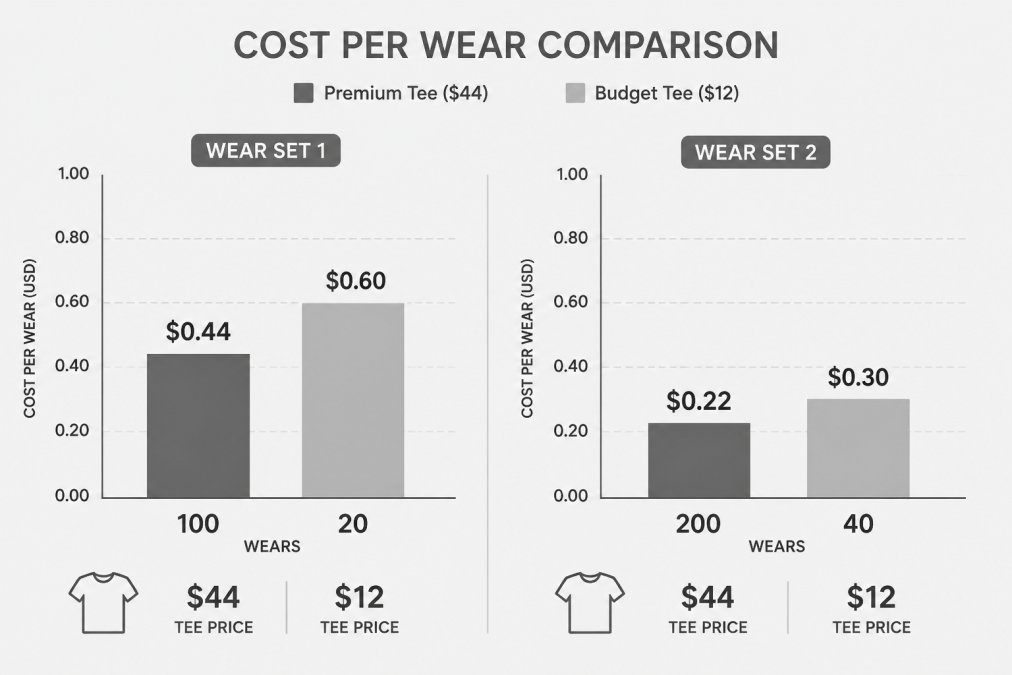
Run the math on a $44 tee worn 100 times: that's $0.44 per wear. A $12 tee worn 20 times before it pills or loses shape works out to $0.60 per wear. The cheaper shirt cost more to own.
The lesson isn't "always buy expensive." Durability decides the equation: a garment has to survive repeated washing and wearing to earn its price back.
How to Evaluate Clothing Quality Before You Buy
Quality shows up in construction details, not marketing copy. Check the fiber content label first: composition tells you more about how a garment will wear than any product description.
Then look at these specifics:
- Stitch density. Dense, even stitching at seams and hems resists splitting.
- Seam finishing. Flatlock or reinforced seams handle movement better than raw edges.
- Fabric weight and hand feel. A fabric that feels substantial usually drapes and holds shape longer.
- Certifications on the label. Fabric certifications tell you what testing the material went through.
- Care instructions. Honest care guidance signals the maker expects the garment to last.
At Mellow Mile, our Organic Cotton Boxers are made with GOTS certified organic cotton and dyed with OEKO TEX certified dyes, and our Athletic Tee is made with OEKO-TEX STANDARD 100 certified fabric, specifics you can verify rather than take on faith.

A Cost Comparison Table: Small-Batch vs Mass-Produced
The table below compares the two production models across the factors that decide whether a purchase or a brand launch makes financial sense.
| Factor | Small-Batch Production | Mass Production |
|---|---|---|
| Minimum order quantity | Low, often dozens of units | High, often thousands |
| Unit cost | Higher per piece | Lower per piece |
| Startup investment | Smaller upfront outlay | Large upfront commitment |
| Lead time per run | Longer relative to volume | Shorter per unit at scale |
| Inventory risk | Limited unsold stock | High exposure to overproduction |
| Quality control | Tighter oversight per unit | Sampled, not piece by piece |
| Customization | Easier to test new colors | Costly to change mid-run |
| Reorder speed | Quick for proven styles | Slow to adjust |
The pattern is consistent: small-batch production trades unit cost for flexibility and lower inventory risk. Mass production trades flexibility for a lower price per piece, provided you can sell the volume.
Where the Money Actually Goes
A table of factors doesn't tell you whether a small run pays for itself. Break the total cost of a run into its parts; most production partners quote a per-unit price that hides four other line items:
- Setup and pattern costs. Digitizing a pattern, grading sizes, and preparing screens or dye lots are one-time costs per style. On a small run, these are spread across few units; on a large run, they nearly disappear per piece.
- Sampling costs. Most factories charge for sample rounds, and a first-time style often needs two or three before approval. Samples are a fixed cost regardless of final run size.
- Unit cost. Fabric, trim, cutting, sewing, and finishing. This is the number most quotes lead with, and the one that falls fastest with volume.
- Freight and duties. Shipping a small run costs disproportionately more per unit because container and customs costs don't scale down with quantity.
- Storage and carrying cost. Unsold inventory ties up cash and incurs warehousing, insurance, and markdown risk. This is the cost mass production hides until the season ends.
A Worked Break-Even Example
Because per-unit quotes vary widely by fabric and factory, the useful exercise is the structure of the math, not a single number. Here's how to model it with your own quotes.
Suppose a small run of a basic tee carries a $2,000 setup and sampling cost, a $14 unit cost, and $1,000 in freight and duties for the run.
The small run costs more than twice as much per unit, but it only requires selling 200 units to clear your investment; the large run requires 1,000.
The Hidden Cost of Unsold Stock
Mass production's lower unit cost only materializes if the units sell at full price. Unsold stock carries real costs: warehousing, insurance, cash that could have funded the next style, and eventual markdowns. A brand that orders 1,000 units at $13.50 landed, sells 600 at full price, and marks down the remaining 400 often ends up with a higher effective cost per sold unit than a brand that ordered 200 at $29 and sold out. What matters is cost per unit sold, not cost per unit produced.
When Small-Batch Clothing Is Worth It (and When It Isn't)
Small batch clothing is worth it when durability and material quality matter more than the lowest sticker price, and when a brand needs to test demand before committing capital.
For buyers, the decision comes down to how long you'll keep the garment. Wear a piece weekly for years and the higher upfront price usually pays back; need a costume for one event and it won't.
For founders, the answer depends on your stage and how certain you are about demand.
A Decision Framework by Brand Stage
- First launch, unproven design. Stay small. The purpose of the first run is to learn whether the silhouette sells, not to maximize margin. A small run limits your exposure if the design misses and gives you real sell-through data before a larger order.
- Proven bestseller with steady reorders. Increase the run. Once a style has demonstrated repeat demand, setup and sampling costs are already sunk, and a larger order brings the unit cost down. This is where mass production's price advantage actually applies.
- Seasonal or trend-driven designs. Stay small even if you could afford more. Trend windows are short, and unsold seasonal stock is the most expensive inventory a brand can carry because it rarely sells at full price the following year.
- Core basics with predictable demand. A larger run makes sense. Basics sell steadily across seasons, so the inventory risk of a bigger order is lower than for a trend piece.
- Uncertain demand or a new category. Start small and plan a reorder rather than a large first order. The reorder lead time, not the first order, determines whether you can keep up if the style sells.
Plan the Reorder, Not Just the First Run
A small batch is only worth it if you can replenish before you sell out. Map the full timeline before you commit: design and pattern work, sampling rounds, material sourcing, production, freight, and customs clearance.
A common pattern is to treat the first run as a demand test and the second as the profit run. That only works if the second run arrives before the first sells out, so build a reorder buffer into your timeline.
Quality, Consistency, and Defect Rates
Small runs are often described as a quality advantage, but the trade-off is more nuanced. Tighter oversight per unit can catch problems early, and a smaller run makes it easier to inspect a higher share of output.
Sizing consistency is another factor. Small runs are usually cut from a single fabric lot, which helps color and hand-feel consistency, but repeat runs may use a different lot. If you plan to reorder, ask your production partner how they handle lot-to-lot variation and whether they retain your pattern and measurements.
The Environmental Caveat
Small batches are not automatically lower impact. A small run can reduce overproduction and unsold stock, a real waste reduction, but per-unit material, packaging, and transport impacts can be higher because freight and setup costs don't scale down. The honest comparison is between the waste avoided by not overproducing and the higher per-unit footprint of a smaller run. For a brand, the strongest environmental argument for small batches is the inventory you don't produce and don't discard, not the production method itself. Organic cotton is better than traditional cotton.
Conclusion
The honest answer: small-batch clothing is worth it when you're buying for longevity and producing to learn before you scale. It costs more per unit and asks for patience on lead times and colorways.
At Mellow Mile, small-batch production is how we keep oversight on the materials that sit against your skin, from our $44 Athletic Tee to our $24 Organic Cotton Boxers. If that trade-off fits how you buy, sign up for 20% off and see the difference for yourself.

Frequently Asked Questions
Is small-batch clothing worth the extra cost?
It depends on how often you'll wear the item. A $44 tee worn 100 times costs $0.44 per wear; a $12 tee worn 20 times costs $0.60 per wear. Small-batch clothing costs more upfront because runs are smaller and quality control is tighter, but the clothing cost per wear often comes out lower when the garment lasts. If you replace cheap basics every few months, small-batch usually wins on total spend.
Is small-batch clothing better quality?
Not automatically. Small-batch production allows tighter quality control and less pressure to cut corners, but quality still depends on the fabric, construction, and the factory. Use the same checks you'd apply anywhere: fabric weight and content, stitch density, seam finishing, and whether certifications like GOTS or OEKO-TEX STANDARD 100 are named. A small run with poor fabric is still poor quality.
How can you tell whether a small-batch clothing brand is trustworthy?
Look for specifics, not slogans. A trustworthy brand names its fabric composition, cites certifications (for example, made with GOTS certified organic cotton or dyed with OEKO TEX certified dyes), states where garments are cut and sewn, and publishes a clear return policy. Vague claims like 'eco-friendly' without documentation are a warning sign. Also check reviews for durability comments after repeated washes, not just first-impression fit.
Is small-batch clothing more sustainable?
It can reduce overproduction and unsold stock, which are real sources of waste in mass production. But 'small-batch' alone doesn't guarantee an environmental benefit. Ask what the fabric is, how it was processed, and whether the brand documents its claims. Viscose from bamboo, for example, is a semi-synthetic fiber made through chemical processing, so it should never be described as natural or plant-based.