


PFAS-Free Clothing for Men: What to Look For in 2026
Table of Contents
- Why PFAS-Free Clothing for Men Matters
- Quick Comparison: PFAS-Free Essentials for Men
- How to Identify PFAS-Free Clothing
- OEKO-TEX STANDARD 100 Certified Fabric: What It Means for Your Skin
- GOTS Certified Organic Cotton in Men's Essentials
- PFAS in Recycled Polyester vs. Virgin Synthetics
- Budget-Friendly Non-Toxic Alternatives for Men
- Frequently Asked Questions
Last Updated: September 21, 2026
Why PFAS-Free Clothing for Men Matters
Most men's performance apparel is built around finishes nobody lists on the tag. Per- and polyfluoroalkyl substances, better known as PFAS or "forever chemicals," are applied to many synthetic garments as durable water repellent and stain-resistance treatments. For men who sweat through workouts, commutes, and long workdays, that fabric sits against skin for hours. This guide from Mellow Mile breaks down how to spot pfas free clothing for men, which certifications mean something, and where the budget options are hiding.
Quick Comparison: PFAS-Free Essentials for Men
Here's how the essentials stack up when you're shopping for pfas-free clothing. Every item below is made without PFAS-based finishes.
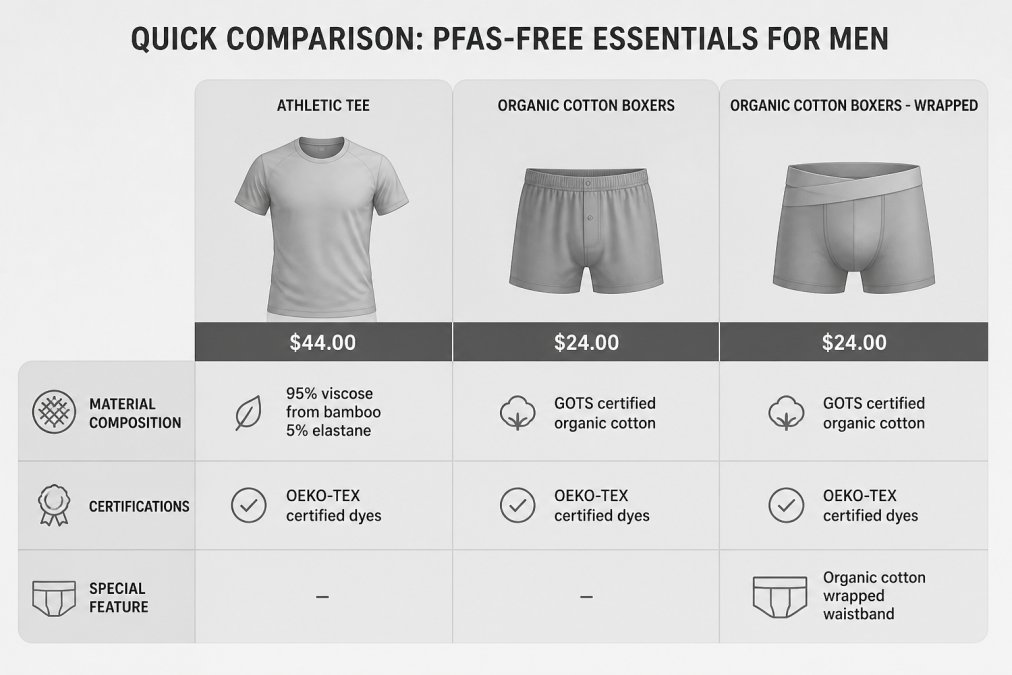
| Product | Price | Fabric | Certification | Best For |
|---|---|---|---|---|
| Athletic Tee | $44.00 | 95% viscose from bamboo, 5% elastane | Made with OEKO-TEX certified dyes | Workouts and daily wear |
| Organic Cotton Boxers | $24.00 | GOTS certified organic cotton | Made with OEKO-TEX certified dyes | Everyday base layer |
| Organic Cotton Boxers - Wrapped | $24.00 | GOTS certified organic cotton | Made with OEKO-TEX certified dyes | Wrapped waistband comfort |
How to Identify PFAS-Free Clothing
Start with the fiber, then check the finish, then verify the certification. That order matters because a natural fiber can still carry a chemical finish, and a synthetic can sometimes be made clean. Reading the FTC guidance on textile labeling helps you understand what brands are legally required to disclose on a care tag versus what they choose to hide.

Look for these signals:
- Fiber content named clearly. "Viscose from bamboo," "organic cotton," "merino wool," and "linen" tell you something. "Performance blend" tells you nothing.
- No water-repellent or stain-release language. These are the finish categories most associated with PFAS.
- A named third-party certification. Vague "chemical-free" claims aren't verifiable. Certifications are.
- OEKO-TEX STANDARD 100 or GOTS on the label. These carry testing requirements behind them.
Labels, Tags, and What They Actually Tell You
A care tag is a legal document, not a marketing brochure. It must list fiber content by percentage, but it does not have to disclose every finish applied during manufacturing. That gap is where most confusion lives.

OEKO-TEX STANDARD 100 Certified Fabric: What It Means for Your Skin
OEKO-TEX STANDARD 100 certified fabric is material tested against a published list of harmful substances and passed. The standard sets limits for residues including certain PFAS compounds, heavy metals, and formaldehyde. Class I, the strictest tier, tests against the limits used for baby articles. A fabric can be certified at different class levels, and the class tells you how strict the limits were.
OEKO-TEX STANDARD 100 explained
GOTS Certified Organic Cotton in Men's Essentials
GOTS certified organic cotton is cotton grown and processed under the Global Organic Textile Standard, which covers organic farming, restricted chemical inputs, and wastewater treatment. Mellow Mile's Organic Cotton Boxers are made with GOTS certified organic cotton, and the organic cotton traces to a producer union in Burkina Faso. Where GOTS matters most is the base layer: underwear sits against skin all day, so the fiber and the dye both count.
PFAS in Recycled Polyester vs. Virgin Synthetics
Recycled polyester is not automatically cleaner than virgin polyester on the chemical front. Both are polyester, and both can be treated with the same durable water repellent (DWR) finishes, where PFAS typically enters the picture. Recycling changes where the plastic came from, not what gets applied afterward. Most buying guides treat "recycled" as a safety signal when it's really an origin label.
Why the Confusion Exists
Two separate claims get merged in marketing copy:
- Feedstock origin, virgin polyester is made from petroleum-derived monomers; recycled polyester is made from post-consumer PET. This is a materials-sourcing fact.
- Finishing chemistry, the DWR, softener, or stain-release treatment applied to the finished fabric. This is a chemical fact.
A garment can be made from 100% recycled polyester and still carry a C6 or C8 fluorochemical DWR. The recycling claim says nothing about the finish. Conversely, a virgin polyester garment with no DWR and no stain-release treatment is not a PFAS concern in the same way, the fiber itself is not the PFAS source.
The Mechanism: How PFAS Gets Into a Garment
PFAS in apparel almost always arrives as a finish, not as a fiber ingredient. The common entry points:
- Durable water repellent (DWR), the coating that makes rain bead up on a shell or jacket. Legacy long-chain fluorochemicals (C8) have largely been phased out by major brands under EPA stewardship pressure, but short-chain fluorochemicals (C6 and others) are still used, and they are still PFAS.
- Stain-release finishes, applied to workwear, khakis, and some dress shirts so spills wipe off. Often fluorochemical-based.
- Certain softeners and anti-wicking agents, less common, but present in some performance knits.
Garment Categories Ranked by Finish Risk
Not every garment carries the same finish load. A rough tiering by how often fluorochemical finishes appear:
| Risk Tier | Garment Type | Why |
|---|---|---|
| Highest | Waterproof/water-repellent shells, rain jackets, ski wear | DWR is the core function |
| High | Stain-resistant workwear, treated khakis, some dress shirts | Stain-release finish is the selling point |
| Moderate | Quick-dry activewear, some compression gear | Wicking and anti-odor finishes vary by brand |
| Low | Plain cotton tees, cotton underwear, linen shirts | No finish needed for the garment to function |
| Low | Viscose from bamboo tees and basics | Soft hand comes from the fiber, not a coating |
What to Ask Instead of "Is It Recycled?"
When you're evaluating a synthetic garment, the useful questions are:
- Does it claim water repellency or stain resistance? If yes, ask what chemistry delivers it. "PFC-free DWR" or "fluorocarbon-free finish" is a specific, checkable claim. "Water-repellent" alone is not.
- Is the finish disclosed at all? Many brands list fiber content and nothing else. That silence is not proof of a finish, but it's not proof of absence either.
- Is there a third-party certification on the fabric? OEKO-TEX STANDARD 100 sets limits for certain PFAS compounds, among other residues, a documented reference point a marketing page does not provide.
Budget-Friendly Non-Toxic Alternatives for Men
Most guides to non-toxic menswear point at the same handful of premium outdoor labels, where a single shell can run into the hundreds. That framing makes the whole category feel expensive. The cheapest path to a lower-finish wardrobe is fewer pieces in fibers that don't need a chemical treatment to do their job, and those fibers are widely available at everyday prices.
The Cost Logic: Why Simple Fibers Are Cheaper
A finish costs money. DWR, stain-release, and anti-odor treatments are added manufacturing steps, applied because the base fabric can't do the job alone. When you buy a plain organic cotton tee or a viscose from bamboo blend, the performance comes from the fiber and the knit, not an applied chemistry, usually at a lower price for the same quality tier.
A Starter Drawer, Built by Priority
If you're replacing a synthetic-heavy drawer on a budget, work in this order:
- Base layer first, underwear and tees. These sit against skin the longest and are the cheapest to swap. Organic cotton boxers and a viscose from bamboo tee cover the two highest-contact slots.
- Next, the workout layer. A viscose from bamboo blend breathes without a wicking finish. You give up some abrasion durability; you keep the soft hand and skip the finish category entirely.
- Then, the everyday shirt. Plain cotton, linen, or a cotton-linen blend. No stain-release claim means no stain-release finish to interrogate.
- Last, the outerwear. Water repellency is the function here. If you need a rain shell, look for a brand that names its finish chemistry ("PFC-free DWR" or "fluorocarbon-free") rather than one that just says "water-repellent."
What "Budget" Actually Looks Like
You don't need a specialty outdoor budget to build a lower-finish drawer. A plain organic cotton tee or a viscose from bamboo tee sits in the same price range as a mid-tier synthetic performance tee, often lower, because you're not paying for the finish. Organic cotton boxers generally land in the same band as conventional cotton or cotton-blend boxers from a mainstream brand.

Where Budget Shoppers Get Tripped Up
Three patterns worth watching for:
- "Recycled" as a price premium. Recycled polyester often costs more than virgin, and it carries the same finish risk. You're paying for the origin story, not a chemical difference.
- "Chemical-free" with no certification. This phrase is not regulated. Without a named standard behind it, OEKO-TEX STANDARD 100, GOTS for the cotton, it's a marketing claim, not a verifiable one.
- Cheap "performance" tees. A low-priced synthetic tee claiming moisture-wicking and odor control is doing something to the fabric to make those claims true. The cheaper the garment, the less likely the brand discloses what that something is.
FTC guidance on textile labeling
Frequently Asked Questions
What are PFAS and why are they used in clothing?
PFAS, or per- and polyfluoroalkyl substances, are synthetic chemicals used to make fabrics water-repellent, stain-resistant, and moisture-wicking. They are often called forever chemicals because they break down very slowly. In clothing, PFAS are most common in performance finishes like durable water repellent (DWR) coatings on activewear, workwear, and outdoor gear. Choosing PFAS-free clothing for men means avoiding garments with these chemical finishes, especially items marketed as water-repellent or stain-proof.
How can I identify if my clothing contains PFAS?
Start by checking the label for terms like water-repellent finish, durable water repellent, or stain-resistant. These are red flags for PFAS. Look for certifications such as OEKO-TEX STANDARD 100, which tests for harmful substances including PFAS. Brands that are transparent about third-party testing and list their certifications are more likely to offer PFAS-free clothing for men. If a garment claims performance without specifying how it achieves it, that is a sign to dig deeper.
Is OEKO-TEX STANDARD 100 certification a reliable indicator of PFAS-free fabric?
OEKO-TEX STANDARD 100 tests for a wide range of harmful substances, including PFAS, and sets strict limits. If a fabric is made with OEKO-TEX STANDARD 100 certified fabric, it has been tested against those limits. However, the certification applies to the fabric, not the finished garment. For men's essentials like tees and boxers, choosing items made with OEKO-TEX STANDARD 100 certified fabric is a practical way to reduce exposure to chemical residues and support your skin health.
What is the least toxic fabric to wear?
Organic cotton and merino wool are natural fibers that are generally considered low-risk for chemical exposure, especially when they carry certifications like GOTS certified organic cotton. Viscose from bamboo is a semi-synthetic fiber made through chemical processing, but when made with OEKO-TEX STANDARD 100 certified fabric, it is tested for harmful residues. The key is to look for third-party certifications and avoid synthetic performance fabrics with water-repellent or stain-resistant finishes, which are common sources of PFAS.
Does organic cotton naturally exclude PFAS?
Organic cotton is grown without synthetic pesticides and processed without certain harsh chemicals, but PFAS can still be added during finishing if the fabric is treated for water repellency or stain resistance. To ensure organic cotton is PFAS-free, look for GOTS certified organic cotton, which restricts chemical inputs throughout the supply chain. Mellow Mile's Organic Cotton Boxers are made with GOTS certified organic cotton and dyed with OEKO-TEX certified dyes, so you get the benefits of organic cotton without PFAS finishes.