


How to Wash Organic Cotton Apparel: A 2026 Care Guide
Table of Contents
- Start With the Care Label on Your Organic Cotton Apparel
- What You'll Need Before You Wash Organic Cotton
- Step-by-Step: How to Wash Organic Cotton Apparel
- The Best Detergent for Organic Cotton Clothes
- Does Organic Cotton Shrink in the Wash?
- How to Dry Organic Cotton Clothes Without Damage
- How Often to Wash Cotton Clothes (and When to Spot Clean)
- Common Mistakes That Ruin Organic Cotton Apparel
- Frequently Asked Questions
Last Updated: October 12, 2026
Start With the Care Label on Your Organic Cotton Apparel
Learning how to wash organic cotton apparel starts with one small step: read the care label sewn inside the garment.

Organic cotton is a natural fiber, but it is not indestructible. Hot water, harsh chemicals, and high heat break down fibers over time.
A few labels to look for:
- Machine wash cold on most cotton underwear and tees
- Tumble dry low or line dry for best results
- Do not bleach on anything dyed
No care label at all? Treat the garment as cold-water, gentle-cycle, air-dry, the safest default for cotton apparel.
What You'll Need Before You Wash Organic Cotton
Gather your supplies before you load the washer. A little prep prevents most of the damage people blame on the fabric.
Total Time: 5 minutes of prep, plus wash and dry time Difficulty: Beginner
Here is what to have ready:
- A mild detergent, free of bleach and optical brighteners
- A mesh laundry bag for delicates or small items
- A stain pre-treatment, such as a little baking soda paste or a drop of gentle detergent
Skip fabric softener entirely, it coats fibers and cuts the softness you paid for. Skip chlorine bleach too, since it weakens cotton and strips dye. Check pockets and close zippers before washing; an open zipper snags knit cotton, and that damage shows up as pulls, not holes.
Step-by-Step: How to Wash Organic Cotton Apparel
Washing organic cotton comes down to six repeatable steps: read the label, turn garments inside out, sort by color, choose cold water and a gentle cycle, add a mild detergent, and air dry. Do those in order and you protect the fabric, the dye, and the fit at the same time.
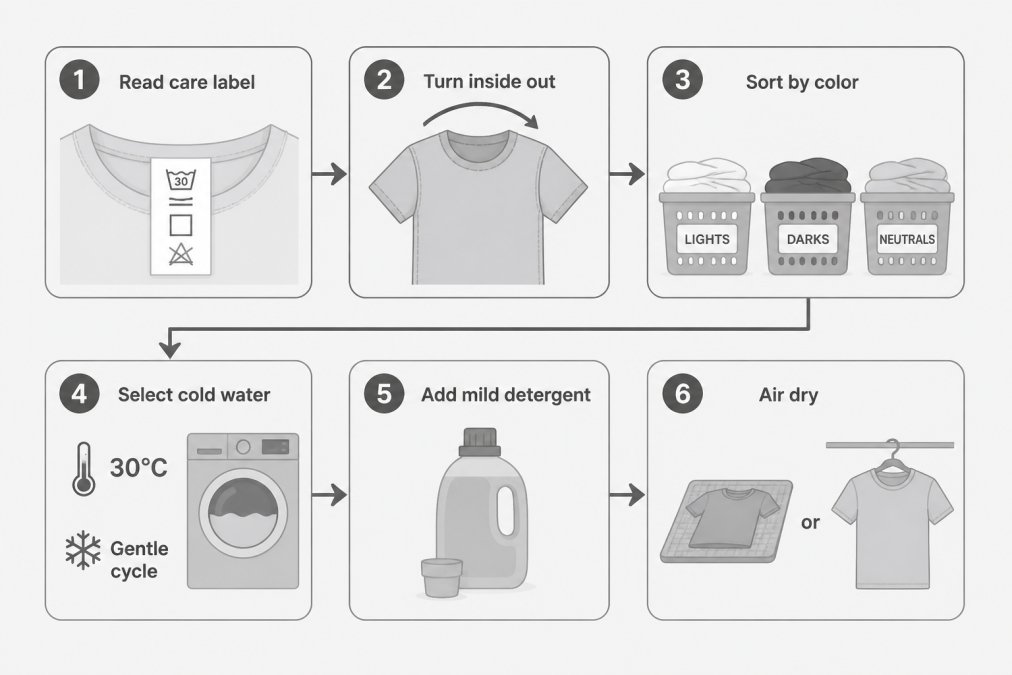
Turn Garments Inside Out and Sort by Color
Turning clothes inside out is the single easiest habit to build. It puts the friction of the wash cycle on the inside of the garment, not the visible face, so prints, dyes, and surface texture stay intact longer.
Sorting matters just as much:
- Wash whites with whites
- Keep darks with darks
- Separate new, deeply dyed items for the first few washes
Color fading comes from dye transferring between garments. Sorting stops it.
Choose Cold Water and a Gentle or Delicate Cycle
Cold water is the default setting for organic cotton. Hot water speeds up shrinkage and fades dye, while cold water cleans just as well for everyday soil. Set the machine to a gentle or delicate cycle for knits and underwear; use a normal cycle only for sturdy items like towels or heavy cotton. Slower agitation means less stress on the fabric and less pilling.
Load the Washer Correctly and Skip the Extra Rinse
Fill the drum about three-quarters full. Overloading traps dirt and detergent against the fabric; underloading lets garments rub together and pill. Measure your detergent, extra detergent leaves residue that stiffens cotton and can irritate sensitive skin. Skip the extra rinse setting; one rinse cycle is enough with the right amount of mild detergent.
The Best Detergent for Organic Cotton Clothes
The best detergent for organic cotton clothes is a mild, liquid formula with no bleach, no optical brighteners, and no heavy perfumes. Liquids dissolve better in cold water than powders, so they rinse out more completely.
What to avoid in a laundry detergent:
- Chlorine bleach
- Optical brighteners
- Fabric softener and dryer sheets
A gentle detergent protects both the fabric and your skin. Mellow Mile customers often tell us, "I have sensitive skin and most workout shirts leave me itchy by the end of the day. Not this one.
Does Organic Cotton Shrink in the Wash?
Yes, organic cotton can shrink in the wash, especially on the first few cycles. Cotton fibers relax and contract when they meet heat and moisture. The fix is simple: wash cold and air dry. Shrinkage comes from hot water, high heat in the dryer, and long, aggressive wash cycles. Keep water cold, keep the dryer off, and shrinkage stays minimal.
How to Dry Organic Cotton Clothes Without Damage
Air drying is the safest way to dry organic cotton clothes, but "air dry" is not one method. How you hang or lay a garment changes whether it dries straight, stretched, or misshapen. Heat is the bigger enemy, and the dryer is where most cotton damage happens.
Why heat shrinks and dulls cotton
Cotton fibers are built from cellulose chains stretched and held under tension during knitting or weaving. Hot water and hot dryer air let those chains relax and pull back toward their shorter state, that is shrinkage. The same heat drives dye molecules out of the fiber, which is why a dark tee fades faster in a hot dryer than in a cold wash.
Pick your drying method by garment type
- T-shirts, boxers, and lightweight knits: hang on a plastic or padded hanger, or lay flat on a rack. They dry in a few hours and hold their shape best flat.
- Heavyweight knits and sweaters: always lay flat. Hanging a wet sweater stretches the shoulders and lengthens the body under its own water weight.
- Woven cotton (button-downs, pants): hang to dry, then smooth by hand while damp. Wovens have less stretch than knits and recover their shape well on a hanger.
If you must use the dryer
Sometimes speed wins. When it does:
- Choose the lowest heat setting, or a no-heat air-fluff cycle.
- Pull items out slightly damp and hang or lay them flat to finish. The last bit of drying is where most heat damage happens.
- Do not overdry. An extra 20 minutes in a hot drum does more harm than the first 40.
How to dry without stretching or fading
- Hang knits by the body, not the shoulders, or drape them over a rack bar. Shoulder-hanging a wet knit creates permanent bumps.
- Dry darks and prints inside out and out of direct sun. Ultraviolet light fades dye even without heat.
- Give garments space. Crowding a rack traps moisture and can leave a musty smell.
If a garment already shrank
Prevention beats recovery, but a slightly shrunken cotton garment is not always lost. Try this:
- Fill a sink with cool water and a capful of mild detergent.
- Submerge the garment and soak about 15 minutes. Do not wring it.
- Lift it out and press the water out gently against the side of the basin. Never twist.
- Lay it flat on a towel and gently stretch the fabric back toward its original measurements, working from the center outward.
- Let it air dry flat, rechecking the shape as it dries.
This works best on knits that shrank a little from heat. A garment that shrank several sizes, or one that felted in a hot wash, usually will not come back.
A quick drying decision rule
If the care label says tumble dry low, you can use the dryer on low for sturdy items. If it says line dry, lay flat, or dry flat, treat the dryer as off-limits. With no label, air dry flat. That one habit prevents most of the shrinkage and fading people blame on the fabric.
How Often to Wash Cotton Clothes (and When to Spot Clean)
How often to wash cotton clothes depends on the garment and how you wear it. Underwear and workout tops get washed after every wear. Outer layers, jeans, and casual shirts can go several wears between washes. Washing less often when a garment is not actually soiled is the easiest way to extend its life, because every wash cycle puts friction and water stress on the fibers.
A simple wear-count guide
- Underwear and socks: every wear
- T-shirts and workout gear: every one to two wears
- Jeans and heavy cotton: every three to five wears
These are starting points, not rules. Humidity, activity level, and how much you sweat all shift the number. If a garment smells clean and looks clean, it usually is clean enough for another wear.
Spot clean between washes
Spot cleaning saves a full wash cycle and is often all a garment needs. Treat a stain as soon as you notice it. The longer a stain sits, the more it bonds to the fiber, and the harder it is to lift without harsh chemistry.
A stain guide by type
Different stains need different first moves. Using the wrong one can set the stain permanently.
Oil and grease (cooking oil, salad dressing, lotion, makeup)
- Blot, do not rub, to lift what you can.
- Apply a drop of mild liquid detergent directly to the stain.
- Work it in gently with your fingers or a soft brush.
- Let it sit 10 to 15 minutes.
- Wash in the warmest water the care label allows. Oil needs a little warmth to release; cold water alone can leave a ring.
Food and drink (coffee, tea, wine, juice, sauce)
- Blot the excess with a clean cloth.
- Flush the back of the stain with cool water so it pushes the pigment out the way it came in.
- Apply mild detergent and let it sit 10 minutes.
- Wash cold. Hot water can set plant-based pigments like wine and berry.
Sweat and deodorant
- Mix a paste of baking soda and a little water.
- Spread it over the stain and let it sit 15 to 20 minutes.
- Rinse, then wash cold with mild detergent.
- For stubborn yellowing under the arms, soak in cool water with oxygen-based bleach (not chlorine). Check the care label first.
Protein stains (milk, spit-up, blood, egg)
- Rinse with cold water first. Hot water cooks protein into the fiber and sets the stain.
- Apply mild detergent or a little enzyme-based stain remover.
- Let it sit 10 minutes, then wash cold.
- If the stain persists, repeat before drying. Dryer heat will lock in anything left behind.
Ink and marker
- Place the stained area face down on a clean white towel.
- Dab the back of the stain with rubbing alcohol on a cotton ball.
- Blot and repeat with a fresh section of towel until the transfer slows.
- Wash cold with mild detergent.
Three rules that apply to every stain
- Blot, never rub. Rubbing pushes the stain deeper and can pill the fabric.
- Test first. Try any treatment on an inside seam or hem before applying it to the visible face.
- Do not dry until the stain is gone. Dryer heat sets whatever is left. If unsure, air dry and re-treat.
When to skip spot cleaning and just wash
Spot cleaning is for a single small mark. If a garment has several stains, smells, or has been worn against skin for a full day, a full cold wash is faster and gentler than treating each spot one by one.
Common Mistakes That Ruin Organic Cotton Apparel
Most organic cotton damage traces back to a handful of habits. Fix these and your clothes last far longer.
- Washing in hot water. Causes shrinkage and color fading.
- Overloading the washer. Traps dirt and detergent, and causes pilling.
- Using too much detergent. Leaves residue that stiffens fabric.
A common mistake is treating all cotton the same. A heavyweight tee and a lightweight knit need different care.
That is the whole system. Cold water, mild detergent, inside out, air dry.
Caring for organic cotton takes a few small habits, not a complicated routine. Our Organic Cotton Boxers and Athletic Tee are made for daily rotation and built to hold up.

Frequently Asked Questions
Does 100% organic cotton shrink in the wash?
Organic cotton can shrink, especially on the first wash, because cotton fibers relax and contract when exposed to heat and agitation. Cold water and air drying minimize this. If a garment does shrink, a short soak in cool water followed by gentle stretching and flat drying can help recover some size. Always check the care label before washing.
Can you machine-wash organic cotton apparel?
Yes. Most organic cotton apparel handles machine washing well on a gentle or delicate cycle with cold water. Turn garments inside out, use a mild detergent, and avoid overloading the drum. Skip the dryer and air dry instead to protect the fabric and keep the fit consistent. Hand washing works too if the care label calls for it.
What water temperature is best for washing organic cotton?
Cold water is the safest choice for organic cotton. Heat causes cotton fibers to contract, which leads to shrinkage and faster color fading. Cold water cleans effectively for everyday soil and sweat while protecting fabric quality. If a care label allows warm water, keep it on the lower end and avoid hot washes entirely.
How often should you wash organic cotton clothing?
Tees and tops worn next to the skin typically need a wash after one or two wears, especially after workouts. Boxers and underwear should be washed after every wear. Outer layers and pants can go three to five wears between washes if they are aired out. Spot clean small stains right away to stretch time between full washes.