


Is Organic Cotton Worth the Price? A Practical Guide
Table of Contents
- Is Organic Cotton Worth the Price? The Real Trade-Offs
- Benefits of Organic Cotton That Justify the Cost
- Downsides of Organic Cotton You Should Know
- Organic Cotton vs Conventional Cotton: What's the Difference?
- Cost Per Wear: Does Durability Offset the Price Premium?
- How to Identify Organic Cotton Clothing and Verify Claims
- The Bottom Line: When Organic Cotton Makes Sense
- Frequently Asked Questions
Last Updated: October 5, 2026
Is Organic Cotton Worth the Price? The Real Trade-Offs
The price difference between organic cotton and conventional cotton can be striking. A pair of organic cotton boxers might cost $24 while similar conventional options run half that. So is organic cotton worth the price? The answer depends on what you're buying for and how long you plan to wear it.

This guide breaks down what you get when you pay more for organic cotton.
Benefits of Organic Cotton That Justify the Cost
Reduced chemical exposure. Conventional cotton farming uses synthetic pesticides and fertilizers extensively. Organic cotton is grown without these chemicals, so wearing it against your skin, especially in undergarments, reduces exposure to residual chemical finishes.
Better for sensitive skin. Many customers report that switching to organic cotton reduces itching, irritation, and rashes, tied to the absence of harsh chemical treatments applied during manufacturing. One customer noted, "I have sensitive skin and most workout shirts leave me itchy by the end of the day. Not this one. Zero irritation."
Softer feel. Organic cotton typically feels softer than conventional cotton because it hasn't been treated with chemical finishes that stiffen the fabric. A customer shared, "Softest shirt I own, and I've tried a lot of the premium brands."
Breathability. Organic cotton breathes better than many synthetic blends. Without chemical coatings, moisture moves through the fabric more freely, keeping you cooler during workouts.
Certifications you can verify. When you buy organic cotton made with GOTS certified organic cotton, you're getting third-party verification that the cotton was grown without synthetic pesticides and processed without harsh chemicals.
Downsides of Organic Cotton You Should Know
Higher price. Organic cotton costs more because farming without synthetic inputs requires more labor, produces lower yields, and involves stricter certification processes. You'll pay a premium, sometimes 50-100% more.
Shrinkage risk. Organic cotton can shrink more than conventional cotton if not cared for properly. One customer mentioned, "Shrank a little in the dryer, so I hang dry now."
Limited color and style options. Because organic cotton production is smaller-scale, brands offer fewer colors and styles than mass-produced conventional cotton.
No performance advantages over synthetics. Compared to high-tech synthetic fabrics designed for athletic performance, organic cotton doesn't win on moisture-wicking or temperature regulation.
Organic Cotton vs Conventional Cotton: What's the Difference?
Conventional cotton uses synthetic pesticides, herbicides, and fertilizers throughout the growing process. After harvest, the raw cotton is bleached and treated with chemical finishes to improve softness, reduce wrinkles, and add water resistance.
Organic cotton is grown without synthetic pesticides or fertilizers; farmers use natural pest management and crop rotation instead. After harvest, it undergoes less aggressive chemical processing, and dyes and finishes must meet safety standards.
The practical difference you feel: organic cotton typically feels softer, breathes better, and causes less skin irritation.
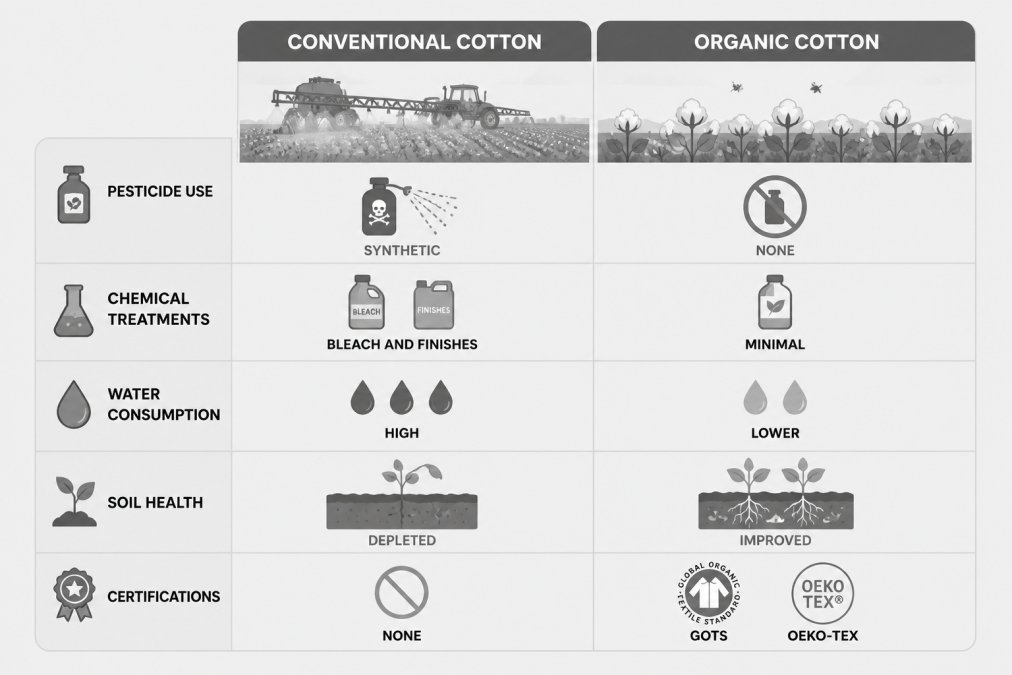
Organic farming practices reduce water pollution, improve soil health, and eliminate synthetic chemical runoff, though organic cotton still requires significant water to grow.
Cost Per Wear: Does Durability Offset the Price Premium?
The sticker price is the least useful number in this decision. What matters is cost per wear: the purchase price divided by the number of times you actually wear the item before it leaves your rotation.
The formula. Cost per wear = purchase price ÷ total wears. The hard part is estimating total wears honestly, since it depends on rotation frequency, how long the fabric and construction hold up, and whether you still want to wear it.
A worked example. Take a pair of boxers worn once a week for two years. That's roughly 104 wears. If the pair costs $24, cost per wear lands near 23 cents. A $12 pair worn once a week that loses its elastic and gets retired after eight months works out to about 32 wears, or roughly 38 cents per wear.
Why fiber type is only part of the durability story. Organic cotton fiber is not inherently stronger than conventional cotton fiber. The durability difference buyers report usually comes from fabric weight, stitch density, elastic quality, and finishing. A heavier knit with reinforced seams outlasts a lighter one regardless of how the cotton was grown.
What actually shortens lifespan. In practice, care habits move the number more than fiber origin does:
- Machine drying on high heat breaks down cotton fibers and elastic over time; line drying or low heat extends wear life noticeably.
- Washing after every single wear accelerates pilling and fade compared to airing garments between wears.
- Detergent choice and wash temperature matter less than drying, but hot water plus high-heat drying is the fastest way to retire a garment early.
- Fit and comfort determine whether the item stays in rotation at all. A garment you avoid wearing has an infinite cost per wear no matter how well it's made.
The break-even question. The premium is justified when the organic option's cost per wear comes in at or below the conventional alternative, when you wear the item often and it holds up.
Where the premium pays off by category. The value proposition is not uniform across product types:
- Underwear and base layers sit against skin for hours daily and get washed constantly, so they accumulate wears quickly. This is where cost per wear most often favors the organic option.
- Everyday tees and shirts worn multiple times a week can justify the premium if construction holds; occasional or seasonal pieces usually cannot.
- Sheets and towels are used nightly or daily and last for years, so the per-use math can favor organic even at a higher upfront price, but only if you keep them in service long enough.
- Babywear and children's clothing get outgrown long before they wear out, which caps total wears and weakens the durability argument even when the comfort argument is strong.
The honest limit of this math. Cost per wear is an estimate, not a guarantee. Treat it as a way to compare two specific garments, not as a blanket verdict on organic cotton.
Organic Cotton Boxers – Wrapped →
How to Identify Organic Cotton Clothing and Verify Claims
"Organic" is not a regulated term on a clothing label the way it is on food, so the burden of verification falls on you. Know what each certification actually covers, and what it doesn't.
GOTS (Global Organic Textile Standard). GOTS is the certification most buyers mean when they say a garment is organic.
OEKO-TEX STANDARD 100. This standard tests the finished fabric against limits for harmful substances, residual chemicals, heavy metals, and formaldehyde.
Read the fiber content label. It should state "organic cotton" with a percentage. If the label just says "cotton" or "natural cotton," treat it as conventional cotton regardless of what the marketing copy implies.
Check the certification number, not the logo. Both GOTS and OEKO-TEX issue certificate numbers that can be looked up in their public databases.
Watch for the vague middle. Terms like "eco-friendly," "clean," "conscious," and "sustainable" have no legal definition on apparel and require no proof.
Ask what the brand will tell you. Legitimate organic cotton programs can describe where the fiber comes from and how it's processed, and can point to the certifications that back it up.
A quick verification checklist:
- Does the label name a specific certification (GOTS, OEKO-TEX STANDARD 100) rather than a vague claim?
- Is there a certificate number you can look up?
- Does the fiber content line say "organic cotton" with a percentage?
- Does the brand describe its supply chain in specifics rather than adjectives?
If you can answer yes to the first three, you're looking at a verifiable organic cotton product. If you can't, you're looking at marketing.
The Bottom Line: When Organic Cotton Makes Sense
Organic cotton is worth the price if any of these apply to you:
You have sensitive skin or experience irritation from conventional clothing.
You wear items frequently enough that durability matters.
You prioritize reducing chemical exposure in your daily life.
You value verifiable certifications.
Organic cotton is probably not necessary if you wear items infrequently, have no skin sensitivity, or are on a tight budget.
The price premium reflects actual differences in farming practices, chemical exposure, durability, and certifications. Whether those differences are worth paying for depends on your situation.
At Mellow Mile, we believe organic cotton matters for the items closest to your skin, especially undergarments. That's why our Organic Cotton Boxers are made with GOTS certified organic cotton and OEKO-TEX certified dyes. When you're wearing something all day, every day, the comfort and chemical-free benefit compounds. GOTS certification standards verify that our cotton is grown without synthetic pesticides, and OEKO-TEX testing requirements ensure the dyes and finishes meet strict safety limits.
For items you wear less frequently, conventional cotton is a reasonable choice. The decision comes down to your priorities and how often you'll wear the item.
Organic cotton isn't a luxury, it's a choice about what you expose your skin to daily. If you prioritize quality, durability, and chemical-free materials, the price premium makes sense. Our Organic Cotton Boxers deliver exactly that: GOTS certified organic cotton, OEKO-TEX certified dyes, and construction designed to last. Consumer Reports on organic cotton benefits backs up what our customers experience. Start with a pair and feel the difference for yourself, that's how most of our customers become repeat buyers.
Frequently Asked Questions
Does organic cotton really last longer than conventional cotton?
Organic cotton can be more durable because it's not treated with synthetic finishes that weaken fibers over time. However, longevity depends more on fabric quality, weave density, and care than on whether cotton is organic. A well-made organic cotton garment will outlast a poorly constructed conventional cotton piece. The real difference shows after 20+ washes, organic cotton pieces often retain shape and softness better. Cost per wear favors organic cotton when you wear items frequently and keep them for years.
How can you tell if cotton is genuinely organic?
Look for third-party certifications on the label or product page. GOTS (Global Organic Textile Standard) verifies organic farming practices and restricts harmful dyes and chemicals. OEKO-TEX STANDARD 100 confirms the finished fabric was tested and meets safety limits for harmful substances. Brands should display these certifications transparently. Be skeptical of vague claims like 'made with organic cotton' without certification details. Reputable brands publish their supply chain information and certification documents online, so ask for them if they're not visible.
Is the price premium worth it if I only wear something occasionally?
If you wear an item infrequently, the price premium is harder to justify. Organic cotton's value comes from durability and repeated wear, the more you wear something, the lower the cost per wear becomes. For occasional pieces, conventional cotton may make financial sense. However, if skin sensitivity or chemical exposure is a concern, organic cotton matters regardless of wear frequency. Consider your priorities: if budget is primary, conventional cotton works fine for occasional use. If health or durability matters more, organic cotton is worth the investment even for less-frequent items.
What environmental benefits actually come from choosing organic cotton?
Organic cotton farming uses significantly less synthetic pesticide and fertilizer than conventional cotton production, reducing chemical runoff into water systems and soil. It also typically uses less water and builds healthier soil over time. However, organic cotton is still cotton, it requires substantial water and land. The environmental advantage is real but not absolute. Viscose from bamboo, by contrast, involves chemical processing that creates its own environmental concerns. The environmental choice is buying durable pieces you'll wear for years, whether organic or conventional, since extending a garment's lifespan reduces overall resource consumption.