


6 Things to Check in an Organic Cotton Clothing Review for Men
Last Updated: October 30, 2026
Quick Summary
Organic cotton clothing is apparel made from organic cotton, a natural fiber, and a useful review for men checks the certification, fiber content, fabric weight, fit, durability and cost per wear rather than how soft a shirt feels on day one. Verify the standard named on the label, such as GOTS for cotton, and confirm the fiber disclosure matches the claim.
- GOTS is the most widely recognized textile certification for organic fiber content and applies to cotton, not regenerated fibers.
- Midweight knits of roughly 5.5 to 6.5 oz/yd² balance breathability and shape retention for everyday tees.
- Measure a shirt you own across the chest and body length, then compare to the brand's size chart.
- Cotton shrinkage peaks in the first wash and dry cycle, and heat is the main accelerant.
- Divide price by realistic wears: $24 boxers worn 100 times cost $0.24 per wear.
Table of Contents
- What an Organic Cotton Clothing Review for Men Should Actually Tell You
- Certifications to Verify Before You Trust Any Organic Cotton Claim
- How to Find the Best Organic Cotton Shirts for Men
- Organic Cotton Underwear for Men: What Matters Most
- Durability, Shrinkage, and Pilling: What Wear Testing Reveals
- How to Care for Organic Cotton Clothes So They Last
- Cost Per Wear: The Math Behind Higher Prices
- Build a Cleaner Drawer with Mellow Mile Essentials
- Frequently Asked Questions
What an Organic Cotton Clothing Review for Men Should Actually Tell You
Most organic cotton clothing reviews for men describe how a shirt felt on day one, the least useful data point.
Organic cotton clothing is apparel made from organic cotton. The fiber is a natural one, and that distinction matters more than the marketing language around it.
Below, we break down the six checks that separate a real review from a press release. Most reviews conflate "organic" with "non-toxic", two different claims, and only one is verified by a certification you can look up.
Certifications to Verify Before You Trust Any Organic Cotton Claim
A certification is only worth what its scope covers, so read the standard, not the hangtag.
Here is what to check on any label:
- GOTS covers organic fiber content and processing criteria for cotton garments. Say "made with GOTS certified organic cotton," not "GOTS certified brand."
- OEKO-TEX STANDARD 100 tests finished fabric against restricted substance limits (OEKO-TEX® STANDARD 100). Class I is the strictest tier, tested against the limits used for baby articles.
- Fiber content disclosure should match the certification claim. A GOTS claim on a polyester blend is a red flag.
The Federal Trade Commission's guidance on textile labeling requires accurate fiber content disclosure on apparel, which gives you a legal backstop if a claim looks inflated.
Watch out: a brand that says "organic" without naming a standard is asking you to take it on faith. Ask which certification body issued the certificate and what it covers.
How to Find the Best Organic Cotton Shirts for Men
The best organic cotton shirts for men balance fabric weight, knit structure, seam construction, and a cut that survives repeated washing. Most reviews stop at "soft" and "true to size." Neither tells you whether the shirt will still fit in month six. Start with the spec sheet, then judge the fit against your own measurements.
Fabric Weight, Knit, and Stretch
Fabric weight is usually listed in ounces per square yard (oz/yd²) or grams per square meter (GSM) on a spec sheet, and it tells you more about durability than any adjective on the product page. As a rough guide for men's knits:
- Lightweight (roughly 4-5 oz/yd² / 135-170 GSM): cooler, drapes more, wears faster at friction points like the collar and underarm.
- Midweight (roughly 5.5-6.5 oz/yd² / 185-220 GSM): the everyday range for tees; balances breathability and shape retention.
- Heavyweight (roughly 7 oz/yd² / 235 GSM and up): holds shape longest, feels warmer, and takes longer to dry.
Knit structure matters as much as weight. A tighter jersey knit resists stretching at the neckline, and a ribbed collar with higher stitch density holds shape better than a thin self-fabric band.
Added stretch, usually a small percentage of elastane, helps a shirt recover its shape after movement.
One insider note: a shirt that feels incredibly soft on day one can pill by month three.
Fit, Sizing, and Cut Across Body Types
Fit is where most online reviews fall apart, because body types vary and a single "true to size" note helps almost no one.
A practical way to shop: take a shirt you already own and like, lay it flat, and measure chest (pit to pit), body length (high point of shoulder to hem), and sleeve length from the shoulder seam.
Our customers flag fit trade-offs directly.
If you are between sizes, check the size chart for athletic shirts before ordering.
Organic Cotton Underwear for Men: What Matters Most
Underwear is the garment where fabric choice has the most direct contact with skin, so the material spec deserves the closest read. Look for a breathable knit, a waistband that does not roll, and a cut that stays put through movement.
Our Organic Cotton Boxers are made with GOTS certified organic cotton and dyed with OEKO-TEX certified dyes. No polyester blends. The result is a soft, breathable fabric that feels good on your skin all day.
Customer feedback points to the same three things: breathability, waistband stability, and no ride-up. One reviewer switched "my entire drawer over" and notes "the waistband doesn't roll and they breathe way better than my old synthetic pairs." Another reports "no riding up on the bike."
For sizing, the underwear size chart lays out the measurements so you can confirm your fit before buying. If you want a deeper breakdown of fabric and construction, our guide to durable organic cotton underwear for men covers it in more detail.
Durability, Shrinkage, and Pilling: What Wear Testing Reveals
Durability is the claim every brand makes and the one almost no review actually tests. A real durability review tells you what was washed, how, how many times, and what changed. Here is the framework to read any durability claim against, and the failure points to check on your own garments.
Shrinkage: Why Cotton Moves and How Much to Expect
Cotton shrinks. That is a fiber property, not a defect. Fibers are stretched and tensioned during knitting and finishing, and the first few washes relax that tension.
The biggest change usually happens in the first wash and dry cycle, with smaller changes after that. Heat is the accelerant, hot water and a hot dryer do more to shrink cotton than any other variable.
One of our customers puts it plainly: "Very soft organic cotton. Shrank a little in the dryer, so I hang dry now.
Pilling: Where It Starts and What It Signals
Pilling is the other tell. It happens when short fibers work loose from the yarn, tangle together, and form small balls on the surface.
Three factors drive pilling: fiber length (longer-staple cotton pills less because fewer fiber ends work loose), knit tightness (a tighter knit traps fibers better), and abrasion (what the garment rubs against). A reviewer who washed a shirt "with jeans by accident" reports "no pilling. Drape is still good." That is a meaningful durability signal, because a rough wash cycle with denim zippers and metal buttons is the fastest way to surface a weak knit.
To test pilling yourself, wash garments inside out with a rough item like jeans once, then inspect the underarm and side-seam areas under good light. Pilling after one rough wash is a warning sign; pilling after months of normal wear is normal for a soft knit.
Color Retention: What Fades and Why
Color loss on cotton usually comes from three sources: dye fastness (how well the dye bonds to the fiber), abrasion (surface fibers wearing away and taking dye with them), and UV exposure (sunlight breaking down dye molecules). Darker dyes, black, navy, deep red, show fading more visibly, which is why a black tee is the honest test of color retention.
A practical check: wash a dark garment inside out in cold water, hang dry it, and compare it to a photo taken before the first wash. If it looks noticeably lighter after five washes, the dye fastness is weak. Washing inside out in cold water slows both abrasion and dye loss.
For a deeper look at how organic cotton workout shirts hold up over time, read our durability breakdown for organic cotton workout shirts.
How to Care for Organic Cotton Clothes So They Last
Care is the cheapest durability upgrade you can make, and most men skip it. Organic cotton is a natural fiber, so heat is its main enemy: hot water, a hot dryer, and high iron settings all shorten garment life.
Follow this routine:
- Wash cold on a normal cycle with a mild detergent.
- Skip the dryer or use low heat. Hang drying prevents most shrinkage and preserves knit recovery.
- Wash inside out to reduce surface abrasion and pilling.
- Avoid fabric softener, which coats the fiber and reduces breathability.
- Air dry knits flat if you can, to keep the shoulder shape.
How do you care for organic cotton clothes without overcomplicating it? Cold water, low heat, and less frequent washing cover most of it. Wash when the garment actually needs it, not after every wear, and your cotton will hold its shape and color far longer.
Cost Per Wear: The Math Behind Higher Prices
A higher sticker price is not automatically a better value, but cost per wear makes the comparison honest. Divide the price by the number of wears you realistically get before the garment wears out.
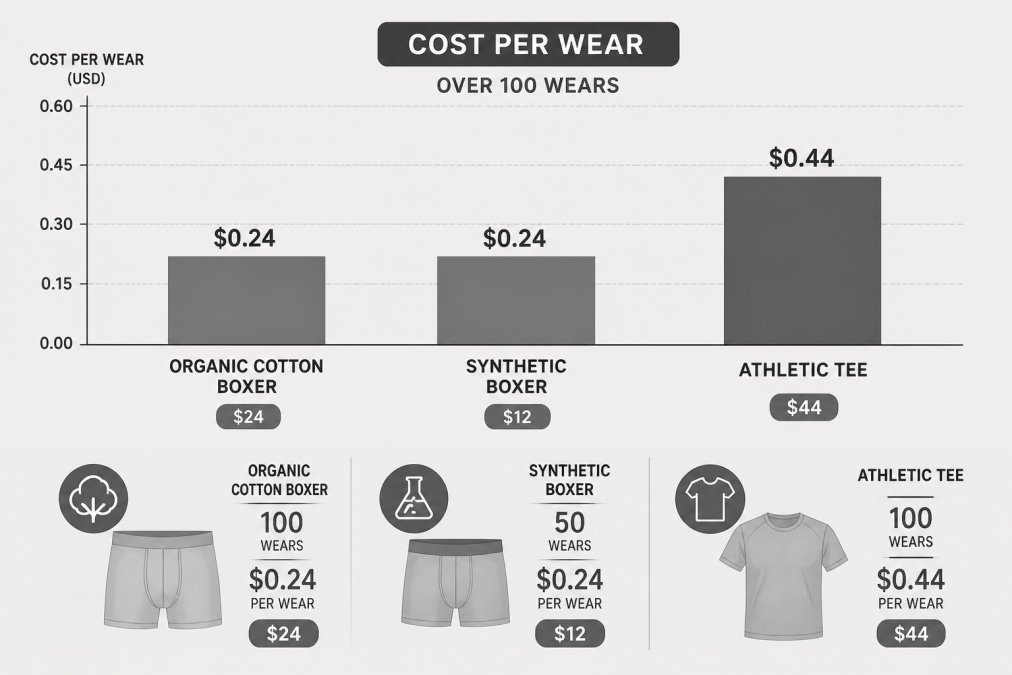
Run the numbers on a $24 pair of boxers worn 100 times and you land at $0.24 per wear.
Our $44 Athletic Tee works out to $0.44 per wear across 100 wears.
| Garment | Price | Wears | Cost Per Wear | Replacement Cycle |
|---|---|---|---|---|
| Organic cotton boxers | $24 | 100 | $0.24 | Longer |
| Synthetic boxers | $12 | 50 | $0.24 | Twice as often |
| Athletic tee | $44 | 100 | $0.44 | Longer |
Build a Cleaner Drawer with Mellow Mile Essentials
The six checks above come down to one idea: verify the spec, not the slogan. Certifications, fiber content, knit structure, and wash behavior tell you what a garment will do over time.
That is the standard we build to. Our organic cotton underwear collection is made with GOTS certified organic cotton and OEKO-TEX certified dyes, and our Athletic Tee is built from viscose from bamboo for breathability and recovery.
If you are ready to rebuild your drawer around garments that hold up, start with the essentials that touch your skin most. Get started with Mellow Mile and sign up for 20% off your first order.
Frequently Asked Questions
Is organic cotton clothing worth it for men?
It depends on what you value. Organic cotton clothing typically costs more upfront, but the fiber is softer against the skin and holds up well with proper care. Look for GOTS certified organic cotton, which verifies the fiber was grown and processed to a recognized standard. Mellow Mile's Organic Cotton Boxers at $24 are made with GOTS certified organic cotton and OEKO-TEX certified dyes, giving you a verifiable starting point rather than a vague label.
Does organic cotton shrink in the wash?
Organic cotton can shrink, especially in the first few washes and in a hot dryer. One Mellow Mile customer noted the fabric shrank a little in the dryer, so he now hang dries. Wash cold, skip the high heat, and hang dry or tumble low to keep sizing stable. Pre-shrunk garments reduce the risk, but no cotton is completely shrink-proof.
How can you tell whether clothing is made with organic cotton?
Check the label and the brand's published certifications. GOTS certification covers the organic status of the fiber and processing, and OEKO-TEX STANDARD 100 verifies the finished fabric was tested for harmful substances. A brand should say 'made with GOTS certified organic cotton' rather than claiming the garment itself is certified. If a brand cannot point to a certification body, treat the organic claim as unverified.
How should men wash and care for organic cotton clothes?
Wash in cold water on a normal cycle with a mild detergent, turn garments inside out to reduce surface wear, and avoid fabric softener, which coats the fiber. Tumble dry low or hang dry. Separate rough items like jeans from softer knits to limit pilling. One customer washed a tee with jeans by accident and reported no pilling, but keeping them apart is the safer habit for long-term fabric quality.
