


Organic Cotton Workout Shirts: Real Durability
Table of Contents
- What Makes Organic Cotton Workout Shirts Durable
- Cotton vs Polyester Workout Shirts: Durability Breakdown
- How to Wash Organic Cotton Shirts to Extend Lifespan
- Organic Cotton Shirt Shrinkage and Shape Retention
- Durability by Workout Intensity and Use Case
- Cost Per Wear: Why Durability Justifies the Investment
- What to Look for When Assessing Durability Before Buying
- Frequently Asked Questions
Last Updated: October 13, 2026
What Makes Organic Cotton Workout Shirts Durable
The durability of organic cotton workout shirts durability comes down to three factors: how tightly the fabric is woven, how the seams are stitched, and how well the fiber itself resists breakdown during use and washing. Understanding these elements helps you choose a shirt that will actually last through months of regular workouts instead of falling apart after a few weeks.
At Mellow Mile, we focus on these durability markers because they directly affect how long your shirt performs. A shirt made with quality construction can outlast cheaper alternatives by years, which means better value over time and less waste in your closet.
Fabric Weight and Knit Construction
Heavier fabric doesn't automatically mean more durable, but the way the fabric is constructed matters significantly. A tightly knit organic cotton shirt resists pilling and abrasion better than loosely woven versions.
Look for fabric weight between 5.5 and 6.5 ounces per square yard for workout shirts. This range offers a balance:
- Lightweight enough to breathe during exercise
- Dense enough to resist wear and tear
- Substantial enough to hold its shape after repeated washing
The knit construction also affects durability. A jersey knit (smooth, flat surface) tends to pill less than a fleece knit, especially during high-friction activities like running or cycling. Single-layer construction is lighter but less durable than double-layer options for heavy-use scenarios.
Seam Strength and Stitching Quality
Seams fail first in most workout shirts. A shirt can have perfect fabric, but if the seams come apart, the shirt is done.
Quality seams have these characteristics:
- Reinforced stitching at stress points (shoulders, armholes, side seams)
- Thread count of at least 2-3 passes per seam
- Flat-fell or French seams that lock the thread inside the fabric
- Stitching tension that's tight enough to hold but not so tight it puckers the fabric
When you try on a shirt, run your finger along the seams. They should feel smooth and even. Any loose threads, puckering, or uneven spacing signals weaker construction. Seams on the shoulders and underarms take the most stress during movement, so inspect those areas closely.
Cotton vs Polyester Workout Shirts: Durability Breakdown
Organic cotton and polyester are fundamentally different fibers with opposite durability profiles. Neither is universally "better", it depends on your workout intensity and care routine.
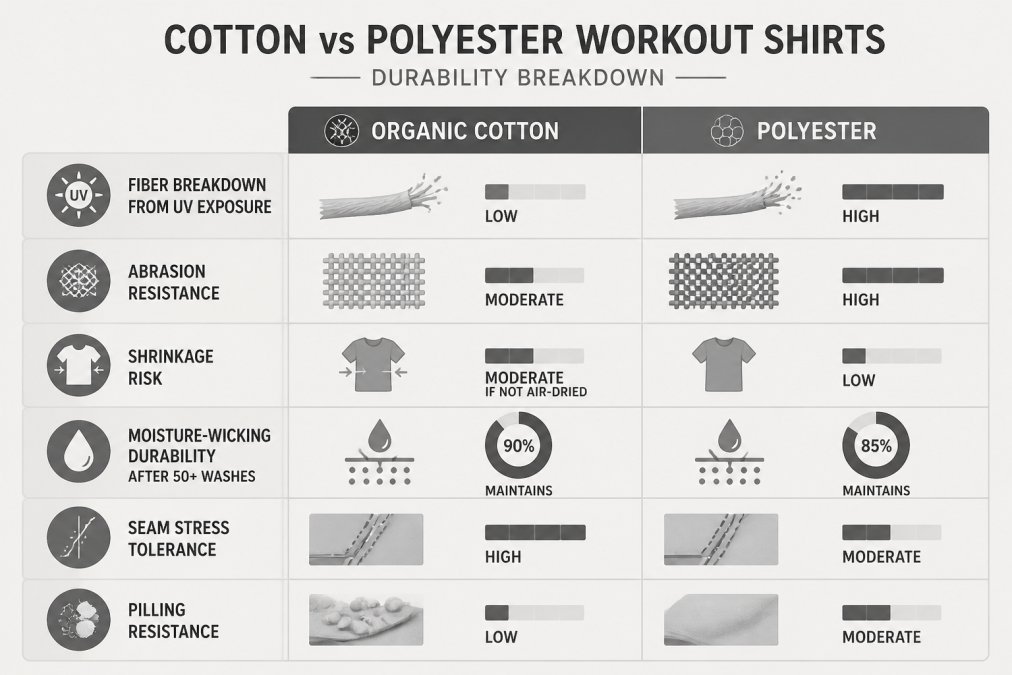
Polyester is synthetic and resists moisture, which means it dries faster and resists mildew. But polyester breaks down under UV light and high heat, yellowing and becoming brittle over time. Organic cotton doesn't break down from light or moderate heat, but it absorbs moisture and can shrink if not cared for properly.
Fiber Breakdown and Abrasion Resistance
Polyester fibers are stronger than cotton fibers individually, which is why polyester shirts resist pilling and abrasion better in the short term. But polyester degrades from sun exposure and chlorine, which matters if you're doing outdoor workouts or swimming.
Organic cotton fibers are weaker individually but more resilient when woven tightly. Organic cotton shirts often feel softer and more supple after repeated washing if you use proper care.
Moisture Wicking and Sweat Management Impact
Moisture wicking affects durability because moisture trapped in fabric accelerates fiber breakdown and mildew growth. Polyester wicks sweat away from your skin faster, which reduces the stress on the fiber.
Organic cotton absorbs more moisture initially, which means it feels heavier when soaked with sweat. But it releases that moisture evenly across the fabric and dries completely with proper drying methods. This even moisture distribution reduces the stress points that cause seams to fail.
How to Wash Organic Cotton Shirts to Extend Lifespan
How you wash your shirt matters as much as what it's made from. Improper washing is the #1 reason organic cotton shirts fail early.
The goal is to clean the shirt without stressing the fibers or seams. High heat, aggressive spinning, and harsh detergents all accelerate breakdown.
Cold-Water Washing and Detergent Selection
Wash organic cotton shirts in cold water, around 60-70 degrees Fahrenheit. Hot water opens the fiber structure, allowing dirt to escape more easily, but it also weakens the cotton fibers themselves and causes faster fading.
Cold water is gentler on fibers and seams. It requires a detergent that works effectively in cold temperatures. Look for detergents labeled "cold-water effective" or those designed for delicates.
Avoid:
- Bleach (breaks down cotton fibers)
- Fabric softeners (coat the fiber and reduce breathability)
- Heavy-duty detergents (too harsh for workout shirts)
- Enzyme-based detergents (designed to break down proteins, which weakens fibers)
A mild, plant-based detergent or sport-specific wash works best. Use less detergent than you think you need, about half the recommended amount. Extra detergent doesn't clean better and leaves residue that weakens fibers.
Air Drying vs Machine Drying
This is the biggest factor in durability. Machine drying is the fastest way to destroy an organic cotton shirt.
High heat in the dryer shrinks the fabric, stresses the seams, and accelerates fiber breakdown. Even on low heat, repeated machine drying shortens the life of your shirt by 50% or more.
Air drying takes longer but preserves the shirt:
- Lay flat on a clean surface or hang on a clothesline
- Avoid direct sunlight for extended periods (UV light fades colors)
- Air drying takes 2-4 hours depending on humidity
- The shirt will feel slightly stiff when dry, but softens with wear
If you must machine dry, use the lowest heat setting and remove the shirt while still slightly damp. But air drying is the clear winner for longevity.
Organic Cotton Shirt Shrinkage and Shape Retention
Organic cotton shrinks. This is not a defect, it's a property of the fiber. How much it shrinks depends on how the shirt was processed before you bought it.
Quality organic cotton shirts are pre-shrunk during manufacturing, which means they've already undergone controlled shrinkage. A pre-shrunk shirt should shrink no more than 2-3% with proper care.
If you wash in hot water or machine dry on high heat, you can expect 5-8% shrinkage on top of any pre-shrinkage.
To minimize shrinkage:
- Always use cold water
- Air dry whenever possible
- Wash inside-out to reduce surface abrasion
- Don't wring the shirt, squeeze gently or roll in a towel
Shape retention is tied to shrinkage. A shirt that shrinks unevenly will lose its shape. Sleeves might tighten while the body stays loose, or the neckline might pucker.
Durability by Workout Intensity and Use Case
Not all workouts stress a shirt the same way. High-intensity exercise creates different durability demands than casual wear.
High-Intensity Exercise and Heavy Sweat
High-intensity workouts, running, CrossFit, spin classes, create maximum stress on seams and fibers. Your shirt absorbs heavy sweat, which means the fabric is constantly wet and heavy. The repeated motion of your arms and torso creates friction that can cause pilling and seam failure.
For high-intensity use, organic cotton shirts need:
- Reinforced seams at the shoulders and underarms
- Tighter knit construction to resist pilling
- Higher fabric weight (6+ ounces) for durability
- Proper drying after every wash (no air-drying delays that leave moisture in the fabric)
A shirt that works fine for casual wear might fail within 3-4 months of daily high-intensity use if the seams aren't reinforced. The repeated stretching and stress simply overwhelm the stitching.
Low-Impact Workouts and Daily Wear
Low-impact activities like yoga, walking, or casual gym sessions create less stress on the shirt. The fabric doesn't experience the same friction or repeated stretching.
For low-impact use, a lighter organic cotton shirt with standard seam construction will last 2-3 years of regular wear. The durability demands are much lower, so you don't need the heaviest fabric or the most reinforced seams.
Daily wear outside the gym, wearing the shirt to work or running errands, extends the lifespan further because the shirt isn't exposed to heavy sweat or high friction. A shirt worn for casual daily use might last 5+ years if properly cared for.
Cost Per Wear: Why Durability Justifies the Investment
An organic cotton workout shirt from Mellow Mile costs $44.00. This seems high compared to a $15 polyester shirt from a fast-fashion brand. But cost per wear tells a different story.
If the polyester shirt lasts 6 months of regular use (roughly 50 washes), that's about $0.30 per wear. If you wear it 3 times per week, it lasts about 4 months.
An organic cotton shirt that lasts 2 years of regular use (roughly 200 washes) comes out to about $0.22 per wear.
The math gets better the longer the shirt lasts:
- 1 year of regular use: $0.33 per wear
- 2 years of regular use: $0.21 per wear
- 3 years of regular use: $0.14 per wear
A shirt that lasts 3 years is actually cheaper per wear than a $15 polyester shirt that falls apart in 6 months.
Durability also means less waste.
What to Look for When Assessing Durability Before Buying
You can't see durability just by looking at a shirt, but you can identify markers that predict how long it will last.
Fabric Certification and Testing Standards
Certifications like OEKO-TEX STANDARD 100 indicate that the fabric has been tested for harmful substances and meets safety standards (OEKO-TEX® STANDARD 100).
GOTS (Global Organic Textile Standard) certification for organic cotton means the cotton was grown and processed without synthetic pesticides or harsh chemicals. If the shirt is made with GOTS certified organic cotton, the label will state "made with GOTS certified organic cotton."
These certifications don't directly measure durability, but they indicate that the manufacturer cares about quality. A brand that invests in certification is more likely to invest in durable construction.
Check the label for:
- Fiber content (100% organic cotton or a named blend)
- Fabric weight (look for 5.5+ ounces)
- Care instructions (if they say "lay flat to dry," that's a signal of durability focus)
- Certification logos (GOTS, OEKO-TEX, Fair Trade)
Real Customer Feedback on Garment Lifespan
Customer reviews that mention how long the shirt has lasted are gold.
These real-world durability reports are more reliable than marketing claims. A review that says "soft and comfortable" tells you about feel, not durability.
Pay attention to reviews mentioning:
- How many washes the shirt has survived
- Whether seams are still intact
- If the shirt has shrunk or lost shape
- How the fabric feels after repeated use
- Comparison to other brands they've owned
Negative reviews about durability are especially valuable. If multiple customers mention pilling, seam failure, or shrinkage, that's a real problem. One complaint might be an outlier; multiple complaints are a pattern.
Durability in organic cotton workout shirts depends on fabric weight, seam construction, fiber quality, and how you care for the garment.
When you choose a shirt like our Athletic Tee, made with 95% viscose from bamboo and 5% elastane, you're prioritizing a shirt designed to feel good and perform without synthetic chemical finishes.

Frequently Asked Questions
Are organic cotton workout shirts durable enough for intense exercise?
Yes, organic cotton workout shirts perform well in high-intensity settings when constructed with proper fabric weight and seam strength. The fiber itself is resilient; durability depends on knit construction, stitching quality, and care. Customers report these shirts holding up through heavy rotation and repeated washing. The key is choosing a shirt with a tighter knit construction and reinforced seams, then following proper care guidelines like cold-water washing and air drying to prevent premature fiber breakdown.
How do I prevent my organic cotton shirt from shrinking?
Organic cotton shrinkage happens primarily in the dryer. Wash in cold water and air dry to minimize shrinkage. If you must machine dry, use low heat. Most shrinkage occurs in the first 3-5 washes; after that, the shirt stabilizes. Proper washing technique, cold water, gentle cycle, appropriate detergent, preserves fiber integrity and reduces the risk of stretching or shrinking. Following care instructions on the label protects your investment.
How should I wash organic cotton shirts to make them last longer?
Use cold water, avoid excessive detergent, and air dry when possible. Cold-water washing preserves fiber strength and color, while air drying prevents heat damage that weakens cotton fibers. Turn the shirt inside out before washing to reduce pilling and fading. Wash with similar colors to avoid dye transfer. Skip fabric softener, which coats fibers and reduces breathability. These practices extend garment lifespan significantly compared to hot-water and high-heat drying.
How does organic cotton compare to polyester for workout durability?
Organic cotton requires proper care to reach its durability potential. Polyester wicks moisture faster but degrades with heat and abrasion over time.