


Buy Organic Cotton Essentials Online: A Guide
Table of Contents
- Why Buy Organic Cotton Essentials Online
- Understanding GOTS Certified Organic Cotton Clothing
- What to Look for When Buying Organic Cotton Essentials
- Building the Best Sustainable Essentials for Men
- How to Build a Capsule Wardrobe with Organic Cotton
- Cost-Per-Wear and Long-Term Value
- Care and Longevity: Making Your Essentials Last
- Frequently Asked Questions
Last Updated: September 23, 2026
Why Buy Organic Cotton Essentials Online
Buying organic cotton essentials online gives you access to basics made without synthetic chemicals or PFAS finishes.

Organic cotton is grown without synthetic pesticides or fertilizers and processed without harsh chemicals.
Online shopping gives you access to organic cotton basics engineered for comfort and durability, free from chemical finishes like PFAS.
Quality organic cotton essentials can last through dozens of washes without pilling or losing shape.
Understanding GOTS Certified Organic Cotton Clothing
GOTS (Global Organic Textile Standard) is a third-party verification, covering cotton grown organically and processed according to strict environmental and social criteria.
GOTS verifies that cotton came from farms using no synthetic pesticides or GMO seeds, soil health was maintained through crop rotation, and manufacturing excluded heavy metals and formaldehyde. Multiple testing stages ensure no weak links reintroduce chemicals.
Look for "made with GOTS certified organic cotton", the fiber is certified, not the finished product. GOTS doesn't cover dyes or finishes, so check for additional certifications.
Brands displaying GOTS certification are willing to pay more and prove their claims through transparent supply chains.
What to Look for When Buying Organic Cotton Essentials
When evaluating organic cotton essentials online, focus on certifications, fabric blends, and dye standards.
Certifications and Third-Party Testing
GOTS shows the fiber was grown and processed to strict standards. Made with OEKO-TEX STANDARD 100 certified fabric means the finished fabric was tested against Class I limits (the strictest category, used for baby clothing).
Both certifications together provide complete verification: GOTS covers cotton and processing; OEKO-TEX covers the final fabric for residual chemicals.
Certifications should appear on product pages, not buried in PDFs. If you have to hunt for them, the brand isn't prioritizing transparency.
Fabric Blends and Synthetic Content: The Microplastic Problem
Pure organic cotton is a good choice. Synthetic fiber blends shed microplastics into your wash cycle with every wear.
Synthetic fibers like polyester, nylon, and elastane break down into microplastic fragments when washed.
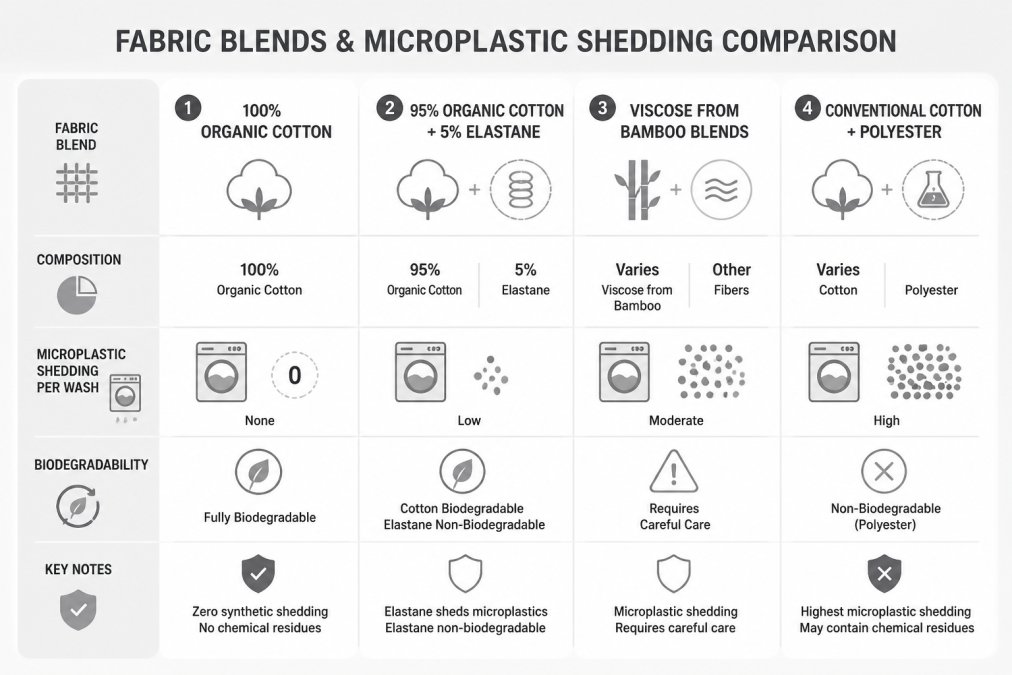
Check the exact fiber content. A 95% organic cotton, 5% polyester blend sheds synthetic fibers every wash, Here's the blend comparison:
100% Organic Cotton
- No synthetic fiber shedding
- Fully biodegradable at end-of-life
- Slightly higher upfront cost
95% Organic Cotton + 5% Elastane
- Sheds microplastics in every wash
- Elastane doesn't biodegrade
- Better initial stretch and recovery
- Lower upfront cost, but hidden environmental cost
Viscose from Bamboo Blends (e.g., 70% Viscose + 30% Organic Cotton)
- Viscose from bamboo is a regenerated cellulosic, semi-synthetic fiber made through chemical processing; bamboo plant properties do not survive processing
Dye Standards and Chemical Finishes
Dyes carry residual heavy metals and chemicals that don't fully rinse out. Made with OEKO-TEX STANDARD 100 certified fabric requires testing for these residues.
PFAS (per- and polyfluoroalkyl substances) are "forever chemicals" used in water-resistant finishes. They don't break down in your body or environment.
Look for brands that specify their dye process and PFAS-free claims. If a product page doesn't mention these, that's a gap worth noting.
Building the Best Sustainable Essentials for Men
The best essentials for men start with basics that work harder and last longer. A quality wardrobe is about buying pieces that earn their place through durability and comfort.
Start with organic cotton boxers. Synthetic blends trap heat, cling when you sweat, and degrade faster. Organic cotton boxers stay breathable, soft through dozens of washes, and free from chemical finishes.
Add organic cotton t-shirts next. Look for plain, well-fitted basics in neutral colors without graphic prints or heavy finishes.
Build around these anchors with organic cotton socks, undershirts, and sleepwear, simple, durable, and chemical-free pieces you'll actually reach for.
Skip trend pieces. A gray organic cotton t-shirt that still fits perfectly and hasn't pilled is worth more than a trendy piece you'll discard in a season.
How to Build a Capsule Wardrobe with Organic Cotton
A capsule wardrobe built on organic cotton essentials means fewer pieces, higher quality, and outfit flexibility.
Organic Cotton Boxers – Wrapped →
Begin with five core pieces: two organic cotton t-shirts in neutral colors, two pairs of organic cotton boxers, and one long-sleeve organic cotton shirt.
Add one organic cotton sweater and one pair of organic cotton pants. Only add pieces that work with at least three other pieces already in your rotation.
Organic cotton essentials last longer, so the higher upfront cost becomes irrelevant over time through cost-per-wear calculations.
The psychological shift matters too. When your drawer contains only pieces you genuinely like wearing, getting dressed becomes simpler. You stop buying to fill gaps and start buying to replace worn pieces. That's sustainable by definition.
Cost-Per-Wear and Long-Term Value
Cost-per-wear is the metric that changes how you evaluate organic cotton essentials. It's simple: divide the price by the number of times you'll wear it before it's no longer wearable.
A $24 organic cotton boxer from Mellow Mile, worn 3-4 times per week, can stay comfortable and maintain its shape for roughly 3-4 years. That's 450-520 wears. Cost-per-wear: $0.046 to $0.053 per wear.
The math favors organic cotton, but only if the garment actually lasts. This is where brand matters. A poorly made organic cotton piece that falls apart after 50 wears is a bad investment. A well-constructed piece from a brand focused on durability is a good one.
When evaluating essentials online, look for construction details: reinforced seams, quality elastic, and consistent stitching. Read customer reviews specifically for longevity comments. If reviewers mention garments holding up after dozens of washes, that's a signal the brand is building for durability.
Small-batch production, like Mellow Mile uses, allows for tighter quality control. Fewer units produced means fewer opportunities for manufacturing defects to slip through. It's a proxy for consistency.
Care and Longevity: Making Your Essentials Last
How you care for organic cotton essentials determines whether they last years or months. The good news: organic cotton is durable when treated properly, and at the end of its life, it can return to the earth.
Washing and Storage for Maximum Lifespan
Wash in cold water. Hot water breaks down elastic and accelerates fiber degradation. Cold water cleaning is equally effective and extends garment life significantly.
Use mild detergent. Heavy-duty detergents with surfactants and enzymes break down cotton fibers over time. A simple, plant-based detergent cleans just as well without the wear.
Skip the dryer. Heat damages elastic and causes shrinkage. Hang-dry your essentials or lay them flat. This adds 30 minutes to your laundry routine but adds years to your garments' lifespan.
Wash less frequently. Essentials don't need washing after every wear unless they're visibly soiled or smell. Wearing a piece twice between washes cuts your total wash cycles in half, which doubles garment lifespan.
Mend small issues immediately. A loose seam becomes a torn seam becomes an unusable garment. A simple repair now prevents a replacement later.
Store properly. Fold instead of hanging to prevent stretching. Keep in a dry place away from direct sunlight, which fades color and weakens fibers.
Follow these practices and an organic cotton essential can remain comfortable and functional for 3-5 years.
End-of-Life: The Circular Economy Advantage
Where organic cotton essentials differ fundamentally from synthetic alternatives is what happens when they're no longer wearable. Organic cotton is biodegradable. Synthetics are not.
When an organic cotton garment reaches the end of its life, you have three options:
Composting Organic cotton can be composted in a home or commercial compost facility. Unlike synthetic blends, it breaks down completely. The fiber returns to soil as organic matter. This is a direct circular path: cotton grown from soil, worn, then returned to soil.
To compost organic cotton essentials: remove any non-cotton components (elastic, synthetic tags, or dyes that aren't OEKO-TEX certified). Cut the garment into small pieces to accelerate decomposition. Add to a compost bin with brown materials (leaves, cardboard) and green materials (food scraps, grass).
Textile Recycling If composting isn't an option, textile recycling programs accept organic cotton.
Why This Matters for Sustainability Claims
Organic cotton essentials can close that loop. A synthetic-blend shirt might be made with some organic cotton, but when it's discarded, the polyester and elastane persist in landfills. An organic cotton essential, by contrast, completes a full cycle: grown without synthetic pesticides, worn without chemical finishes, and returned to soil or recycled into new fiber.
Frequently Asked Questions
How can I verify if clothing is made with GOTS certified organic cotton?
Look for explicit labeling stating 'made with GOTS certified organic cotton.' Legitimate brands provide certification details on product pages or hang tags. GOTS certification means the organic cotton was grown without synthetic pesticides and processed under strict environmental and social standards. Ask the brand for third-party documentation if you're unsure. Mellow Mile's Organic Cotton Boxers are made with GOTS certified organic cotton and include OEKO-TEX STANDARD 100 certified dyes, with full certification details available on the product page.
What are the benefits of choosing organic cotton over conventional cotton?
Organic cotton is grown without synthetic pesticides, reducing chemical exposure on your skin and in the environment. It supports soil health and water conservation compared to conventional cotton farming. For essentials worn close to sensitive skin, organic cotton eliminates residual chemical finishes that conventional fabrics often retain. The trade-off is slightly higher cost, but durability and comfort often justify the investment for daily-wear items.
Are organic cotton clothes more durable than standard cotton?
Quality matters more than fiber type alone. Well-made organic cotton essentials can be very durable. Small-batch production processes allow for better stitching, reinforced seams, and higher-grade fabric weight.
What should I look for when buying organic cotton essentials online?
Prioritize fiber content (look for 100% organic cotton or high organic percentages), certifications (GOTS for organic cotton, OEKO-TEX for dyes), and manufacturing transparency. Check return policies in case sizing or feel doesn't match expectations. Read customer reviews focusing on durability and skin comfort. Review supply chain information to understand where and how garments are produced. Price should reflect quality construction, not just certification.