


7 Steps to Choose Breathable Athletic Hats That Work
Last Updated: November 2, 2026
Quick Summary
To choose breathable athletic hats, match the fabric and ventilation to your activity and climate: thin polyester with laser-cut holes for hot, humid runs, merino for cooler trail days, and UPF 50+ with a wide brim when sun exposure is high. Check that vents cover the top and sides, the sweatband is thin and wicking, and the crown fits just above your ears.
- Polyester wicks sweat and dries in under 30 minutes in sun; cotton can take two hours or more.
- Estimate ventilation by checking whether mesh or perforations cover roughly a third of the crown.
- A thick, non-wicking sweatband blocks vents from receiving moisture, so the hat stays clammy.
- For hot, humid runs, pick thin polyester with laser-cut holes across the top and sides.
- Rinse after every sweaty run, hand wash cold, skip fabric softener, and air dry to keep vents clear.
Table of Contents
- What Makes an Athletic Hat Breathable
- Breathable Running Hat Materials Compared
- Ventilation Features That Move Air
- Running Hat Fit Guide: Crown, Sweatband, and Shape
- Running Hats With Sun Protection
- How to Wash a Running Hat So It Keeps Performing
- Pick Your Hat and Get Moving
- Frequently Asked Questions
What Makes an Athletic Hat Breathable
Breathable athletic hats move heat and moisture away from your head faster than your body produces them. Three things control that: airflow through the fabric, how quickly the material pulls sweat off your skin, and how fast that sweat evaporates once it reaches the surface. Get all three right and the hat stays comfortable. Miss one and you get a hot band of damp fabric pressed against your forehead by mile three.
Here is the part most buying guides skip. Breathability is not a single fabric property you can rank from a spec sheet. It is a system. A hat with excellent mesh panels and a thick, non-wicking sweatband will still feel clammy, because the sweat never reaches the vents. This guide walks through the decisions that actually matter, in the order a runner would make them.
Airflow, Fabric, and Sweat Evaporation
Airflow is the starting point. Vents, mesh, and perforations let hot air escape and cooler outside air enter. Without them, even a thin fabric traps heat against your scalp.
Evaporation is the finish line. Sweat cools you only when it evaporates. A fabric that holds water, like cotton, keeps moisture against your skin and slows that process. A fabric that spreads moisture across a wide surface area dries faster.
Moisture-wicking describes how a fabric pulls liquid sweat from the skin side to the outer surface. Sweat management is the broader job: wicking, spreading, and drying. When a hat handles all three, you notice it as comfort, not as technology.
Breathable Running Hat Materials Compared
Running hats are made from several fabrics, and the right pick depends on your climate and how hard you sweat. A simple rating table can hide the trade-offs that matter on a long run. This section breaks down how each fabric actually performs across airflow, drying time, odor control, durability, and feel, so you can match the material to your conditions rather than a vague "breathable" label.
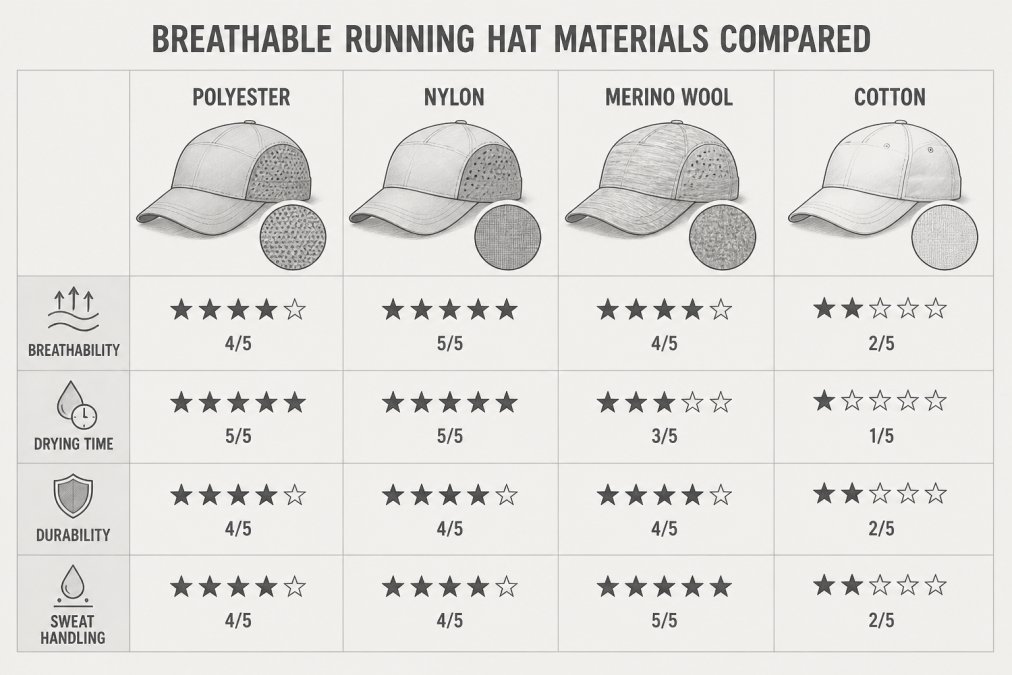
Polyester, Nylon, Merino Wool, and Cotton Side by Side
| Fabric | Airflow | Drying Time | Odor Control | Durability | Feel |
|---|---|---|---|---|---|
| Polyester | High with vents | Fast (under 30 min in sun) | Low to moderate; holds odor if not washed | High | Light, smooth |
| Nylon | High | Fast | Low to moderate | Very high | Slightly slick, stiffer hand |
| Merino wool | Moderate | Moderate (1-2 hours) | High; naturally resists odor | Moderate | Soft, warm |
| Cotton | Low | Slow (2+ hours) | Low; holds moisture and odor | Moderate | Soft but heavy when wet |
Polyester is a common running hat material. It is lightweight and wicks sweat effectively when knit thin. The trade-off: polyester can develop a persistent odor if sweat and bacteria stay in the fibers, so rinsing after every run matters more than with other fabrics.
How to Compare Without Relying on Marketing Claims
Most hats do not publish fabric weight or drying time, so use these practical checks:
- Ventilation area: Estimate the percentage of the crown covered by mesh or perforations. More open area means more airflow, but less sun protection.
- Drying time: Wet the hat and time how long it takes to dry in direct sun. Synthetics typically dry in under 30 minutes; cotton can take two hours or more.
- Moisture transfer: Place a drop of water on the inside of the fabric. If it spreads quickly and appears on the outside, the wicking is working.
If you are comparing materials more broadly, our guide to chemical-free athletic wear materials and certifications covers what the labels actually mean.
Ventilation Features That Move Air
Ventilation is where a hat earns its breathability claim. Look for laser-cut ventilation holes, mesh panels, and vented sides. Each moves air differently, and the placement matters more than the total number of vents.
- Laser-cut holes punch small openings through the crown panels, letting heat escape without weakening the fabric. They work best when concentrated on the top and sides, where heat rises.
- Mesh panels sit on the sides and top, where heat rises. Larger mesh panels increase airflow but reduce sun protection, so balance the two for your exposure.
- Vented sides open the area above the ears, a spot that traps heat fast. This is often overlooked but makes a noticeable difference on long runs.
A common mistake is buying a hat with vents only on the front. Heat rises, so the top and sides matter more than the bill. Another mistake is assuming more vents always means better breathability, if the sweatband is thick and non-wicking, the vents never receive the moisture they need to work.
How to Evaluate Ventilation Area
You can estimate ventilation without a lab. Look at the crown from above: if mesh or perforations cover roughly a third or more of the surface, the hat will move air well in hot conditions. If vents are limited to a few small holes on the front, expect limited airflow. For high-sun exposure, prioritize a vented crown with a wide brim rather than maximum open area.
Matching Ventilation to Your Activity and Climate
- Hot, humid runs: Choose thin polyester with laser-cut holes across the top and sides. Mesh panels help, but avoid large open areas that let sun through.
- Dry heat: Ventilation matters, but so does sun coverage. A vented crown with a wide brim and dark underbrim balances airflow and glare reduction.
- Trail running in exposed terrain: A caped coverage flap at the back adds neck protection without blocking airflow up top.
- Cool-weather training: You need less ventilation and more warmth; merino wool with modest vents suits this better than a fully mesh cap.
Our athletic hats feature laser-perforated holes for breathability. If ventilation is your priority, you can browse the performance hats collection to see the options.
Running Hat Fit Guide: Crown, Sweatband, and Shape
Fit decides whether breathability features actually reach your skin. A hat that sits too tight presses the sweatband against your forehead and blocks airflow. Too loose and it shifts, which chafes on long runs.
Check three things:
- Crown depth. The hat should sit just above your ears without riding up.
- Sweatband. A thin, wicking band routes sweat away from your eyes. A thick cotton band holds it.
- Shape. Round and oval heads fit differently. Adjustable straps cover most of the gap.
If you have thick hair or wear a ponytail, look for a slightly deeper crown and a strap that adjusts at the back. Before ordering, check the athletic shirt size chart to confirm measurements.
Running Hats With Sun Protection
Sun protection and breathability pull in opposite directions. A wide brim shades your face but traps heat. The fix is balancing coverage with airflow.
Look for UPF 50+ fabric, which blocks most UV rays. A wide brim protects ears and neck, and a dark underbrim cuts glare off the ground. Light-colored fabric reflects heat; dark fabric absorbs it, so a light crown with a dark underbrim is a smart combo.
For long summer runs, pair a vented crown with a brim wide enough to shade your eyes. For trail running in exposed terrain, a caped coverage flap at the back adds neck protection without blocking airflow up top.
How to Wash a Running Hat So It Keeps Performing
Washing matters more than most runners think. Sweat, salt, and sunscreen clog the tiny pores in performance fabric and vents. A clogged hat breathes worse than a new one.
- Rinse after every sweaty run to clear salt
- Hand wash in cold water with mild detergent
- Skip the fabric softener, which coats fibers and blocks wicking
- Air dry, never in a hot dryer
- Reshape the brim while damp
For the full method, read our guide to washing organic cotton apparel, which covers cold-water care and air drying in detail.
Pick Your Hat and Get Moving
The right breathable athletic hats come down to matching fabric and vents to your activity and climate. Hot, humid runs call for thin polyester with laser-cut holes. Cooler trail days might suit merino. Sun exposure pushes you toward UPF 50+ and a wide brim.
Here is the short version:
| Your Priority | Best Choice |
|---|---|
| Hot, humid runs | Polyester with laser perforation |
| Maximum durability | Nylon |
| Odor control | Merino wool |
| Sun coverage | UPF 50+ wide brim |
| Everyday wear | Soft, breathable fabric |
Our athletic hats are made from 100% polyester with laser-perforated holes for breathability, and dyed with non-toxic dyes. At $26.00, they are a way to test a vented cap on your next run. You can shop the Sagebrush athletic hat to see the details.

Frequently Asked Questions
What makes an athletic hat breathable?
Breathability comes down to three things: the fabric, the amount of airflow the design allows, and how quickly the hat moves sweat away from your head. Open weaves, mesh panels, and laser-cut ventilation holes let hot air escape. Moisture-wicking fabrics spread sweat across the surface so it evaporates faster. A hat that traps heat and holds moisture will feel heavy and hot no matter how light it is.
Which materials are best for a breathable running hat?
Our athletic hats are made from 100% polyester, which is lightweight and wicks sweat effectively. A polyester hat with laser-perforated holes balances breathability and everyday comfort.
How should a running hat fit?
A running hat should sit snug without pressing on your forehead or leaving deep marks. The crown should clear the top of your head, and the sweatband should sit flat against your skin. Check that the hat stays put when you turn your head or jog in place. If it slides or lifts in wind, size down or use the rear adjuster. Too tight causes pressure points; too loose means it shifts mid-run.
How do you wash a sweaty athletic hat?
Hand wash in cool water with a small amount of mild detergent, then rinse thoroughly. Air dry the hat in a well-ventilated spot, reshaping the crown by hand. Wash after every few heavy sweat sessions to prevent salt buildup and odor.
Choosing a hat that actually breathes takes a little homework, but the payoff shows up on every hot run. At Mellow Mile, we build small-batch athletic hats with laser-perforated ventilation, 100% polyester construction, and non-toxic dyes, so you get airflow without guesswork. Browse the collection and sign up for 20% off your first order to find the cap that fits your training.
