


How to Select Breathable Athletic Hats for Sensitive Skin
Last Updated: November 4, 2026
Quick Summary
To select breathable athletic hats for sensitive skin, prioritize the fabric touching your forehead, mesh or laser-cut perforations for airflow, and flat seams with a soft, absorbent sweatband. Check the sweatband material, seam placement, band width, interior tags and brim edge before buying, and choose an adjustable fit with room to loosen.
- Mesh panels work best on the sides and back, where heat builds fastest.
- Flat-locked or bonded seams lie flatter than standard overlapped seams.
- A hat snug on day one often presses harder once the band swells with sweat.
- Loosen the closure one notch first to test whether pressure causes the itch.
- Hand wash in cool water with fragrance-free, dye-free detergent and air dry away from heat.
Table of Contents
- Start With the Fabric Against Your Skin
- Breathable Running Hats: Mesh, Perforation, and Airflow
- Sweatband and Seam Construction That Prevents Irritation
- Finding the Best Running Hat for Sun Protection
- Itchy Hat Solutions: Fit, Friction, and Adjustability
- How to Wash an Athletic Hat for Sensitive Skin
- Try the Mellow Mile Athletic Hat
- Frequently Asked Questions
Start With the Fabric Against Your Skin
Learning how to select breathable athletic hats for sensitive skin starts with one rule: the fabric touching your forehead matters more than the fabric on top of your head. Most hats put a band of synthetic material directly against your skin for an hour or more.
Breathable athletic hats are hats built to move heat and moisture away from your head instead of holding it there. Three things do that work:
- The fabric itself, and how quickly it moves sweat outward
- The openings that let hot air escape
- The band that sits against your skin
Get the first two right and the third wrong, and you will still itch. That is the part most buying guides skip.
Why Polyester and Nylon Feel Different to Sensitive Skin
Polyester and nylon are smooth, strong, and cheap to produce. They also hold heat close to the body and dry slowly when woven tightly.
If you want the full picture of how synthetic fabrics interact with reactive skin, our guide on why synthetic fabrics irritate skin breaks down heat, friction, and chemical finishes in plain terms.
Not every synthetic hat is a problem. Construction and dye choices matter. The point is to read the whole spec.
If you are still deciding which fiber suits you best, start with this breakdown of the best fabric for sensitive skin before you shop.
Breathable Running Hats: Mesh, Perforation, and Airflow
Breathable running hats solve heat through openings, not through thin fabric alone. Mesh panels, laser-cut perforations, and open-weave sections let hot air leave the hat and cooler air enter.
Here is what to look for, ranked by how much it helps:
- Mesh panels on the sides and back, where heat builds fastest
- Laser-perforated holes across the crown for steady airflow
- Open-weave fabric on the top panel
- A thin, absorbent sweatband that pulls moisture off your skin
Mesh does one trade-off you should know about. Bigger openings mean better ventilation and less sun protection on that panel.
For a step-by-step framework on picking a ventilated running cap, read 7 steps to choose breathable athletic hats that work.
Sweatband and Seam Construction That Prevents Irritation
Irritation can start at the sweatband and the seams, not just the crown. A rough band, a raised seam over the forehead, or a plastic edge that presses into skin can cause friction.
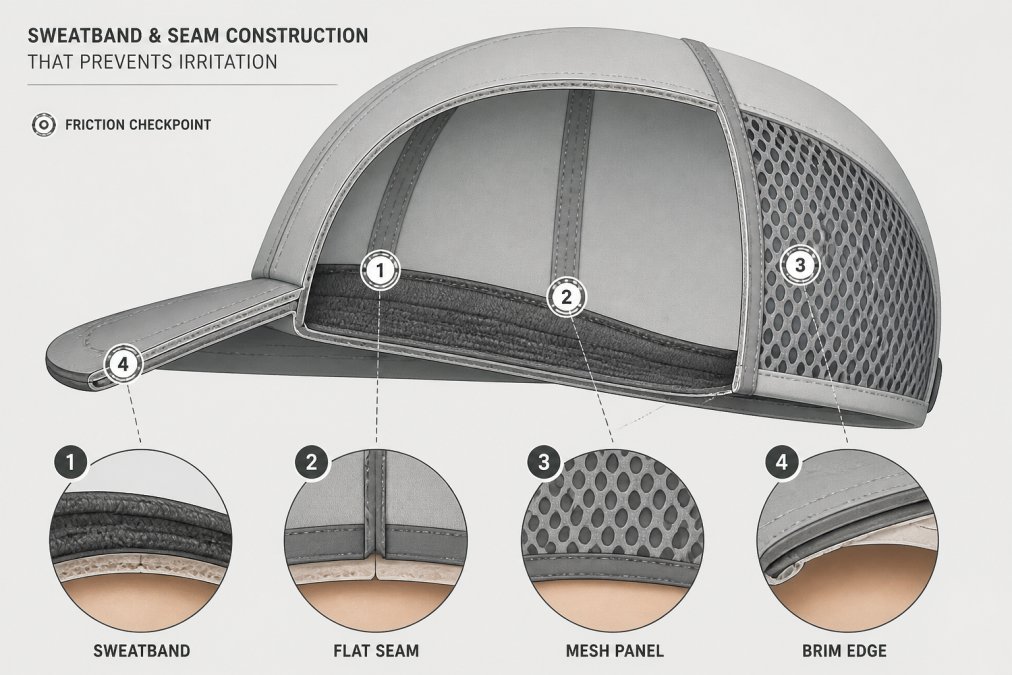
What Sits Against Your Skin, Layer by Layer
Four components touch your head, and each fails in a different way:
- Sweatband: the primary contact surface. Look for a soft, absorbent band with a smooth face and no exposed foam edge. A band that stays damp holds moisture against skin for the whole run.
- Seams: flat-locked or bonded seams lie flatter than standard overlapped seams. A raised seam running across the forehead is the single most common source of friction.
- Interior tags: printed or heat-transfer labels beat sewn tags, which scratch and trap sweat at the nape.
Sweatband Materials Compared
| Material | Feel Against Skin | Moisture Behavior | Trade-off |
|---|---|---|---|
| Polyester terry | Soft, slightly textured | Absorbs and spreads sweat | Can stay damp if thick |
| Microfiber | Very smooth | Wicks quickly | Less cushioning |
| Cotton-blend band | Soft, familiar | Absorbs well, dries slowly | Holds moisture longer |
| Silicone grip strip | Grippy | Does not absorb | Can feel tacky on bare skin |
Friction Irritation vs. a Possible Allergy
If a reaction spreads beyond the contact zone or does not settle, check with a dermatologist.
Five Points to Check Before You Buy
- Sweatband material: soft, absorbent, smooth against skin
- Seam placement: flat seams or seams kept away from the forehead
- Band width: wide enough to spread pressure, not a thin cord
Watch out: a hat that fits snugly on day one often presses harder once you sweat and the band swells. Buy for a comfortable fit with room to adjust, not a tight one. Also check the inside of the crown for stiffening tape or a plastic insert behind the front panel, it can press into the forehead on hats that look soft from the outside.
Finding the Best Running Hat for Sun Protection
The best running hat for sun protection covers the areas that burn first: forehead, nose, ears, and the back of the neck. Coverage and breathability pull against each other, so the goal is a hat that shades without sealing heat in.
Use this order when you compare options:
| Feature | What to Check | Why It Matters |
|---|---|---|
| Brim shape | Front brim long enough to shade eyes and nose | Cuts glare and facial sun exposure |
| Crown coverage | Solid fabric on top, mesh on sides | Blocks overhead sun, vents heat |
| Color | Lighter colors reflect more heat | Cooler feel in direct sun |
| Sweatband | Absorbent, soft against skin | Keeps sweat out of your eyes |
| Fit | Snug but not tight, adjustable | Prevents pressure and friction |
A hat with a UPF rating gives you a stated level of UV protection. If a brand lists one, check what it covers, since a rating applies to the fabric, not the whole hat.
Itchy Hat Solutions: Fit, Friction, and Adjustability
Most itchy hat solutions come down to fit, not fabric. A hat that is too tight presses the band into your forehead. One that is too loose slides and rubs. Both create the friction that sets off irritation. The trick is isolating which variable is causing the problem instead of guessing.
Isolate the Cause in Order
Work through these one at a time so you know what actually fixed it:
- Loosen the closure one notch and give it a few minutes. If the itching stops, the cause was pressure, not material.
- Check the seam line. Reposition the hat so no seam sits over a sensitive spot. If the itch moves with the seam, the seam is the problem.
- Switch to a wider sweatband if the current one is thin. A narrow band concentrates pressure on a small area.
- Wash the hat before the first wear to remove any manufacturing residue, then rinse thoroughly.
- Rotate two hats so neither stays damp against your skin day after day.
Check for Friction at Four Points
Before a long run, press the hat down and feel for rubbing at these spots:
- Forehead: the band should sit flat with no ridge
- Temples: the brim edge should not dig in when you turn your head
- Ears: no hard edge or strap pressing behind the ear
- Hairline and nape: the closure and tag should lie flat, not bunch
Pick an Adjustment System That Avoids Pressure Points
Adjustability matters more than most people think. A closure you can fine-tune lets you loosen the hat as it warms up and your head swells slightly. That single feature prevents a lot of pressure-based irritation.
- Hook-and-loop strap: easy to fine-tune, but the strap end can rub at the nape if it is stiff.
- Buckle or clip: secure and low-profile, but offers coarser adjustment steps.
- Elastic band: stretches with you, but can lose tension over time and press if it is narrow.
- Drawcord: good for a wide range of fit, but the toggle can sit against the back of the head.
Whichever you choose, the closure should sit flat against the head with no hard plastic tab pressing into skin.
A Short Wear Test Before You Commit
Consider wearing the hat indoors for a short period before your first real workout. Jog in place, turn your head, and sweat a little if you can. Then check:
- Any red marks or ridges on the forehead or temples
- Any spot that feels warm, damp, or prickly
- Whether the hat shifted and needed re-adjusting
If a mark fades within a few minutes and there is no sting, the fit is likely fine. If a spot stays irritated, try the next size or a different closure before you keep it.
When to Return or Replace
Return or replace a hat if a red mark or itch persists after a short wear, if a seam sits directly over a sensitive spot you cannot reposition, or if the closure cannot be adjusted to a comfortable fit.
Watch out: washing a hat does not fix a pressure problem. If the itch comes from a tight band or a raised seam, cleaning it will not help, change the fit or the construction instead.
How to Wash an Athletic Hat for Sensitive Skin
Wash an athletic hat by hand in cool water with a fragrance-free, dye-free detergent, then air dry it away from direct heat. Skip the dryer. Heat can warp the brim and set sweat and residue deeper into the band.
A simple routine:
- Rinse the sweatband after every hard workout
- Hand wash weekly with mild detergent
- Rinse thoroughly to remove all soap
- Reshape the crown and brim by hand
If you have reactive skin, avoid fabric softener and scented detergents entirely. For more on caring for skin-friendly clothing, our guide on The Longest Mile covers washing and material care in more depth.
Try the Mellow Mile Athletic Hat
Our Sagebrush Athletic Hat is made from 100% polyester, dyed with non-toxic dyes, and cut with laser-perforated holes for airflow across the crown.
The perforated crown is designed for airflow.
Best for: runners and gym-goers who overheat fast and want a light, ventilated cap. Skip if: you want a fully solid crown with maximum shade over the top panel.
You can see the full range and pick a color on the Sagebrush Athletic Hat page.

Frequently Asked Questions
What is the most breathable hat for hot weather and sensitive skin?
Look for laser-perforated holes or mesh panels that let air move through the crown, plus a sweatband that pulls moisture away from your forehead. A lightweight construction helps too. The Mellow Mile Athletic Hat uses laser-perforated holes for breathability and is made from 100% polyester with non-toxic dyes, so it suits hot-weather runs and everyday wear. Check that the brim does not trap heat and that the closure adjusts without pressing on your skin.
How do I make an itchy hat less irritating?
Start by washing it before the first wear to remove any factory residue. Check the sweatband for rough seams or scratchy labels and cut or cover them if needed. Adjust the closure so the hat sits snug but not tight, since pressure points cause rubbing. If the itch continues, the fabric itself may be the trigger, so switch to a hat with a smooth interior and perforated panels.
Which hat materials are less likely to irritate sensitive skin?
Smooth, lightweight fabrics with a soft interior tend to cause fewer contact reactions than rough or heavy materials. Polyester with non-toxic dyes and laser-perforated ventilation is one option for athletic hats. Avoid hats with stiff inner seams, metal grommets that touch the forehead, or heavy canvas. Always check the label for dye and finish information, and wash new hats before wearing.
How should an athletic hat fit to avoid rubbing?
The hat should sit level on your head with about a finger's width of space above your ears. The sweatband should touch your forehead evenly without pressing hard. If you feel pressure at the temples or the back of the head, loosen the adjustable closure. A secure fit that does not slide during runs is ideal, but a tight fit causes friction. Test by shaking your head gently; the hat should stay put without leaving red marks.
Choosing a hat that works for sensitive skin comes down to three checks: the band against your forehead, the airflow through the crown, and the fit you can adjust as you heat up. Get those right and the rest is detail. Mellow Mile builds small-batch essentials with clean material choices, non-toxic dyes, and construction that holds up to daily wear. Sign up for 20% off your first order and find out what a hat that breathes properly feels like.
