


Are Bamboo Clothes Better for Skin? A Fact-Based Guide
Last Updated: October 23, 2026
Quick Summary
Bamboo clothes are not automatically better for skin, because viscose from bamboo is a semi-synthetic fiber whose plant properties do not survive processing. Smoothness, breathability, certification, fit, and washing decide whether a garment suits reactive skin more than the fiber name does.
- Viscose from bamboo and bamboo rayon are the same regenerated cellulose fiber under different label names.
- Flatlock seams and tagless necks reduce the two most common mechanical skin irritants.
- Hypoallergenic has no enforceable definition for textiles in the United States.
- Wash new garments before first wear with fragrance-free, dye-free detergent and skip fabric softener.
- Patch-test a new garment on your forearm for a few hours before torso wear.
Table of Contents
- What Bamboo Clothes Actually Are (and What They Aren't)
- Viscose From Bamboo vs Cotton: How They Compare Against Skin
- Can Bamboo Viscose Cause Skin Irritation?
- The Best Fabric for Sensitive Skin Isn't One Answer
- Hypoallergenic and Antibacterial Claims: What the Evidence Supports
- How to Wash Clothes for Sensitive Skin
- How to Choose Bamboo Clothes for Your Skin
- Frequently Asked Questions
What Bamboo Clothes Actually Are (and What They Aren't)
Most shoppers picture a plant when they read "bamboo." That picture is misleading. Viscose from bamboo is a regenerated cellulosic fiber: the bamboo is broken down chemically and reformed into a semi-synthetic textile, not woven straight from stalks (the FTC). At Mellow Mile, we build our Athletic Tee from 95% viscose from bamboo and 5% elastane, and we describe it that way on purpose.

That distinction matters more than any marketing claim. The bamboo plant's properties do not survive the chemical conversion into fiber. So when a label implies the shirt inherited them, the label is overselling.
Bamboo Viscose vs. Bamboo Rayon: Same Fiber, Different Label
Bamboo viscose and bamboo rayon describe the same material. Both are regenerated cellulose made by dissolving bamboo pulp and extruding it into fiber. The label difference is naming convention, not chemistry. If you are comparing fibers in detail, this guide to whether bamboo fabric is really non-toxic covers the processing side.
Viscose From Bamboo vs Cotton: How They Compare Against Skin
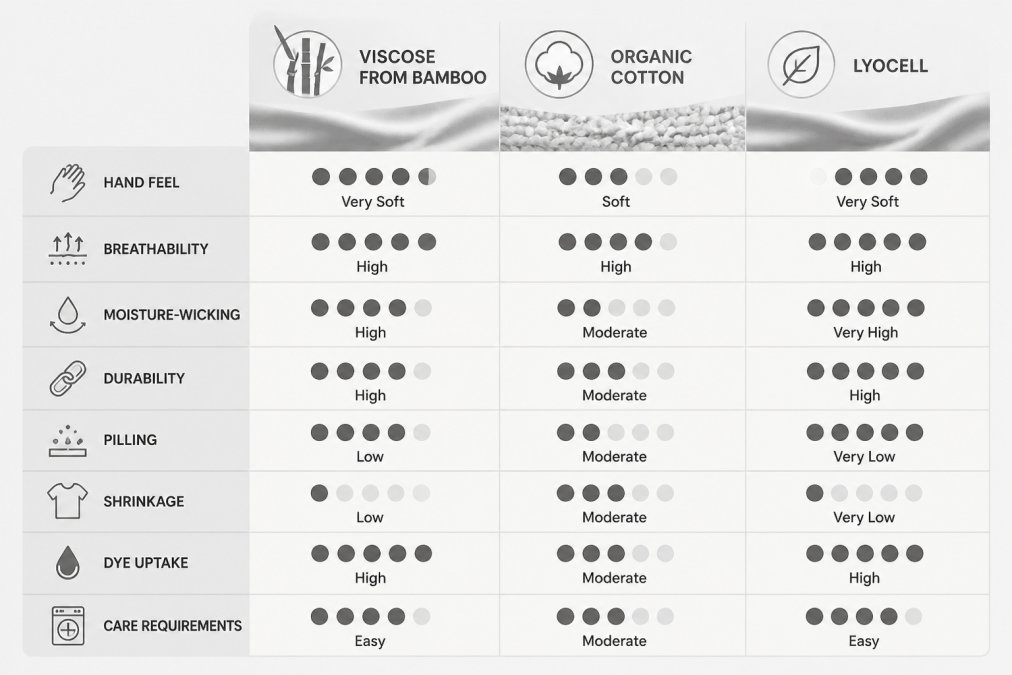
Neither fiber wins outright, and the fiber is rarely the whole story. Viscose from bamboo has a smooth, cool hand feel and drapes softly against skin.
Softness, Breathability, and Moisture Handling
Softness is the headline. Viscose from bamboo feels smoother than most cotton knits, which reduces the micro-abrasion that can aggravate sensitive skin. Lyocell feels similarly smooth. Breathability and moisture-wicking are good across all three, not magical.
Cotton absorbs moisture well but holds it longer. Viscose from bamboo and lyocell move it off the skin faster. For a hot workout, that difference is noticeable.
The Variables That Outrank Fiber
Two shirts made from the same viscose from bamboo can behave completely differently against reactive skin. Before you compare fiber names, compare these:
- Weave and knit density. An open knit releases heat and sweat; a dense knit traps both. A lightweight jersey usually feels cooler than a heavy interlock, regardless of fiber.
- Dyes and finishes. Fiber-reactive dyes bond to cellulose and tend to bleed less; pigment dyes sit on the surface. Softeners, anti-pilling finishes, and water-repellent treatments are added chemistry that some skin reacts to. Fewer finishes means fewer variables.
- Seams and tags. Flatlock seams and tagless necks reduce the two most common mechanical irritants. A smooth fiber sewn with a bulky seam still scratches.
Skin-Condition-Specific Considerations
"Sensitive skin" is not one condition, and the fabric trade-offs differ by diagnosis. This is a general-orientation comparison, not medical advice, a dermatologist can match it to your specific case.
- Eczema (atopic dermatitis). The dominant triggers are heat, sweat, and friction. Smooth, breathable, loosely fitted garments help; tight, occlusive ones hurt. Cotton and viscose from bamboo both work when the fit and weave are right. Wash new garments before wearing and use fragrance-free detergent.
- Contact dermatitis. The trigger is usually a substance, not a fiber, dyes, finishes, formaldehyde-releasing resins, or detergent residue. Certification and a short ingredient list matter more than fiber choice here.
- Acne and folliculitis. Trapped sweat and friction along the back and shoulders are the usual culprits. Breathable, loose, moisture-moving fabrics help; heavy or tight garments do not.
If you want to understand how synthetic fabrics irritate skin by comparison, our breakdown of why synthetic fabrics irritate skin explains the mechanism.
Can Bamboo Viscose Cause Skin Irritation?
Yes, for some people. Viscose from bamboo is not automatically gentle. Residual processing chemicals, dyes, and finishes can irritate reactive skin, and a tight fit creates friction regardless of fiber. Anyone who reacts to synthetic fabrics should read labels closely.
If you want to understand how synthetic fabrics irritate skin by comparison, our breakdown of why synthetic fabrics irritate skin explains the mechanism.
Processing Chemicals and Residual Exposure
Turning bamboo into viscose involves solvents, including carbon disulfide. Well-run mills recover most of it, and finished fabric is washed. Residual amounts in a finished garment are typically low, but "low" is not "zero," and it is not a guarantee for every skin type.
This is where certifications help. Fabric made with OEKO-TEX STANDARD 100 certified material has been tested against restricted substance limits (OEKO-TEX® STANDARD 100). That is a test of the fabric, not a promise that your skin will love it.
The Best Fabric for Sensitive Skin Isn't One Answer
The best fabric for sensitive skin depends on the trigger. If friction is your problem, smooth viscose from bamboo helps. If you react to dyes and finishes, certification matters more than fiber.
Our advice: change one variable at a time. Swap the shirt, keep everything else the same, and give it a week. If you want a curated starting point, this guide to men's apparel for sensitive skin narrows the field.
Hypoallergenic and Antibacterial Claims: What the Evidence Supports
Treat both claims with caution, but for different reasons. "Hypoallergenic" has no enforceable definition for textiles in the United States, any brand can print it. Antibacterial and odor-resistance claims tied to the bamboo plant are the bigger stretch, because plant properties do not survive viscose processing. What the evidence does support is narrower and more useful: smooth fibers reduce friction, breathable fabrics reduce heat and sweat buildup, and certified fabrics limit restricted substances.
Why the Plant-to-Fabric Claim Doesn't Hold
The bamboo plant contains compounds that, in the living plant, resist microbes. Viscose processing dissolves the bamboo pulp and regenerates it into cellulose fiber. The resulting textile is chemically a regenerated cellulosic, the same family as rayon and lyocell, and the plant's original compounds are not what you are wearing. Any antibacterial performance in a finished garment comes from a finish applied to the fabric, not from the plant.
Processing Chemicals vs. Residual Exposure
These are two different questions, and conflating them is where most articles go wrong.
- During manufacturing, viscose production uses solvents, including carbon disulfide. Well-run mills recover most of the solvent and treat wastewater; poorly run mills do not. This is a worker-safety and environmental question, and it is real.
- In the finished garment, the relevant question is residue. Fabric is washed and finished before it reaches you, and residual amounts are typically low. "Low" is not "zero," and it is not a guarantee for every skin type, which is why certification and a first wash matter.
How to Read the Evidence
Rank claims by how checkable they are:
- Tested and certified. A named standard (for example, OEKO-TEX STANDARD 100) with a certificate number is verifiable. It tests the fabric against restricted-substance limits; it is not a promise your skin will love it.
- Tested but not certified. A brand may cite lab results without a certificate. Ask which standard and which limits.
- Descriptive but unverified. "Soft," "breathable," "cool to the touch" are reasonable descriptions you can check by feel.
- Unverifiable performance claims. "Naturally antibacterial," "odor-resistant due to the plant," "hypoallergenic" with no standard behind it. Treat these as marketing until proven otherwise.
A Practical Patch-Test Protocol
If you have a diagnosed skin condition or a history of contact dermatitis, trial a new garment before committing to a full day of wear:
- Wash it once with fragrance-free, dye-free detergent and hang dry.
- Wear it against your forearm for a few hours on day one.
- If there is no reaction, wear it for a short session against your torso on day two.
This is where we make our case for Mellow Mile. Our Athletic Tee is made with OEKO-TEX STANDARD 100 certified fabric and OEKO-TEX certified dyes, with no PFAS-based finishes, and our Organic Cotton Boxers are made with GOTS certified organic cotton. Small-batch production keeps sizing honest through XL and XXL. One customer put it plainly: "I have sensitive skin and most workout shirts leave me itchy by the end of the day. Not this one."
How to Wash Clothes for Sensitive Skin
Washing matters as much as what you buy. Detergent residue, fabric softener, and dryer sheets leave deposits that cause contact dermatitis for many people. A simple routine removes most of that risk.
- Wash new garments before the first wear
- Use a fragrance-free, dye-free detergent
- Skip fabric softener and dryer sheets entirely
For cotton pieces, our step-by-step guide on how to wash organic cotton apparel covers temperature and drying in more detail.
How to Choose Bamboo Clothes for Your Skin
Start with the label, then the fit, then the finish. A garment that lists viscose from bamboo honestly, fits without clinging, and carries a recognized fabric certification is a safer bet than one leaning on plant imagery.
| What to Check | Why It Matters | Red Flag |
|---|---|---|
| Fiber name | Tells you it is viscose, not raw plant fiber | Bare "bamboo" with no process named |
| Certification | Confirms restricted-substance testing | Vague "naturally antibacterial" claims |
| Fit | Loose fit reduces friction and heat | Skin-tight cut on a "sensitive skin" shirt |
| Dyes and finishes | Fewer additives means fewer triggers | Strong scent out of the bag |
| Care label | Predicts shrinkage and pilling | No care instructions at all |
This is where we make our case for Mellow Mile. Our Athletic Tee is made with OEKO-TEX certified dyes and no PFAS-based finishes, and our Organic Cotton Boxers are made with GOTS certified organic cotton.
Frequently Asked Questions
What is the downside of bamboo clothes?
The main downsides are care and durability, not comfort. Viscose from bamboo is a regenerated cellulosic fiber made through chemical processing, so it can shrink and pill more readily than cotton if you machine dry it on high heat. Some people with very reactive skin find dyes and finishes, not the fiber itself, are the trigger. Check the label for OEKO-TEX STANDARD 100 certified fabric and wash cold to keep the hand-feel intact.
Is organic cotton or viscose from bamboo better for sensitive skin?
It depends on what your skin reacts to. Organic cotton is a natural fiber with a long track record for sensitive skin, and it holds up well to repeated washing. Viscose from bamboo has a smoother, cooler hand-feel that some people prefer in heat or during workouts. Neither is universally better. If you react to chemical finishes, look for OEKO-TEX STANDARD 100 certified fabric and GOTS certified organic cotton, and patch-test a single garment before replacing your whole drawer.
Can bamboo viscose cause skin irritation?
It can for some people, but the fiber is rarely the culprit. Irritation more often traces to dyes, chemical finishes, or a fit that traps sweat and rubs. Viscose from bamboo goes through chemical processing, and residual traces vary by manufacturer. If you have contact dermatitis or eczema, start with one shirt or pair of boxers, wash it once before wearing, and watch for redness or itching over a few days. Stop wearing it if symptoms appear and see a dermatologist for persistent reactions.
How do I wash bamboo clothes for sensitive skin?
Wash cold on a gentle cycle with a fragrance-free, dye-free detergent, and skip fabric softener and dryer sheets, which leave residue on the fabric. Turn garments inside out to reduce surface friction. Tumble dry low or hang dry; high heat is what causes viscose from bamboo to shrink and pill. Use about half the detergent you would for cotton, since buildup is a common irritant. If a garment still feels stiff or scratchy after one wash, run it through a second rinse cycle before wearing.
Your skin does not need another miracle fiber. It needs a shirt that names what it is made of, skips the chemical finishes, and fits without friction. Mellow Mile builds small-batch essentials around exactly that: non-toxic materials, no PFAS-based finishes, and durable construction that holds up wash after wash. Sign up for 20% off and start with a tee you can test against your own skin.
