


Best Sustainable Men's Clothing Brands 2026: A Buyer's Guide
Last Updated: October 23, 2026
Quick Summary
Sustainable men's clothing is apparel with documented choices about fiber origin, chemical inputs, labor conditions, and lifespan that a buyer can verify. We judge brands on five criteria: fiber composition, certification scope, manufacturing disclosure, end-of-life options, and price transparency. Check the fiber panel and certification scope before paying a premium.
- A certificate covering a fabric mill does not certify the finished garment.
- Viscose from bamboo is a semi-synthetic fiber, not a natural plant-based fabric.
- A $44 tee worn two hundred times beats a $12 tee worn fifteen.
- Replace underwear and base layers first, then tees, trousers, and outerwear last.
- A capsule of roughly fifteen interchangeable items covers a workweek and weekend.
Table of Contents
- What Actually Makes a Men's Clothing Brand Sustainable in 2026
- How to Spot Greenwashing When You Research Ethical Men's Clothing Brands
- Materials That Hold Up: Organic Cotton Men's Clothing and Alternatives
- Price, Cost Per Wear, and What You're Actually Paying For
- How to Build a Sustainable Men's Wardrobe Without Starting Over
- Men's Capsule Wardrobe Essentials That Earn Their Space
- Sizing, Fit, and the Questions to Ask Before You Buy
- Frequently Asked Questions
What Actually Makes a Men's Clothing Brand Sustainable in 2026
Start with fibers, because that is where most claims begin and end.
Sustainable men's clothing is apparel designed and produced with documented choices about fiber origin, chemical inputs, labor conditions, and lifespan, backed by evidence a buyer can check.
This guide from Mellow Mile walks through the five criteria we use to judge men's clothing, the greenwashing patterns that waste the most money, and how to build a wardrobe that lasts.
The Five Criteria That Separate Real Claims From Marketing
We score every brand against the same five questions. A weak answer in one area does not disqualify a brand, but it changes what you should pay.
| Criterion | Strong evidence | Weak evidence | Red flag |
|---|---|---|---|
| Fiber composition | Named fiber plus percentage on the label | Generic "natural blend" | No fiber content listed |
| Certification scope | Certificate names the standard and the facility | Logo with no standard named | "Certified" with no certifier |
| Manufacturing disclosure | Country and factory tier disclosed | Country only | "Ethically made" with no detail |
| End-of-life options | Repair, resale, or take-back program | Care instructions only | Nothing |
| Price transparency | Cost per wear is defensible | Mid-tier pricing, vague sourcing | Premium price, no evidence |
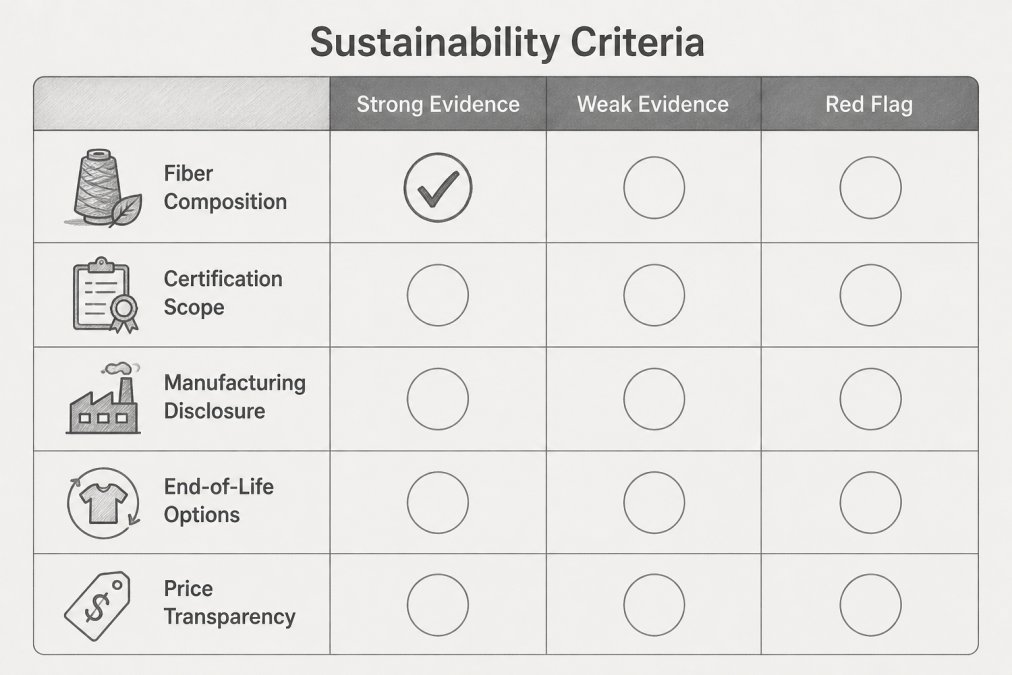
The fiber row is the one buyers skip, and the one that decides whether a shirt feels good against your skin in August.
How to Spot Greenwashing When You Research Ethical Men's Clothing Brands
Greenwashing in apparel usually is not a lie. The Federal Trade Commission's Green Guides exist precisely because "eco-friendly" and "sustainable" get used without qualification, and the guidance asks marketers to qualify claims rather than leave them floating.
Here is the pattern that catches the most people. It is not. Viscose from bamboo is a regenerated cellulosic fiber produced through chemical processing, and the plant's properties do not carry through to the finished fabric.
Three checks that take under five minutes:
- Find the fiber content panel. If the brand's product page does not match the label, walk away.
- Search the certification name plus "scope." A certificate covering a fabric mill is not a certificate covering the garment.
- Look for a named factory or at least a country of manufacture. "Globally sourced" tells you nothing.
Materials That Hold Up: Organic Cotton Men's Clothing and Alternatives
Fiber choice drives comfort, durability, and how a garment ages.
Organic cotton is a natural fiber grown without the synthetic inputs used in conventional cotton.

Hemp is durable and gets softer over time, but it starts stiff and wrinkles freely.
Recycled fibers divert material from waste streams, though quality varies widely.
TENCEL Lyocell is a regenerated cellulosic fiber made in a closed-loop process that recovers most of the solvent.
Viscose From Bamboo: What It Is and What It Isn't
Viscose from bamboo is a semi-synthetic fiber made by dissolving bamboo cellulose and extruding it into filament.
What it is not: natural, plant-based fabric, or inherently antimicrobial. Those claims get made constantly, and none survive contact with how the fiber is produced.
Our Athletic Tee is made from 95% viscose from bamboo with 5% elastane for stretch, made with OEKO-TEX STANDARD 100 certified fabric.
How Each Fiber Ages, Washes, and Ends Its Life
Durability is where fiber marketing and real life diverge. A few patterns hold:
- Organic cotton softens for the first dozen washes, then holds. Expect modest shrinkage on the first hot wash; hang drying protects the fit.
- Hemp softens dramatically over the first season and then stabilizes. It outlasts cotton in abrasion but shows creases.
- Recycled fibers vary by staple length. Post-consumer content pills sooner; pre-consumer content behaves closer to virgin.
End-of-life matters as much as first wear. Repair services extend a garment's life, and take-back or resale programs keep usable clothing out of the waste stream. Before you buy, check whether the brand offers repair, resale, or take-back, and whether the fiber supports the repair you would need, like re-hemming cotton or re-sewing a viscose seam.
Price, Cost Per Wear, and What You're Actually Paying For
Price tags tell you almost nothing on their own. Cost per wear does. Divide the price by the number of times you realistically wear the item before it fails, and the cheap shirt usually loses.
A $12 tee worn fifteen times costs more per wear than a $44 tee worn two hundred times. The math is unforgiving to fast fashion, which is why brands rarely put it on the label.
Three tiers, and what each should buy you:
- Under $20: expect thin fabric and short life. Fine for a costume, poor for a drawer staple.
- $20 to $50: the realistic range for well-made basics. At this level you should see a named fiber, a stated certification, and a fit description specific enough to trust.
- Over $50: you are paying for construction, origin, or brand. Demand evidence for all three.
How to Build a Sustainable Men's Wardrobe Without Starting Over
Replacing a wardrobe in one trip is expensive and usually wasteful. Replace items as they fail, one category at a time, starting with whatever touches your skin most.
Here is the sequence we recommend:
- Underwear and base layers first. These sit against skin all day and wear out fastest, so upgrades here deliver the most comfort per dollar.
- Then the tees you actually wear. Count them. Most men own far more than they rotate.
- Then one pair of jeans or trousers in a fabric and cut you will still want in three years.
- Then outerwear, bought last because it lasts longest and benefits most from a bigger budget.
- Retire, don't dump. Use repair services, resale, or take-back programs where the brand offers them.
The throughline is simple: buy fewer, better items and let the drawer shrink. A smaller wardrobe makes each purchase decision count.
Men's Capsule Wardrobe Essentials That Earn Their Space
A men's capsule wardrobe is a small set of interchangeable pieces that cover most days without decision fatigue. The number matters less than the overlap, so pick items that work with everything else.
The core list:
- Five to seven tees in neutral colors, in a fiber you can wear next to skin without irritation
- Two pairs of underwear in rotation per day of the week, replaced before the elastic goes
- One dark denim and one chino, both in a cut you have actually tried on
- One overshirt or light jacket that layers over everything above
That is roughly fifteen items. It covers a workweek, a weekend, and a workout if you choose the tees well.
Sizing trips people up here. We carry XL and XXL in our core pieces, and our Organic Cotton Boxers are made with GOTS certified organic cotton and OEKO-TEX certified dyes for anyone starting with base layers.
Sizing, Fit, and the Questions to Ask Before You Buy
Fit questions decide whether a garment gets worn or returned. Ask them before checkout, not after.
What is the actual size range? Check that your size exists in the specific color and cut you want, not just somewhere on the site.
How does it run? Look for fit notes from real buyers.
Will it shrink? Natural fibers move. Still great." Plan for it. Organic cotton is a natural fiber and will move on the first hot wash; hang drying protects the fit you bought.
What is the return policy if it does not perform? A brand confident in its construction will state the policy clearly.
A Cross-Brand Fit Checklist
Because most roundups stop at "true to size," here is the checklist we use when comparing fit across brands:
- Size range: Does the brand publish a full size chart with chest, waist, and length, or only S/M/L? A published chart is a stronger signal than a fit quiz.
- Fit options: Does the brand offer more than one cut (slim, regular, relaxed), or only one? A single cut means the fit is the brand's opinion, not a choice.
- Model measurements: Do product pages list the model's height and the size worn? Without it, the photo tells you nothing about how the garment will fit you.
- Shrinkage disclosure: Does the care label state expected shrinkage, or only "machine wash cold"? The former is a fit disclosure; the latter is a cleaning instruction.
Frequently Asked Questions
How can you tell whether a men's clothing brand is actually sustainable?
Look at what the certification covers, not just whether one exists. A brand saying it uses GOTS certified organic cotton tells you the fiber met that standard; it does not mean the finished garment is certified. Check the fiber label, ask which specific standard applies, and see whether the brand publishes manufacturing details. Vague words like 'eco-friendly' with no named standard behind them are the clearest signal to keep looking. Two or three specific, verifiable claims beat a page of general ones.
Which materials should you look for in sustainable men's clothing?
Organic cotton is a natural fiber and a solid starting point for basics and underwear. Hemp and recycled fibers appear in denim and outerwear. Viscose from bamboo is a regenerated cellulosic, semi-synthetic fiber made through chemical processing, so treat it as a performance material rather than a natural one, and check whether the dyes and finishes carry a named certification. Whatever the fiber, the construction matters as much: reinforced seams and stable elastic decide whether a garment survives a year of washing.
What is the 3-3-3 rule for men's clothing?
The 3-3-3 rule is a capsule wardrobe shortcut: roughly three tops, three bottoms, and three pairs of shoes that all work together, giving you around 27 outfit combinations from nine pieces. It is a starting framework, not a strict count. The useful part is the constraint, because it pushes you toward pieces that match what you already own. For a wardrobe, apply the same logic to underwear and workout layers, since those wear out fastest and get replaced most often.
How do you build a sustainable men's wardrobe without replacing everything at once?
Replace on failure, not on schedule. When a piece wears out, buy its replacement against your criteria list instead of restocking the same thing. Start with the layers closest to your skin, since those get washed most and wear fastest. Add one or two versatile pieces per season rather than a full refresh. Keep a short note of what you actually reach for, and let that list guide the next purchase. Cost per wear improves fastest when you stop buying things you rarely wear.
