


What Makes Clothing Truly Non-Toxic?
Last Updated: October 25, 2026
Quick Summary
What makes clothing truly non toxic comes down to three verifiable things: the fiber is grown or sourced responsibly, the manufacturing process avoids restricted chemicals, and the finished garment has been tested by an independent lab to confirm it's free from harmful residues. Each layer matters independently, and you need all three to have genuine confidence in what you're wearing.
- Fiber type alone doesn't guarantee safety; organic cotton can still be treated with harmful chemical finishes after harvest.
- OEKO-TEX STANDARD 100 tests finished garments for over 300 harmful substances including PFAS, heavy metals, and formaldehyde.
- PFAS are forever chemicals used in water-resistant and stain-resistant finishes that accumulate in your body over time.
- Ask brands directly for third-party lab test results; vague language or refusal to share reports is a red flag.
- Start by replacing items closest to your skin like underwear and sleepwear, then gradually transition outer layers as they wear out.
Table of Contents
- Understanding Non-Toxic Clothing: What It Actually Means
- Non-Toxic Fabrics: Fiber Content and What It Tells You
- Chemical Finishes in Clothing: Treatments That Matter
- Clothing Labels and Certifications: Decoding What They Mean
- How to Assess Finished Garments for Safety
- Practical Steps to Build a Non-Toxic Wardrobe
- Starting Your Non-Toxic Clothing Transition
- Frequently Asked Questions
Understanding Non-Toxic Clothing: What It Actually Means
Understanding what makes clothing truly non toxic is far simpler than most marketing suggests. It comes down to three things: the fiber itself, how it's processed, and whether the finished garment has been tested for harmful residues.
At Mellow Mile, we've spent time understanding what actually protects your skin. The truth is that a fiber's origin tells you almost nothing about safety. Organic cotton grown without pesticides can still be dyed with harsh chemicals.
What makes clothing truly non toxic comes down to three verifiable things: the fiber is grown or sourced responsibly, the manufacturing process avoids restricted chemicals, and the finished garment has been tested by an independent lab to confirm it's free from harmful residues. Each layer matters independently. You need all three to have genuine confidence in what you're wearing.
Non-Toxic Fabrics: Fiber Content and What It Tells You
The fiber content label is your first clue, but it's incomplete. A label that says "100% cotton" doesn't tell you whether that cotton was grown with heavy pesticide use or whether it was then dyed with azo dyes that break down into carcinogens. Fiber alone is not a safety guarantee.
Natural Fibers: Organic Cotton, Hemp, and Linen
Organic cotton is a natural fiber grown without synthetic pesticides or fertilizers, which reduces chemical exposure during cultivation. This matters for farmworkers and soil health.
Hemp and linen are plant fibers that require less chemical input during growing than conventional cotton. Both are durable and breathable. The risk with all three plant fibers is what happens after harvest.
Animal-Derived Fibers: Wool and Silk
Wool and silk are protein fibers with different processing pathways. Wool is often treated with lanolin (a natural oil) and sometimes with chemical shrink-proofing to prevent felting.
Animal fibers don't carry organic certification the way cotton does, so transparency about processing is harder to verify. If you're choosing wool or silk for non-toxic reasons, look for finished-product testing rather than relying on fiber type alone.
Synthetic and Regenerated Fibers: What to Know
Polyester, nylon, and acrylic are fully synthetic fibers made from petrochemicals. Viscose from bamboo is a regenerated cellulosic, semi-synthetic fiber made through chemical processing.
Many synthetic athletic fabrics are treated with PFAS (per- and polyfluoroalkyl substances) for water-repellency and stain resistance.
The fiber type matters less than the finished-product testing. A polyester shirt tested and confirmed free from PFAS is safer than an organic cotton shirt treated with PFAS and never tested.
Chemical Finishes in Clothing: Treatments That Matter
Chemical finishes are applied after the fabric is woven or knitted. They're invisible on the label, which is why they're dangerous, most shoppers don't know they're there.
Common Chemical Treatments and Their Purpose
Fabric softeners make clothes feel smoother and reduce static. Wrinkle-resistant finishes reduce the need for ironing by cross-linking fibers with formaldehyde or similar compounds. Antimicrobial treatments are supposed to reduce odor and bacterial growth.
Each serves a purpose. The problem is that many of these finishes transfer to your skin during wear, especially when you sweat or the fabric gets wet.
PFAS and Water-Repellent Treatments
PFAS are "forever chemicals", they don't break down in the environment or your body. They're used in water-repellent and stain-resistant finishes on athletic wear, outdoor clothing, and some everyday fabrics.
If a label says "water-resistant," "stain-resistant," or "performance finish," PFAS may be present. The only way to know is third-party testing of the finished garment.
Dyes and Fabric Finishing Processes
Fabric dyes fall into categories: fiber-reactive dyes (used on cotton and other cellulosics), acid dyes (used on protein fibers), and disperse dyes (used on synthetics).
Bright white bleaching often involves optical brighteners, which are fluorescent compounds that make fabric appear whiter. These don't wash out completely and can cause skin irritation in sensitive individuals.
Clothing Labels and Certifications: Decoding What They Mean
Labels and certifications create the illusion of safety, but they measure different things. Understanding what each one actually tests is critical.
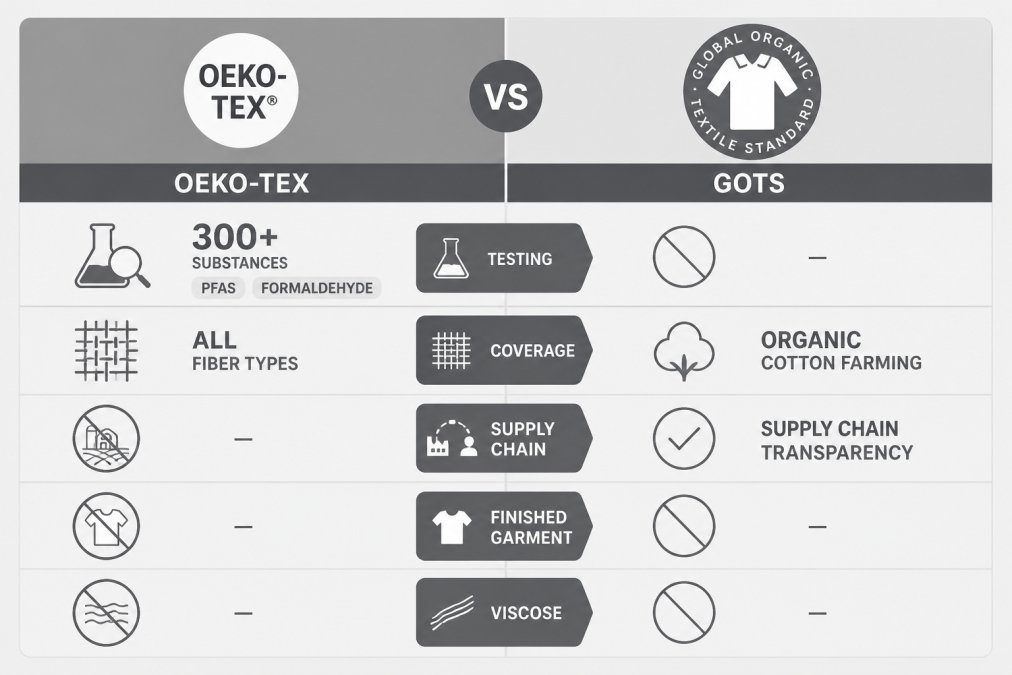
OEKO-TEX vs GOTS: Understanding the Difference
GOTS (Global Organic Textile Standard) certifies that organic cotton was grown without synthetic pesticides and that the supply chain was managed responsibly. It does NOT test the finished garment for chemical residues.
OEKO-TEX STANDARD 100 tests the finished garment for over 300 harmful substances, dyes, heavy metals, formaldehyde, PFAS, and others. It does NOT certify the fiber or farming practice.
These certifications answer different questions.
Other Certifications and Their Scope
Bluesign is a system that controls chemical use during manufacturing. It restricts hazardous substances at the input stage. It's a process certification, not a finished-product test.
Fair Trade certifications focus on labor practices and economic fairness, not chemical safety.
Certifications that sound like safety claims, often have no third-party verification. They're marketing language.
Different certifications measure different aspects of safety and responsibility.
| Certification | What It Tests | What It Does NOT Test |
|---|---|---|
| GOTS | Organic cotton farming practice and supply chain | Chemical residues in finished garment |
| OEKO-TEX STANDARD 100 | Finished garment for 300+ harmful substances | Fiber source or farming practice |
| Bluesign | Chemical use during manufacturing process | Final product safety verification |
| Fair Trade | Labor practices and economic fairness | Chemical safety or environmental impact |
How to Assess Finished Garments for Safety
The strongest evidence of non-toxic clothing is third-party testing of the finished garment. Everything else is upstream control, which is valuable but incomplete.
What Third-Party Testing Reveals
A finished-garment test from an accredited lab (OEKO-TEX or equivalent) tells you what's actually in the fabric after all processing is complete. Learn how to identify toxic chemicals in clothes before buying. It measures specific chemicals: formaldehyde levels, PFAS concentration, heavy metals, azo dyes, and others.
This is the only way to know with certainty whether a garment is non-toxic. Fiber type, farming practice, and brand reputation are useful context, but they're not proof.
Questions to Ask Before Buying
Ask the brand directly: "Has this garment been tested for chemical residues?
Ask whether PFAS-free claims are verified. "We don't use PFAS" is marketing.
Ask about dyes. "Are these fiber-reactive or azo dyes? What's the source?" Not every brand will know.
Ask about water-repellent finishes.
OEKO-TEX STANDARD 100 testing requirements outlines what the certification covers.
Practical Steps to Build a Non-Toxic Wardrobe
Building a non-toxic wardrobe doesn't mean replacing everything at once. It means making intentional choices with each purchase.
Step 1: Read Fiber Content and Care Labels
Start with the fiber content. If it says "100% polyester" or "60% polyester, 40% cotton," you now know the base material. Cross-reference with what you've learned: polyester isn't inherently unsafe, but it's often treated with PFAS.
The care label tells you about durability and how to maintain the garment. Delicate items that require hand-washing may shed chemicals more easily during washing.
Step 2: Prioritize Certified Fabrics
Look for OEKO-TEX STANDARD 100 certification on the tag or product page. This is the single strongest signal for finished-garment safety.
For cotton products, GOTS certification is meaningful because it covers the fiber source. Our Organic Cotton Boxers are made with GOTS certified organic cotton and OEKO-TEX certified dyes, so you're getting both layers of verification.
Step 3: Choose Brands That Disclose Supply Chain Details
Brands that are transparent about manufacturing location, dye sources, and chemical inputs should be able to tell you where the fabric is dyed, what chemicals are restricted, and whether the finished garment is tested.
Red flags: vague language without specifics. No answer when you ask about chemical finishes. Refusal to share test results or certifications.
Step 4: Wash Before Wearing and Rotate Carefully
Even certified garments may have residual dyes or finishes. Wash new clothing before wearing it, especially if you have sensitive skin. This removes loose dyes and surface chemicals.
Rotate your wardrobe so no single garment is worn or washed excessively. Hanging items to dry instead of using a dryer extends garment life and reduces heat-driven chemical release.
Starting Your Non-Toxic Clothing Transition
Non-toxic clothing is about reducing your exposure to chemicals.
Start by replacing the items closest to your skin: underwear, socks, undershirts, sleepwear.
Our Organic Cotton Boxers are made with GOTS certified organic cotton and OEKO-TEX certified dyes, both layers of verification.

For athletic wear and outer layers, prioritize finished-product testing. Ask brands for OEKO-TEX reports.
Over time, as garments wear out, replace them with certified options.
Non-toxic clothing protects your largest organ, your skin, from unnecessary chemical exposure. Mellow Mile was built on this principle: small-batch production that prioritizes finished-product testing and transparency, so you know exactly what you're wearing. Browse our non-toxic collection to see how these principles work in practice, or learn more about what makes fabrics truly safe before making your next purchase.
Frequently Asked Questions
What does non-toxic clothing actually mean?
Non-toxic clothing refers to garments made from fibers grown or produced with minimal chemical inputs, finished with safe dyes and treatments, and tested to confirm they don't contain harmful residues. It combines three factors: the fiber type, the chemicals used in processing and dyeing, and third-party verification that the finished garment meets safety limits. A truly non-toxic garment addresses all three, fiber choice alone isn't enough.
What's the difference between OEKO-TEX and GOTS certifications?
GOTS certified organic cotton verifies the cotton was grown without synthetic pesticides and processed with restrictions on harmful chemicals; it covers the entire supply chain from farm to finished product. OEKO-TEX STANDARD 100 tests the finished fabric or garment against strict limits for harmful substances, regardless of fiber type or origin. GOTS ensures clean farming and processing; OEKO-TEX confirms the end product is safe. They measure different things, GOTS is about the process, OEKO-TEX is about the result.
How do I know if clothing has chemical finishes like PFAS?
Chemical finishes like PFAS are often not listed on garment labels. Look for terms like 'water-repellent,' 'stain-resistant,' 'wrinkle-resistant,' or 'performance finish' in product descriptions, these signal chemical treatments. Third-party testing is the only way to confirm the absence of PFAS or other restricted substances. Brands committed to non-toxic clothing will publish testing results or certifications like OEKO-TEX STANDARD 100. If a brand doesn't disclose testing or certifications, ask them directly before purchasing.
Which materials are best for sensitive skin?
Organic cotton and viscose from bamboo are both soft options for sensitive skin, but they differ. Organic cotton is grown without synthetic pesticides and is a natural fiber; viscose from bamboo is a regenerated cellulosic fiber made through chemical processing but is hypoallergenic when finished safely. Both work well if the finished garment is free from harsh dyes and chemical treatments. Look for products made with GOTS certified organic cotton or OEKO-TEX STANDARD 100 certified fabric, and wash new garments before wearing to remove any residual processing chemicals.
Why do some non-toxic clothing brands cost more?
Higher cost reflects several factors: certified organic fibers cost more to produce than conventional alternatives; small-batch production limits economies of scale; rigorous testing and certification add expense; and transparent supply chains require investment in traceability and fair labor practices. Durability also matters, garments made with quality fibers and without degrading chemical finishes last longer, making them a better value over time despite a higher upfront price.
Do I need to wash new clothes before wearing them?
Yes. Even garments made with safe fibers and certified dyes can carry residual processing chemicals, dust, or dye particles from manufacturing and storage. Washing before wearing removes these residues and is especially important for items in direct contact with skin, like underwear and athletic wear. Use cool water and gentle detergent for the first wash to preserve the fabric.
