


How to Recycle Old Men's Clothing: A Step-by-Step Guide
Last Updated: November 4, 2026
Quick Summary
To recycle old men's clothing, first sort every item into four piles: donate, upcycle, recycle, and discard. Wash wearable items before donating, and route torn or stained garments to textile recycling drop-off locations rather than curbside bins.
- Sort items into four labeled piles: donate, upcycle, recycle, and discard.
- Wash everything before donating, since dirty donations often get tossed.
- Call ahead to ask whether a drop-off accepts torn or stained textiles.
- Never put textiles in curbside recycling, where they tangle sorting equipment.
- Single-fiber cotton and wool recycle more cleanly than blended fabrics.
Table of Contents
- How to Sort Old Men's Clothing by Condition
- Clothing Donation Best Practices for Men's Wardrobes
- How to Find Textile Recycling Drop-Off Locations Near You
- How to Upcycle Men's Dress Shirts into Useful Items
- What to Do With the Un-Donatable Pile
- Industrial Textile Recycling vs. DIY: Which Path Fits Your Clothes
- Choosing Better Men's Clothing So Less Ends Up in the Recycling Bin
- Sign Up for 20% Off Your First Order of Durable Essentials
- Frequently Asked Questions
How to Sort Old Men's Clothing by Condition
Learning how to recycle old men's clothing starts with one honest question: can someone else still wear this?
The clothing waste problem is real. According to the U.S. Environmental Protection Agency, millions of tons of textiles enter the municipal waste stream every year, and most of it could have been reused or recycled.
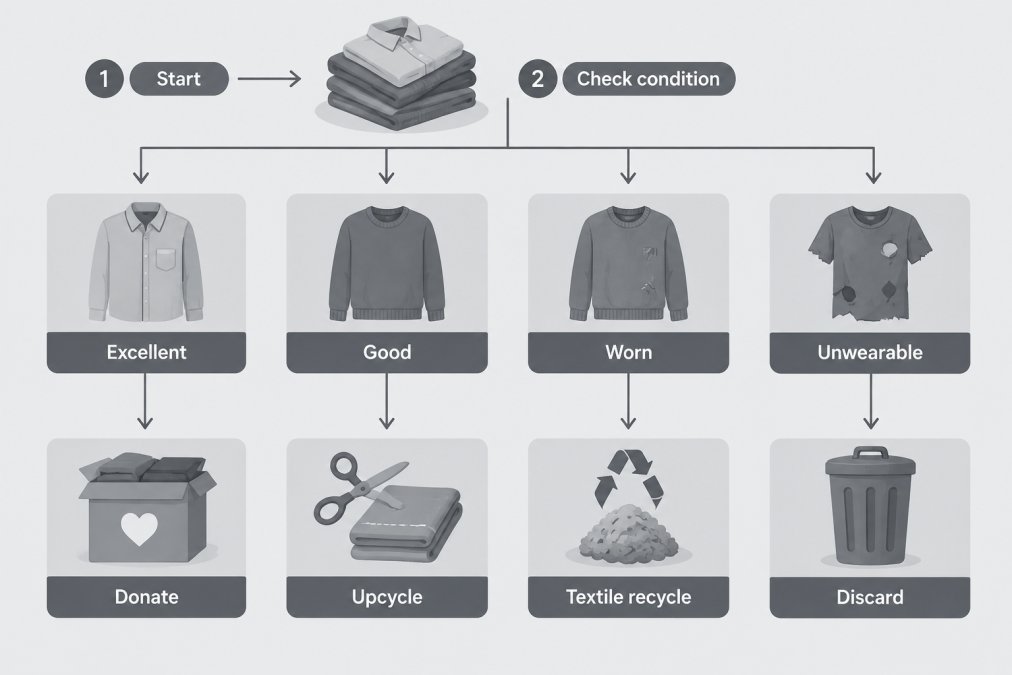
The Four Piles: Donate, Upcycle, Recycle, Discard
Set up four bags or boxes and label them. Then sort fast, without overthinking.
- Donate: clean, wearable, no stains or tears
- Upcycle: structurally sound but dated, faded, or missing buttons
- Recycle: torn, worn through, or single missing socks
Be honest about condition. A stretched collar or a blown-out knee moves an item out of the donate pile.
Before anything leaves your closet, sort each item into one of four piles based on its condition.
| Pile | What goes in it |
|---|---|
| Donate | Clean, wearable, no stains or tears |
| Upcycle | Structurally sound but dated, faded, or missing buttons |
| Recycle | Torn, worn through, or single missing socks |
| Discard | Wet, mildewed, or contaminated items |
Clothing Donation Best Practices for Men's Wardrobes
Donation is the highest-value path for wearable clothing, but only when it's done right. Follow these clothing donation best practices:
- Wash everything first. Dirty donations often get tossed.
- Keep sets together. Suit jackets and trousers should stay paired.
- Check pockets for keys, receipts, and cufflinks.
- Bag by category: shirts, pants, outerwear, shoes.
- Donate seasonally appropriate items.
Watch out: donation centers reject items that arrive wet or mildewed, and those bags often go straight to the trash. Dry everything fully before you drop it off.
How to Find Textile Recycling Drop-Off Locations Near You
Textile recycling drop-off locations are easier to find than most men assume. Start with these steps:
- Check your city or county waste department website for textile programs.
- Search charity and thrift store chains that accept worn textiles, not just wearable ones.
- Look for in-store drop-off bins at retailers that run garment collection programs.
- Ask your local transfer station about textile bins.
Call ahead and ask one question: "Do you accept torn or stained textiles?" That single call separates a real recycling option from a donation bin that will trash your bag.
How to Upcycle Men's Dress Shirts into Useful Items
Knowing how to upcycle men's dress shirts turns a tired wardrobe into useful household goods. Dress shirts are ideal material: tightly woven cotton, generous yardage, and sturdy buttons.
No-Sew Projects for Beginners
- Tote bags: cut off the collar and sleeves, sew or fabric-glue the bottom hem, keep the button placket as a closure.
- Zippered pouches: trim a sleeve into a rectangle, fold, and stitch a zipper along two edges.
- Shop rags: cut into squares for garage and workshop use.
Sewing Projects for Confident Crafters
- Aprons from the shirt back and sleeves
- Pillow covers using the button placket as the opening
- Quilt squares from matched shirting fabrics
Save the buttons and interfacing scraps. Sewing notions add up fast, and reusing them keeps small pieces out of the bin.
What to Do With the Un-Donatable Pile
The un-donatable pile is the one most guides skip. These are the items no charity will take: torn underwear, single socks, stained work shirts, worn-out shoes, mildewed anything. Charities sort for resale, so a garment that cannot be sold is a cost to them, not a donation. That is why the bag you drop in a donation bin with torn items often ends up in a landfill anyway.
Sort the pile by fiber before you route it
Fiber content decides where an item can go. Check the care label, then split the pile:
- Cotton and wool (single fiber): commonly recycled. Mechanical reclaimers shred these into shoddy fiber for insulation, wiping cloths, and new yarn. Keep them separate from blends.
- Polyester and nylon (single fiber): recyclable through chemical and mechanical processes, but only when the stream is clean. Keep them apart from natural fibers.
- Blends (cotton-poly, wool-acrylic): the hardest to recycle because the fibers cannot be easily separated. Most programs accept them for downcycling into padding and wiping cloths rather than fiber-to-fiber recycling.
A common pattern is that a single-fiber garment has a real second life, while a blend gets downcycled once and then landfilled. Sorting by fiber is the single highest-leverage step in this pile.
Where each destination actually takes the item
- Textile recycling bins and drop-off centers: these accept torn, stained, and worn items for fiber recovery or downcycling. Confirm the bin is a textile program, not a donation bin, the two look identical from the parking lot. Ask whether the operator sorts by fiber or downcycles everything.
- Retailer take-back programs: several national apparel and footwear retailers run collection programs that accept any brand, including worn-out items, and route them to reuse or recycling. Check the store's current accepted-items list before you go, because programs change.
- Fabric scrap collection for crafters and schools: quilters, sewing classes, and maker spaces take clean scraps and offcuts. This works best for fabric pieces, not whole stained garments.
Watch out: never put textiles in curbside recycling. They tangle sorting equipment and get pulled out as contamination, and in some areas that can affect how your whole bin is handled.
Prepare the un-donatable pile so it is not rejected
- Wash and fully dry everything. Wet or mildewed textiles are refused by nearly every program.
- Remove buttons, zippers, and hardware only if the receiving program asks; many prefer items intact.
- Bag items by fiber type and label the bags, which speeds sorting at the drop-off.
The goal is simple: every item leaves your house headed somewhere that will actually use it, not to a bin that will quietly trash it.
Industrial Textile Recycling vs. DIY: Which Path Fits Your Clothes
Most guides use "recycling" and "upcycling" as if they were the same thing. They are not, and the difference decides where each garment should go. Industrial textile recycling breaks a garment down to recover fiber or material. DIY upcycling keeps the garment intact and gives it a new job. One handles volume and low-quality fabric; the other handles structure and skill.
What industrial recycling actually does
Industrial recycling takes worn, stained, or blended textiles and processes them in one of two ways:
- Mechanical recycling shreds fabric back into fiber, often called shoddy, which becomes insulation, wiping cloths, carpet padding, and lower-grade yarn. It works best on single-fiber cotton and wool.
- Chemical recycling dissolves and re-spins certain synthetics and cellulosics into new fiber. It handles some blends but is less available and accepts a narrower stream.
Either way, the output is a material, not a garment. That is the trade-off: industrial recycling absorbs volume and low-quality fabric, but the fiber usually gets one more life before landfill rather than becoming a new shirt.
What DIY upcycling actually does
DIY keeps the garment whole. A dress shirt becomes a tote, an apron, or quilt squares. The trade-off runs the other way: DIY preserves the material's value and keeps it in use longer, but it only works on items with structure and only at the pace of your time and skill. A stained, threadbare tee is a poor DIY candidate; a faded but intact oxford is a good one.
How to choose, item by item
Run each garment through three questions:
- Is it structurally sound? If seams, fabric, and shape hold up, DIY is on the table. If it is worn through or torn, route to industrial recycling.
- Is it single-fiber or blended? Cotton and wool recycle more cleanly than blends. Single-fiber items are strong industrial candidates; blends are better downcycled or repurposed whole through DIY.
- Do you have the time and tools? DIY only pays off if you will actually finish the project. Unfinished projects become clutter, then trash.
A simple rule: sound and single-fiber goes either way; worn or blended goes industrial; stained but intact goes DIY if you have a plan, industrial if you do not.
Where the two paths overlap
Some items can go either direction, and the deciding factor is volume. A single worn shirt is a DIY project or a recycling-bin drop. A closet of worn shirts is an industrial recycling run.
Watch out: do not send a garment to industrial recycling if it is still wearable, donation or resale keeps it in use longer than shredding ever will.
Choosing Better Men's Clothing So Less Ends Up in the Recycling Bin
The best recycling plan is buying less in the first place. If you want a practical roadmap, our guide on how to build a sustainable men's wardrobe walks through the core pieces and how to phase them in.
Small-batch construction matters too. Why small batch clothing lasts longer explains how tighter production runs and better seams keep garments in rotation for years. Fiber choice plays a role as well: why organic cotton lasts longer covers staple length, fiber integrity, and wash care that prevent pilling. When you're ready to compare options, our roundup of the best sustainable men's clothing brands gives you a vetted starting point.
At Mellow Mile, we build essentials around this idea. Our small-batch production focuses on materials free from chemical finishes like PFAS. Our Athletic Tee is made from 95% viscose from bamboo with 5% elastane for stretch, dyed with OEKO-TEX certified dyes.
Sign Up for 20% Off Your First Order of Durable Essentials
Recycling old clothing matters. Buying clothing that lasts matters more. Our customers notice the difference: "Three months of heavy rotation and the elastic still feels new," writes Brandon E. Luke H. put it simply: "Switched my entire drawer over."
Ready to start? Browse our organic cotton underwear collection, or sign up for 20% off your first order and build a drawer of essentials designed to stay in rotation.
Frequently Asked Questions
What do I do with old clothes that can't be donated?
Clothes that are stained, torn, or too worn for donation still have a path. Cut them into cleaning rags, use them as garage or garden shop rags, or drop them at a textile recycling bin that accepts any condition. Many donation centers also sort unusable items for fiber recovery rather than sending them to landfill. Check with your local drop-off location first to confirm they accept worn textiles.
What is the 3-3-3 rule for clothes?
The 3-3-3 rule is a decluttering guideline: if you haven't worn an item in 3 months, 3 seasons, or 3 years, it's a candidate for donation or recycling. For men's clothing, apply it by season: workout tees, dress shirts, and outerwear each get a 3-season check. The rule helps you decide what to keep and what to route to donation or textile recycling drop-off locations instead of letting it sit unworn.
How do I identify if my clothing is recyclable?
Most textiles are recyclable through industrial textile recycling, even if they're torn or stained. Check the fiber content tag: natural fibers like organic cotton and wool, and semi-synthetic fibers like viscose from bamboo, are accepted by most textile recyclers. Items with heavy embellishments, metal hardware, or mixed materials may need the hardware removed first. When in doubt, call your local textile recycling drop-off location to confirm what they accept.
What is the difference between upcycling and recycling textiles?
Upcycling turns old clothing into a new item of equal or higher value, like a men's dress shirt becoming a tote bag or zippered pouch. Recycling breaks textiles down into raw fiber for insulation, rags, or new yarn. Upcycling is a DIY project you do at home; recycling happens at an industrial facility. Both keep clothing waste out of landfill, but upcycling preserves the fabric's original form while recycling recovers the fiber.
The real challenge isn't finding a recycling bin. It's buying clothing that never needs one. Mellow Mile makes small-batch essentials with non-toxic materials, durable construction, and a feel that holds up against your skin. Get started with Mellow Mile and sign up for 20% off your first order of essentials built to last.
